Kuva Space
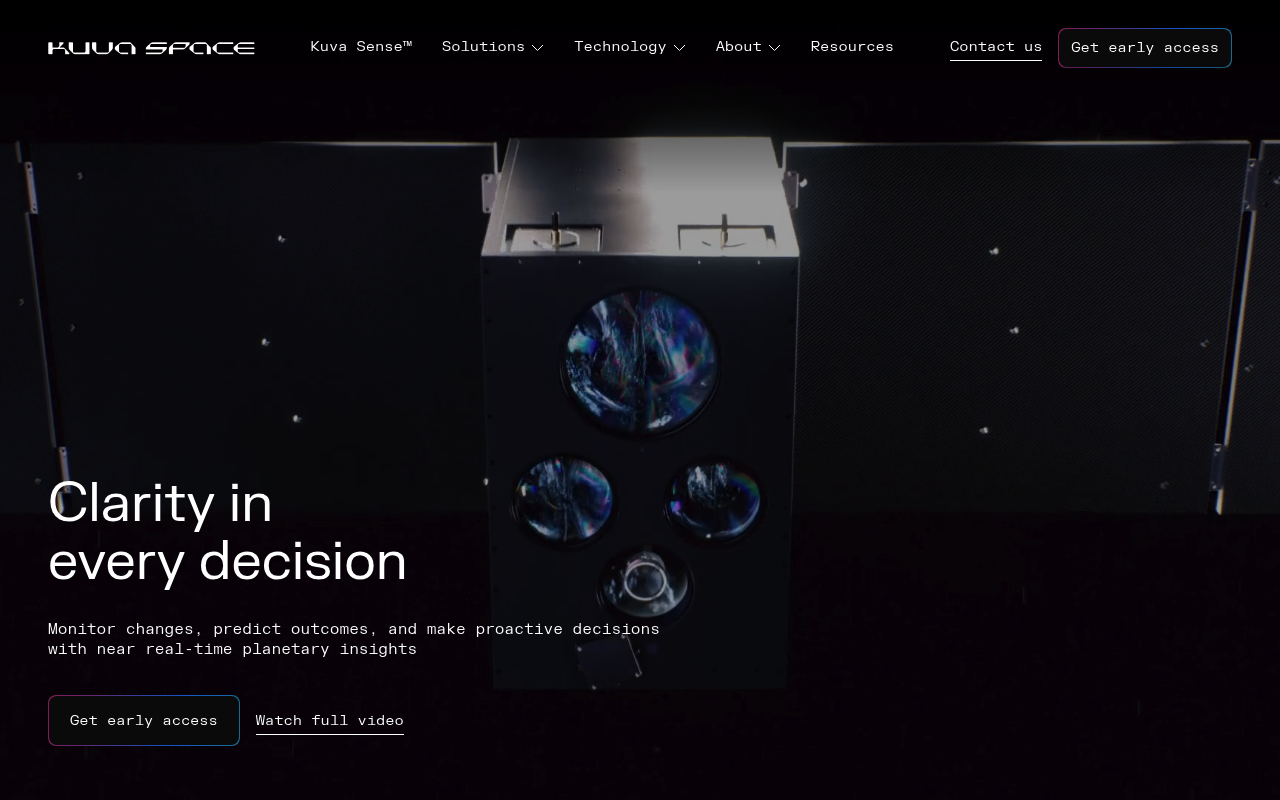
Kuva Space is a Finnish space-data company headquartered in Espoo that operates a fleet of hyperspectral Earth observation microsatellites and delivers AI-driven planetary intelligence through its Kuva Sense platform. Founded in 2016 (originally as Reaktor Space Lab) by Tuomas Tikka and Janne Kuhno in collaboration with Reaktor, the company designs, builds, and operates its own 6U CubeSat-class spacecraft carrying a patented in-orbit tunable Fabry-Perot 2D snapshot hyperspectral imager. Its operational Hyperfield-1A (launched August 2024 on SpaceX Falcon 9 from Vandenberg) and Hyperfield-1B (launched June 2025) cover the 475–950 nm VNIR range with up to 160 tunable spectral bands at 25 m spatial resolution and a 50 km swath from a 500 km polar sun-synchronous orbit. The larger 70 kg Hyperfield-2 microsatellite, scheduled for H2 2026, expands coverage to 450–1,650 nm at 15 m resolution with an additional 3.6 m GSD RGB camera. By 2030 Kuva Space plans to grow the constellation to roughly 100 satellites to enable sub-daily revisit anywhere on Earth. Onboard AI handles cloud filtering, spectral band alignment, and compression so that downlinked products feed directly into Kuva Sense, where automated analytics generate insights-as-a-service for agriculture (crop identification, yield forecasting, harvest timing), aquaculture (water quality, algal bloom detection, biomass), environment and carbon (sequestration monitoring, deforestation, pollution tracking), and safety and security (vessel detection and tracking, illegal activity warning, rapid change detection). Kuva Space is part of the European Space Agency InCubed-co-funded HYPERFIELD program, was awarded a €1.8M ESA Civil Security from Space contract within the SMART-CONNECT consortium to demonstrate rapid hyperspectral insights for crisis response, and in 2026 signed a Letter of Intent with SSC Space to strengthen Nordic space capabilities. The commercial model is subscription-based insights-as-a-service rather than pay-per-pixel imagery sales, with current access offered through the Kuva Sense Early Adopter Program; the company markets "robust APIs and customizable data formats" for system integration but does not currently publish open public API reference documentation, an OpenAPI specification, or a self-service developer portal. The only public engineering surface is the open-source kuva-data-processing Python toolkit (kuva-metadata, kuva-reader, kuva-geometry) on GitHub and PyPI, which reads Kuva GeoTIFF-based L0/L1AB/L1C/L2A data products and their metadata sidecars.
Kuva Space is profiled on the APIs.io network. Tagged areas include Earth Observation, Hyperspectral Imaging, Satellite Imagery, Remote Sensing, and Microsatellites.
Kuva Space’s developer surface includes GitHub presence, YouTube channel, and 22 more developer resources.
Kin Score
 Kin Score
How this is scored →
Kin Score
How this is scored →scored 2026-10-17 · rubric v0.24.0
Security Posture 1
Authentication, domain security, vulnerability disclosure, and trust-center signals.
Resources
Design & Contract 1
Pagination, idempotency, versioning, errors, and events
Build 2
SDKs, sample code, and the tooling you integrate with
Access & Security 2
Authentication, authorization, and security posture
Learn 1
Tutorials, courses, talks, and written guidance
Operate 1
Status, limits, changes, and where to get help
Company 4
The organization behind the API
Other 13
Properties that don't map to a standard resource type
Scroll for all 13
Source (apis.yml)
Work with this as data
Every provider here is available over the APIs.io API and to AI agents over MCP.