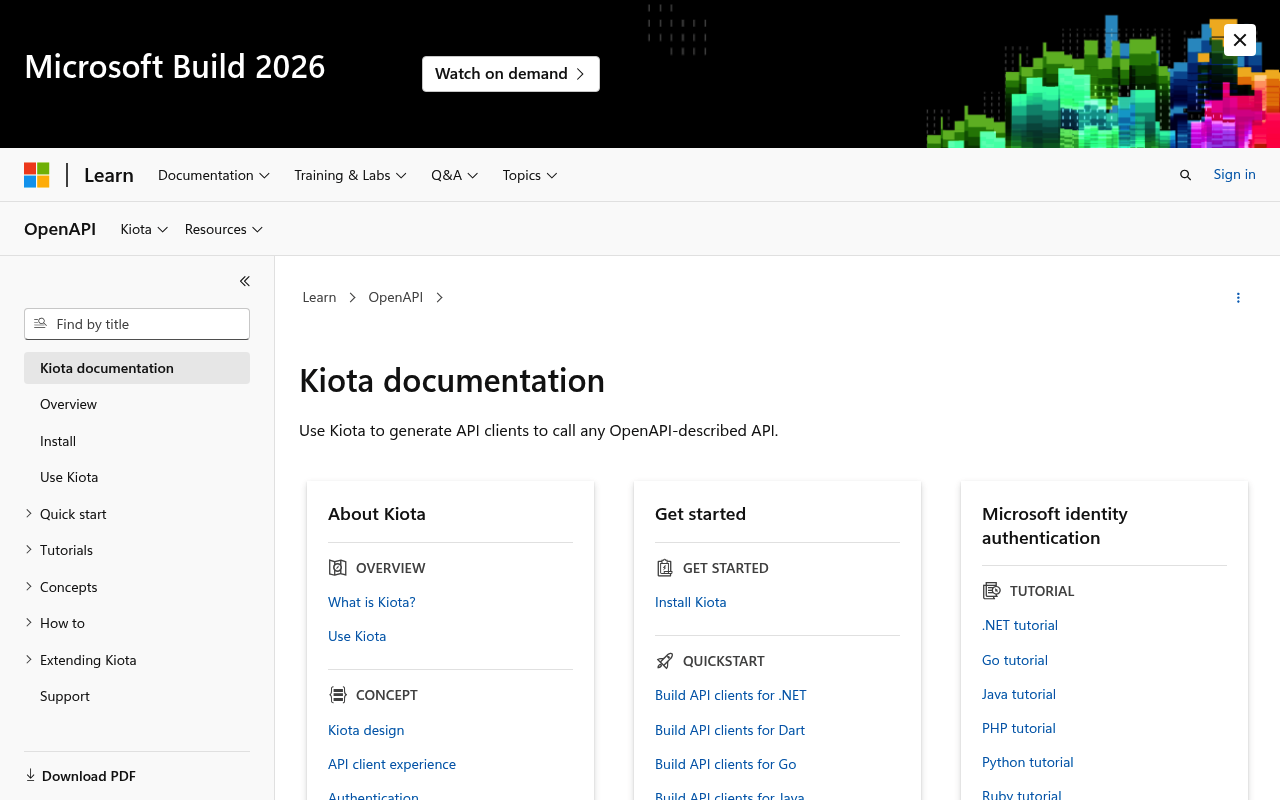
Kiota website screenshot

Kiota

Kiota is Microsoft's open source (MIT) API client generator: a command line tool that turns any OpenAPI-described API into a strongly-typed, lightweight client in C#, Dart, Go, Java, PHP, Python, Ruby or TypeScript. It exists to remove the need to take a dependency on a different hand-written SDK for every API you call. Kiota generates only the source it needs on top of a small per-language core library, keeps external dependencies minimal, and can target a filtered subset of a large description. Beyond code SDKs it also emits agent-facing plugin packages — apiplugin for Microsoft 365 Copilot declarative agents, openai manifests, and API Manifest permission snapshots. Kiota is a consumer of API descriptions rather than a publisher of an API: there is no Kiota endpoint, base URL, API key or status page. Its surface is a CLI, runtime libraries in eight package registries, a published OpenAPI extension vocabulary, and a nine-rule description validation ruleset it runs before every generation.

Kiota publishes 1 API on the APIs.io network. Tagged areas include Code Generation, Microsoft, OpenAPI, SDK, and Developer Tools.

The Kiota catalog on APIs.io includes 1 Spectral governance ruleset.

Kiota’s developer surface includes developer portal, documentation, API reference, getting-started guide, support, engineering blog, CLI, and 28 more developer resources.

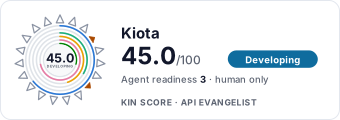
46.3/100 developing ▲ 8.2 Agent 5/100 human only open core · MIT Full breakdown ↓
scored 2026-10-04 · rubric v0.23.0
1 API
Code GenerationMicrosoftOpenAPISDKDeveloper ToolsAPI ClientOpen SourceCLIJSON SchemaSDK Generation

Kin Score

Kin Score Kin Score How this is scored →
scored 2026-10-04 · rubric v0.23.0
Regulatory Posture applies to this provider. Its tags matched the Horizontal (data, software, accessibility, platform) regime, so Regulatory Posture carries 15 points of the composite. If this regime is wrong for your business, say so on your provider repo — the applicability map is public and we will correct it.
Open Source Surface applies to this provider. This product is open source and we read its repository directly, so Open Source Surface carries 10 points of the composite. It is scored from what the repository actually publishes — a security policy, a contribution guide, a release history, a code of conduct — read live from the provider rather than inferred from our own catalog pointers. This facet adds; nothing was taken away to make room for it. An open-source project is not excused from the commercial facets, because exemption would strip it of the points it does earn. If we have the wrong repository, or this product is not open source, say so on your provider repo and we will drop the facet rather than have you publish against it.
Create-or-Update Ergonomics could not be measured. We hold no machine-readable contract for this provider to read, so there is nothing to measure a write surface against. Excluded rather than scored zero: never-measured and measured-empty are different facts. Publishing an OpenAPI is what makes this facet — and several others — scorable at all.
The six quality facets above are damped to 75 points between them, because both conditional facets apply and carry 25 points together. That is why each facet's contribution is shown against a damped maximum: raising a quality facet moves the composite by 75% of its nominal weight, not 100%. The full arithmetic is at apis.io/rating/.
Improve this rating by publishing the missing artifacts — every area above can be raised, and the full rubric is at apis.io/rating/. Every facet and dimension name above is a link: it opens that measurement's own page — what it means, the exact checks that feed it, how the whole catalog distributes on it, and the providers at the top of it. This rating is computed from github.com/api-evangelist/kiota: open an issue to ask a question, or submit a pull request to add artifacts. Submit an artifact on GitHub — free → Manage your own listing — the Influence plan, $499/mo →

What adopting Kiota moves on the Kin Score 4

Kiota is an area vendor: providers adopt it to run part of their developer surface. This is the Kin Score checks its features can move for a provider that adopts it, what each one really earns, and what it earns nothing for.

sdk generationcapability map5 features checked 2026-09-25 · rubric v0.22.0

Kiota generates typed API clients for C#, Go, Java, PHP, Python, Ruby, Swift and TypeScript, plus a shell target. Maturity ranges from stable (C#, Go, PHP, Python) to experimental. Most Kiota clients are built by API consumers inside their own code, so they never reach the provider’s surface. The score moves only when a provider publishes the clients and declares them as SDKs, or ships a shell CLI. Its pre-generation validation warnings (for example NoServerEntry) only help a contract the provider then fixes. Kiota has no docs, MCP, llms.txt or skill output.

Contract Quality3.0 of 211 pts
Developer Ergonomics10.0 of 42 pts
CheckEarnsThrough
Three or more SDKs
Developer ErgonomicsPublish and declare three or more language clients.
4.0 of 4 API client generation
At least one SDK
Developer ErgonomicsPublish a generated client as a maintained package and declare it as an SDK entry. A client a consumer generates inside its own app never counts.
3.0 of 3 API client generation
Command-line interface
Developer ErgonomicsRelease the generated shell client as a CLI and declare it as a CLI entry.
3.0 of 3 shell language target
Real servers declaredconditional
Contract QualityNoServerEntry only warns. The provider has to add a real host to the published contract, and the API has to have one.
3.0 of 3 Pre-generation validation rules
Across 8977 providers that publish a contract, adopting Kiota would move 8835. Median lift: composite +4.7 (90th percentile +4.8), agent readiness +0.0 (+0.0). Conditional rows excluded.
What Kiota ships that earns nothing (3)
  • API description search — Kiota’s search reads third-party registries. It publishes nothing about the provider and does not host an index for it.
  • Path filtering and lock file — Filtering a description produces a client for a subset of paths. It publishes no contract.
  • API client generation — The client reflects the contract and adds no idempotency key to it.

A model, not a score. Adopting this vendor changes a provider's Kin Score only when the provider publishes the resulting artifacts on its own surface; nothing here writes a score, and no sponsorship or partnership can. The rating is not for sale → · Full vendor facets artifact

APIs 1

Individual APIs this provider publishes, each with its own machine-readable definition.

Kiota

Kiota generates strongly-typed, lightweight API clients from OpenAPI descriptions in C#, Dart, Go, Java, PHP, Python, Ruby and TypeScript, with minimal dependencies and idiomati...

Pricing Plans 1

Published pricing tiers and plan structures.

Kiota Plans Pricing

3 plans

PLANS

Rate Limits 1

Documented rate limits and quota policies.

Kiota Rate Limits

5 limits

RATE LIMITS

FinOps 1

Cost, billing, and metering signals for API financial operations.

Kiota Finops

FINOPS

Spectral Rules 1

Spectral governance rulesets for linting and validating these APIs.

Kiota API Rules

0 rules ·

SPECTRAL

JSON Schema 1

Standalone JSON Schema definitions for this provider's data models.

Kiota Workspace

3 properties

JSON SCHEMA

Security Posture 3

Authentication, domain security, vulnerability disclosure, and trust-center signals.

Kiota Authentication

oauth2-device-code/apiKey/http-bearer/anonymous · 0 schemes

SECURITY

Kiota Domain Security

TLSv1.3 · HSTS · DMARC

SECURITY

Kiota Vulnerability Disclosure

security.txt · contact published

SECURITY

Resources

Get Started 2

Portal, sign-up, and the first successful call

Documentation 4

Reference material describing how the API behaves

Agent Surfaces 2

MCP servers, agent skills, and machine-readable catalogs

Design & Contract 4

Pagination, idempotency, versioning, errors, and events

Build 6

SDKs, sample code, and the tooling you integrate with

Access & Security 6

Authentication, authorization, and security posture

Operate 5

Status, limits, changes, and where to get help

Commercial 3

Pricing, plans, and the legal terms of use

Company 2

The organization behind the API

Other 1

Properties that don't map to a standard resource type

Source (apis.yml)

apis.yml Raw ↑
aid: kiota
name: Kiota
x-parent: microsoft
description: 'Kiota is Microsoft''s open source (MIT) API client generator: a command line tool that turns any OpenAPI-described
  API into a strongly-typed, lightweight client in C#, Dart, Go, Java, PHP, Python, Ruby or TypeScript. It exists to remove
  the need to take a dependency on a different hand-written SDK for every API you call. Kiota generates only the source it
  needs on top of a small per-language core library, keeps external dependencies minimal, and can target a filtered subset
  of a large description. Beyond code SDKs it also emits agent-facing plugin packages — apiplugin for Microsoft 365 Copilot
  declarative agents, openai manifests, and API Manifest permission snapshots. Kiota is a consumer of API descriptions rather
  than a publisher of an API: there is no Kiota endpoint, base URL, API key or status page. Its surface is a CLI, runtime
  libraries in eight package registries, a published OpenAPI extension vocabulary, and a nine-rule description validation
  ruleset it runs before every generation.'
type: Index
deliveryModel:
  model: open-core
  license: MIT
  license_evidence:
    repo: microsoft/kiota
    spdx: MIT
    stars: 3823
  open_source: true
  commercial: true
  callable_host: false
  label: Open core · an OSS project plus a commercial hosted product
  confidence: medium
  source:
  - pricing
  - repository-license
  generated: '2026-09-25'
  method: derived
accessModel:
  pricing: open-source
  onboarding: self-service
  trial: false
  try_now: false
  public: true
  label: Open Source (MIT)
  confidence: high
  source:
  - https://github.com/microsoft/kiota/blob/main/LICENSE
  - https://learn.microsoft.com/en-us/openapi/kiota/install
  generated: '2026-08-06'
  method: searched
image: https://kinlane-images.s3.amazonaws.com/shared/apis-json/icons/kiota.png
tags:
- Code Generation
- Microsoft
- OpenAPI
- SDK
- Developer Tools
- API Client
- Open Source
- CLI
- JSON Schema
- SDK Generation
tags_raw:
- Code Generation
- Microsoft
- OpenAPI
- SDKs
- Developer Tools
- API Clients
- Open Source
- CLI
- JSON Schema
- Open-Source
- JSON-Schema
- SDK Generation
url: https://raw.githubusercontent.com/api-evangelist/kiota/refs/heads/main/apis.yml
created: '2026-03-25'
modified: '2026-08-06'
specificationVersion: '0.23'
apis:
- aid: kiota:kiota
  name: Kiota
  description: Kiota generates strongly-typed, lightweight API clients from OpenAPI descriptions in C#, Dart, Go, Java, PHP,
    Python, Ruby and TypeScript, with minimal dependencies and idiomatic code patterns, plus agent-facing plugin packages.
    It is delivered as a CLI, a container image, a VS Code extension and a set of per-language runtime libraries — not as
    a hosted service.
  humanURL: https://learn.microsoft.com/en-us/openapi/kiota/
  tags:
  - Code Generation
  - OpenAPI
  - SDK
  - CLI
  tags_raw:
  - Code Generation
  - OpenAPI
  - SDKs
  - CLI
  properties:
  - type: Documentation
    url: https://learn.microsoft.com/en-us/openapi/kiota/overview
  - type: APIReference
    url: https://learn.microsoft.com/en-us/openapi/kiota/using
  - type: GettingStarted
    url: https://learn.microsoft.com/en-us/openapi/kiota/quickstarts/
  - type: GitHubRepository
    url: https://github.com/microsoft/kiota
  - type: CLI
    url: cli/kiota-cli.yml
  - type: ChangeLog
    url: changelog/kiota-changelog.yml
common:
- type: VendorFacets
  url: vendor-facets/kiota-vendor-facets.yml
- type: Releases
  url: https://github.com/microsoft/kiota/releases
- type: SecurityPolicy
  url: https://github.com/microsoft/kiota/blob/main/SECURITY.md
- type: CodeOfConduct
  url: https://github.com/microsoft/kiota/blob/main/CODE_OF_CONDUCT.md
- type: ContributionGuide
  url: https://github.com/microsoft/kiota/blob/main/CONTRIBUTING.md
- type: Website
  url: https://learn.microsoft.com/en-us/openapi/kiota/
- type: Portal
  url: https://learn.microsoft.com/en-us/openapi/kiota/
- type: Documentation
  url: https://learn.microsoft.com/en-us/openapi/kiota/overview
- type: APIReference
  url: https://learn.microsoft.com/en-us/openapi/kiota/using
- type: GettingStarted
  url: https://learn.microsoft.com/en-us/openapi/kiota/quickstarts/
- type: Support
  url: https://github.com/microsoft/kiota/issues
- type: Community
  url: https://github.com/microsoft/kiota/discussions
- type: GitHubOrganization
  url: https://github.com/microsoft/kiota
- type: SourceCode
  url: https://github.com/microsoft/kiota
- type: Blog
  url: https://devblogs.microsoft.com/microsoft365dev/
- type: License
  url: https://github.com/microsoft/kiota/blob/main/LICENSE
- type: TermsOfService
  url: https://learn.microsoft.com/en-us/legal/termsofuse
- type: PrivacyPolicy
  url: https://privacy.microsoft.com/en-us/privacystatement
- type: CLI
  url: cli/kiota-cli.yml
- type: Packages
  url: packages/kiota-packages.yml
- type: SDKs
  url: packages/kiota-packages.yml
- type: ChangeLog
  url: changelog/kiota-changelog.yml
- type: Lifecycle
  url: lifecycle/kiota-lifecycle.yml
- type: Deprecation
  url: https://learn.microsoft.com/en-us/openapi/kiota/support
- type: Authentication
  url: authentication/kiota-authentication.yml
- type: Vocabulary
  url: vocabulary/kiota-vocabulary.yml
- type: Rules
  url: rules/kiota-validation-rules.yml
- type: Conformance
  url: conformance/kiota-conformance.yml
- type: JSONSchema
  url: json-schema/kiota-workspace-schema.json
- type: LLMsTxt
  url: llms/kiota-llms.txt
- type: WellKnown
  url: well-known/kiota-well-known.yml
- type: SecurityTxt
  url: well-known/kiota-security.txt
- type: Security
  url: security/kiota-vulnerability-disclosure.yml
- type: VulnerabilityDisclosure
  url: security/kiota-vulnerability-disclosure.yml
- type: DomainSecurity
  url: security/kiota-domain-security.yml
maintainers:
- FN: Kin Lane
  email: kin@apievangelist.com
x-enrichment:
  date: '2026-08-06'
  status: enriched
  artifacts_added: 11
  pass: local-v1

Work with this as data

Every provider here is available over the APIs.io API and to AI agents over MCP.

MCP server

One button, every client — Claude, Cursor, VS Code and the rest.

https://apis.io/mcp

Tools for providers

9 MCP tools reach this
  • find_providersBrowse and filter every provider in the catalog.
  • get_provider_artifactsEvery artifact this provider publishes, grouped by type.
  • get_provider_operationsEvery operation across all of their OpenAPIs — one call instead of parsing every spec.
  • get_provider_toolsEvery MCP tool they ship, with the operation each wraps.
  • get_provider_evidenceHow each part of their score was established. Free — the basis for a claim should not sit behind it.
  • get_provider_ratingPRO — composite, band, trend and facet scores.
  • apis_io_searchSTART HERE — APIs, providers and tags for one query, each with its total.
  • resolveTurn a domain, URL or GitHub org into the provider it belongs to.
  • find_cohortsEvery scored population of providers in the catalog.
All 92 tools →

Call it yourself

curl for this page
This provider
curl "https://apis.io/api/v1/providers/kiota"
All providers
curl "https://apis.io/api/v1/providers?limit=25"
Every operation they expose
curl "https://apis.io/api/v1/providers/kiota/operations?limit=25"
How their score was established
curl "https://apis.io/api/v1/providers/kiota/evidence"

Discovery needs no key. Ratings and market analysis are Pro.

Get an API key

Free tier, no form to fill in. Signing in shares your email address with us — we store it to create your key and to recognise you if you sign in with another provider. See our Privacy Policy and Terms.

A second provider on the same verified email joins the account you already have.