Judoscale
Judoscale provides an autoscaling platform that integrates with cloud hosting services such as Heroku, Render, Railway, Fly.io, Scalingo, Northflank, and AWS. It automatically adjusts the number of web and worker dynos or containers based on request queue length and job queue metrics, offering configurable step sizes, schedules, and per‑process scaling ranges. The service aims to improve performance and reduce costs by scaling only when needed, with support for multiple programming languages and frameworks.
Judoscale is profiled on the APIs.io network. Tagged areas include Company, Autoscaling, Cloud, DevOps, and Heroku.
Judoscale’s developer surface includes authentication, changelog, getting-started guide, documentation, engineering blog, pricing, and 10 more developer resources.
Kin Score
 Kin Score
How this is scored →
scored 2026-10-31 · rubric v0.25.0
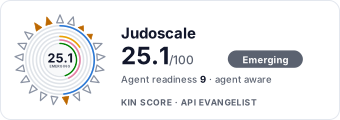 It updates itself when the score changes. Paste this where you link to your API docs:
<a href="https://apis.io/providers/judoscale/"><img src="https://apis.io/badge/judoscale/card.svg" alt="Judoscale on APIs.io — Kin Score by API Evangelist"></a>Other styles, a README pill and a shields.io endpoint are on the badge page.
- Machine-Readable Contract +18 pts — api_specs includes an OpenAPI document
- Agentic Access Contract +10 pts — agentic_access artifact present (x-agentic-access), graded by author
- Idempotency +9 pts — OpenAPI mutating operations declare an idempotency key — a header, a request-body property, or a named de-duplication token whose own description says so (verified); else common[].type matches /idempoten/i (documented)
- A2A Agent Card +8 pts — a2a/
-a2a.yml manifest, graded on conformance.grade against A2A 1.0.0 - Stable Error Semantics +8 pts — OpenAPI $refs a shared error schema across 4xx/5xx responses (verified), else common[].type includes ErrorCatalog / ErrorCodes / DeclineCodes
- Rate-Limit Signaling +7 pts — OpenAPI responses document X-RateLimit-* / RateLimit headers (verified), else a rate_limits artifact or RateLimits link (documented)
- Contract Quality scores 0.0 — up to +25.0 composite points
- Contract Governance scores 0.0 — up to +12.0 composite points
- Developer Ergonomics scores 42.9 — up to +11.4 composite points
Security Posture 2
Authentication, domain security, vulnerability disclosure, and trust-center signals.
Resources
Get Started 2
Portal, sign-up, and the first successful call
Documentation 1
Reference material describing how the API behaves
Agent Surfaces 1
MCP servers, agent skills, and machine-readable catalogs
Build 2
SDKs, sample code, and the tooling you integrate with
Access & Security 2
Authentication, authorization, and security posture
Operate 1
Status, limits, changes, and where to get help
Commercial 3
Pricing, plans, and the legal terms of use
Company 2
The organization behind the API
Other 2
Properties that don't map to a standard resource type
Source (apis.yml)
Judoscale API — frequently asked questions
How do I authenticate with the Judoscale API?
Judoscale uses bearer-token authentication (3 schemes). The details are profiled on APIs.io as Judoscale Authentication.
Is the Judoscale API ready for AI agents?
Judoscale has a Kin Score of 25.1 out of 100 (emerging) and an Agent Readiness score of 8.5 (agent-aware), scored by API Evangelist on 2026-10-31.
Work with this as data
Every provider here is available over the APIs.io API and to AI agents over MCP.