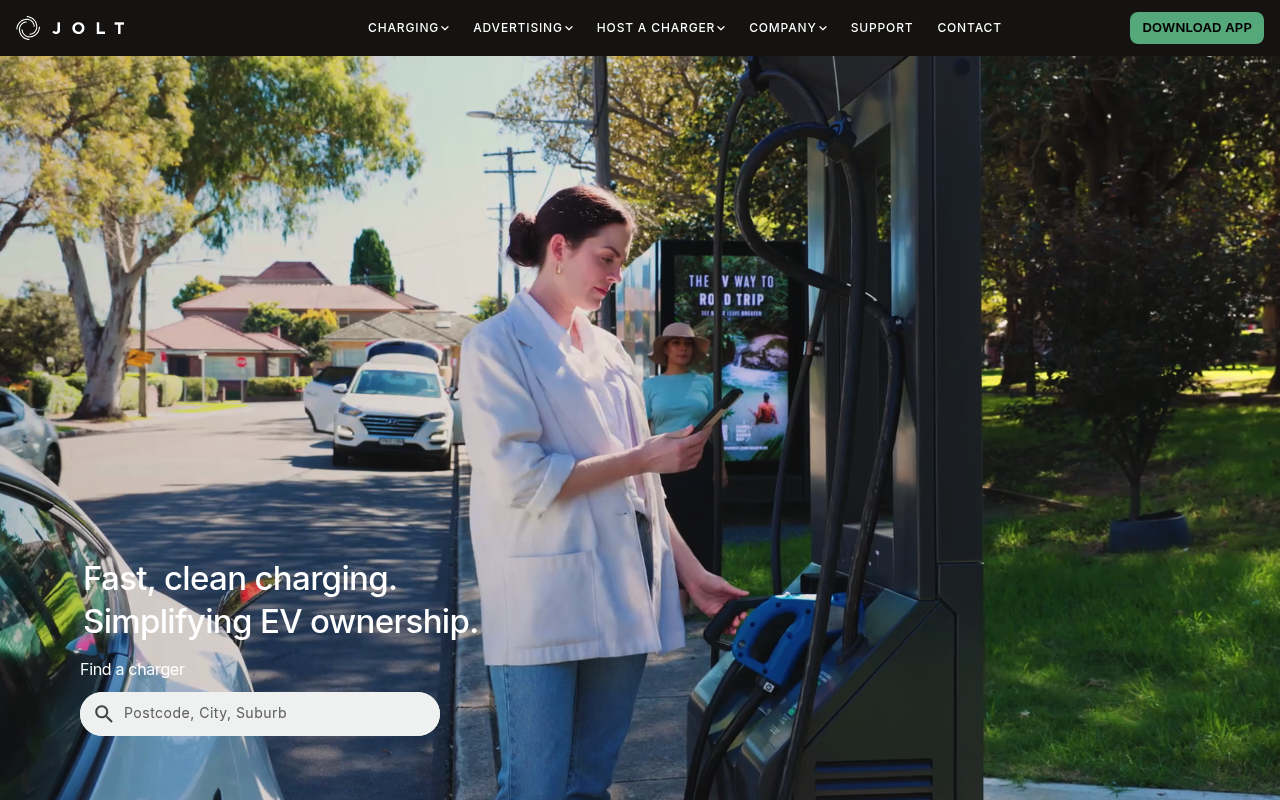
JOLT website screenshot

JOLT

JOLT is a Sydney-headquartered electric vehicle charging network operator that builds and runs free-to-start kerbside DC fast chargers across Australia, and has since extended the same model into New Zealand, Canada, the United Kingdom and the United States. Its charge points deliver the first 7kWh of each day's charging at no cost — around 45km of range in roughly 15 minutes over CCS2 or CHAdeMO — funded not by the driver but by the digital out-of-home advertising screens mounted on the charger itself, which makes JOLT simultaneously a charge point operator and a media network selling audience reach to advertisers. It sits in the energy value chain as a downstream infrastructure and demand-side player: it buys electricity (claiming 100% GreenPower green-certified wind and solar), owns and operates the charging assets on public and retail land in partnership with governments and hosts such as Transport for NSW, Ausgrid and major grocery retailers, and monetises the dwell time rather than the kilowatt-hour. Its API posture is honestly closed. JOLT publishes no developer programme, no API documentation, no OpenAPI or other machine-readable contract, and no open data feed; the only public HTTP surfaces on its domains are a marketing WordPress install (whose custom jolt/v1 REST namespace exposes a single VAT form endpoint) and an api.joltcharge.com host that serves a static redirect to the mobile app rather than any API. It is not a designated data holder under the Australian Consumer Data Right for energy — it does not appear in the CDR Register's energy data holder brands — so the CDR energy mandate that compels Australian electricity retailers to expose standardised usage and tariff data does not reach it, and no OCPP, OCPI, ISO 15118 or Green Button/ESPI conformance is published. All customer charging data, session history and audience analytics are reachable only through the JOLT consumer app or a sales conversation.

JOLT is profiled on the APIs.io network. Tagged areas include Energy, Australia, EV Charging, Electricity, and Utilities.

JOLT’s developer surface includes engineering blog, support, signup flow, pricing, and 12 more developer resources.

16.6/100 emerging ▬ flat Agent 0/100 human only saas Full breakdown ↓
scored 2026-09-08 · rubric v0.20.0
0 APIs
EnergyAustraliaEV ChargingElectricityUtilitiesRenewablesAdvertisingMobilityCarbonInfrastructure

Kin Score

Kin Score Kin Score How this is scored →
scored 2026-09-08 · rubric v0.20.0
Regulatory Posture applies to this provider. Its tags matched the Energy & Utilities regime, so Regulatory Posture carries 15 points of the composite. If this regime is wrong for your business, say so on your provider repo — the applicability map is public and we will correct it.
Create-or-Update Ergonomics could not be measured. We hold no machine-readable contract for this provider to read, so there is nothing to measure a write surface against. Excluded rather than scored zero: never-measured and measured-empty are different facts. Publishing an OpenAPI is what makes this facet — and several others — scorable at all.
The six quality facets above are damped to 85 points between them, because the conditional facet above carries the other 15. That is why each facet's contribution is shown against a damped maximum: raising a quality facet moves the composite by 85% of its nominal weight, not 100%. The full arithmetic is at apis.io/rating/.
Improve this rating by publishing the missing artifacts — every area above can be raised, and the full rubric is at apis.io/rating/. Every facet and dimension name above is a link: it opens that measurement's own page — what it means, the exact checks that feed it, how the whole catalog distributes on it, and the providers at the top of it. This rating is computed from github.com/api-evangelist/jolt-charge: open an issue to ask a question, or submit a pull request to add artifacts. Submit an artifact on GitHub — free → Manage your own listing — the Influence plan, $499/mo →

Security Posture 1

Authentication, domain security, vulnerability disclosure, and trust-center signals.

Jolt Charge Domain Security

TLSv1.3 · DMARC

SECURITY

Resources

Get Started 1

Portal, sign-up, and the first successful call

Agent Surfaces 1

MCP servers, agent skills, and machine-readable catalogs

Design & Contract 1

Pagination, idempotency, versioning, errors, and events

Build 1

SDKs, sample code, and the tooling you integrate with

Access & Security 1

Authentication, authorization, and security posture

Operate 2

Status, limits, changes, and where to get help

Commercial 3

Pricing, plans, and the legal terms of use

Company 5

The organization behind the API

Other 1

Properties that don't map to a standard resource type

Source (apis.yml)

apis.yml Raw ↑
aid: jolt-charge
url: https://raw.githubusercontent.com/api-evangelist/jolt-charge/refs/heads/main/apis.yml
name: JOLT
kind: company
description: 'JOLT is a Sydney-headquartered electric vehicle charging network operator that builds and runs free-to-start
  kerbside DC fast chargers across Australia, and has since extended the same model into New Zealand, Canada, the United Kingdom
  and the United States. Its charge points deliver the first 7kWh of each day''s charging at no cost — around 45km of range
  in roughly 15 minutes over CCS2 or CHAdeMO — funded not by the driver but by the digital out-of-home advertising screens
  mounted on the charger itself, which makes JOLT simultaneously a charge point operator and a media network selling audience
  reach to advertisers. It sits in the energy value chain as a downstream infrastructure and demand-side player: it buys electricity
  (claiming 100% GreenPower green-certified wind and solar), owns and operates the charging assets on public and retail land
  in partnership with governments and hosts such as Transport for NSW, Ausgrid and major grocery retailers, and monetises
  the dwell time rather than the kilowatt-hour. Its API posture is honestly closed. JOLT publishes no developer programme,
  no API documentation, no OpenAPI or other machine-readable contract, and no open data feed; the only public HTTP surfaces
  on its domains are a marketing WordPress install (whose custom jolt/v1 REST namespace exposes a single VAT form endpoint)
  and an api.joltcharge.com host that serves a static redirect to the mobile app rather than any API. It is not a designated
  data holder under the Australian Consumer Data Right for energy — it does not appear in the CDR Register''s energy data
  holder brands — so the CDR energy mandate that compels Australian electricity retailers to expose standardised usage and
  tariff data does not reach it, and no OCPP, OCPI, ISO 15118 or Green Button/ESPI conformance is published. All customer
  charging data, session history and audience analytics are reachable only through the JOLT consumer app or a sales conversation.'
deliveryModel:
  model: saas
  open_source: false
  commercial: true
  callable_host: false
  label: Hosted service · you call their endpoint
  confidence: medium
  source:
  - pricing
  generated: '2026-08-28'
  method: derived
accessModel:
  pricing: unknown
  onboarding: unknown
  trial: false
  try_now: false
  public: false
  label: Unknown
  confidence: low
  source:
  - security
  generated: '2026-09-02'
  method: derived
image: https://joltcharge.com/au/wp-content/uploads/sites/10/2023/05/jolt-logo.svg
tags:
- Energy
- Australia
- EV Charging
- Electricity
- Utilities
- Renewables
- Advertising
- Mobility
- Carbon
- Infrastructure
created: '2026-07-27'
modified: '2026-07-27'
specificationVersion: '0.23'
apis: []
common:
- type: DomainSecurity
  url: security/jolt-charge-domain-security.yml
- type: Conformance
  url: conformance/jolt-charge-conformance.yml
- type: LLMsTxt
  url: llms/jolt-charge-llms.txt
- type: Website
  url: https://joltcharge.com/au/
- type: Blog
  url: https://joltcharge.com/au/news/
- type: BlogRSS
  url: https://joltcharge.com/au/feed/
- type: LinkedIn
  url: https://www.linkedin.com/company/jolt-charge
- type: GitHubOrganization
  url: https://github.com/jolt-charge
- type: Support
  url: https://joltcharge.com/au/contact/
- type: ContactForm
  url: https://joltcharge.com/au/contact/
- type: SignUp
  url: https://joltcharge.com/au/start/
- type: Pricing
  url: https://joltcharge.com/au/jolt-plus/
- type: Careers
  url: https://joltcharge.com/au/careers/
- type: TermsOfService
  url: https://joltcharge.com/au/terms/
- type: PrivacyPolicy
  url: https://joltcharge.com/au/privacy/
- type: FairUsePolicy
  url: https://joltcharge.com/au/fair-use-policy/
maintainers:
- FN: Kin Lane
  email: kin@apievangelist.com

Work with this as data

Every provider here is available over the APIs.io API and to AI agents over MCP.

MCP server

One button, every client — Claude, Cursor, VS Code and the rest.

https://apis.io/mcp

Tools for providers

9 MCP tools reach this
  • find_providersBrowse and filter every provider in the catalog.
  • get_provider_artifactsEvery artifact this provider publishes, grouped by type.
  • get_provider_operationsEvery operation across all of their OpenAPIs — one call instead of parsing every spec.
  • get_provider_toolsEvery MCP tool they ship, with the operation each wraps.
  • get_provider_evidenceHow each part of their score was established. Free — the basis for a claim should not sit behind it.
  • get_provider_ratingPRO — composite, band, trend and facet scores.
  • apis_io_searchSTART HERE — APIs, providers and tags for one query, each with its total.
  • resolveTurn a domain, URL or GitHub org into the provider it belongs to.
  • find_cohortsEvery scored population of providers in the catalog.
All 92 tools →

Call it yourself

curl for this page
This provider
curl "https://apis.io/api/v1/providers/jolt-charge"
All providers
curl "https://apis.io/api/v1/providers?limit=25"
Every operation they expose
curl "https://apis.io/api/v1/providers/jolt-charge/operations?limit=25"
How their score was established
curl "https://apis.io/api/v1/providers/jolt-charge/evidence"

Discovery needs no key. Ratings and market analysis are Pro.

Get an API key

Free tier, no form to fill in. Signing in shares your email address with us — we store it to create your key and to recognise you if you sign in with another provider. See our Privacy Policy and Terms.

A second provider on the same verified email joins the account you already have.
