io.net is a decentralized GPU network for AI compute, built on Solana, that aggregates idle consumer and data-center GPUs (NVIDIA A100, H100, H200, and Blackwell-class) into on-demand, geo-distributed compute clusters orchestrated with the Ray framework. The platform exposes a Web3-native alternative to hyperscaler GPU cloud through several developer-facing surfaces: IO Intelligence (an OpenAI-compatible inference API for 15+ open-source models including Llama 3.3 70B), IO Cloud (Container-as-a-Service and VM-as-a-Service APIs for deploying GPU containers, Ray clusters, Kubernetes clusters, and bare-metal instances), IO Agents (agent and agentic-workflow APIs), IO Explorer (a network analytics API for devices, clusters, and block rewards), IO Worker (the supplier-side onboarding stack), IO ID (the account/wallet hub), and IO Staking. Confidential Compute on Intel TDX-enabled H100/H200/B200 GPUs and a remote attestation service for Intel TDX and NVIDIA H200 confidential VMs round out the security surface. The IO token is an SPL token on Solana used for settlement, staking, and rewards; fiat and USDC payments are accepted and converted to IO. io.net also publishes an MCP server at mcp.io.solutions for agent-driven cluster provisioning. The platform's tagline is "the open-source AI infrastructure platform" and its commercial pitch is AI compute at 50–70% below comparable hyperscaler rates.
io.net is listed with 8 APIs on the APIs.io network. Tagged areas include Artificial Intelligence, GPU, Decentralized Compute, DePIN, and Web3.
io.net’s developer surface includes developer portal, documentation, getting-started guide, API reference, signup flow, developer console, engineering blog, and 28 more developer resources.
Regulatory Posture applies to this provider. Its tags matched the
Horizontal (data, software, accessibility, platform) regime, so
Regulatory Posture carries 15 points of the composite.
If this regime is wrong for your business, say so on your
provider repo — the
applicability map is public and we will correct it.
Open Source Surface applies to this provider. This product is open source and we
read its repository directly, so Open Source Surface carries
10 points of the composite. It is scored from what the repository actually
publishes — a security policy, a contribution guide, a release history, a code of conduct — read live from the
provider rather than inferred from our own catalog pointers.
This facet adds; nothing was taken away to make room for it. An open-source project is not excused from
the commercial facets, because exemption would strip it of the points it does earn.
If we have the wrong repository, or this product is not open source, say so on your
provider repo and we
will drop the facet rather than have you publish against it.
Create-or-Update Ergonomics could not be measured. We hold no machine-readable contract for
this provider to read, so there is nothing to measure a write surface against. Excluded rather than scored zero:
never-measured and measured-empty are different facts. Publishing an OpenAPI is what makes this facet — and
several others — scorable at all.
The six quality facets above are damped to 75 points between them,
because both conditional facets apply and carry
25 points together. That is why each facet's contribution is shown against a damped
maximum: raising a quality facet moves the composite by 75% of its nominal
weight, not 100%. The full arithmetic is at apis.io/rating/.
Show this score on your site.
It updates itself when the score changes. Paste this where you link to your API docs:
<a href="https://apis.io/providers/io-net/"><img src="https://apis.io/badge/io-net/card.svg" alt="io.net on APIs.io — Kin Score by API Evangelist"></a>
Other styles, a README pill and a shields.io endpoint are on the badge page.
Improve this rating by publishing the missing artifacts — every area above can be raised, and the full rubric is at apis.io/rating/. Every facet and dimension name above is a link: it opens that measurement's own page — what it means, the exact checks that feed it, how the whole catalog distributes on it, and the providers at the top of it. This rating is computed from github.com/api-evangelist/io-net: open an issue to ask a question, or submit a pull request to add artifacts.
Submit an artifact on GitHub — free →Manage your own listing — the Influence plan, $499/mo →
Markets this provider is in provisional
The Kin Score Market layer reads a provider inside its market:
its position, and how deep its integrations go. Depth is only comparable within a position. Provisional and unweighted:
not part of the Kin Score or agent readiness.
Registered MCP server and declares compatibility are report only — not weighted.
Undeclared means we found nothing we can read, so there is no number: we never infer integrations.
Standards this provider implements or carries. De facto ones are profiled and measured by the API Commons; formal ones come from the standards directory and are linked by the provider's own tags. The evidence column says how each claim was established — not that it was made.
OpenAI-compatible inference API for open-source AI models hosted on io.net's decentralized GPU network. Exposes /v1/models and /v1/chat/completions over the base URL https://api...
REST API for discovering, configuring, and running AI agents and agentic workflows on io.net's no-code workflow editor. Supports agent discovery, workflow execution, workflow-sc...
Container-as-a-Service REST API for deploying GPU-backed containers across io.net's decentralized network. Operations include container deployment and termination, real-time log...
VM-as-a-Service REST API for provisioning, extending, and terminating GPU virtual machines on io.net. Surfaces hardware availability and pricing, supports multi-VM cluster orche...
Network analytics API exposing device summaries and detailed metrics, block-reward analysis, proof-of-work challenge tracking, and device notifications. Powers the public IO Exp...
Administrative API for creating scoped sub-API keys with per-model restrictions and per-key credit limits, tracking usage and aggregated spend, and revoking keys. Designed for t...
Hosted Model Context Protocol server at https://mcp.io.solutions/mcp that exposes IO Cloud provisioning and management tools to MCP-aware agents (Claude Desktop, Claude Code, Cu...
Open-source FastAPI remote attestation service for Intel TDX and NVIDIA H200 confidential VMs operating on the io.net network. Issues verifiable cryptographic attestations that ...
Discovery needs no key. Ratings and market analysis are Pro.
Get an API key
Free tier, no form to fill in. Signing in shares your email address with us — we
store it to create your key and to recognise you if you sign in with another
provider. See our Privacy Policy and
Terms.
 Kin Score
How this is scored →
Kin Score
How this is scored →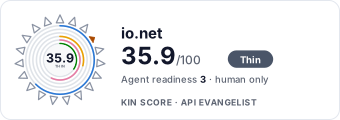 It updates itself when the score changes. Paste this where you link to your API docs: