Interos
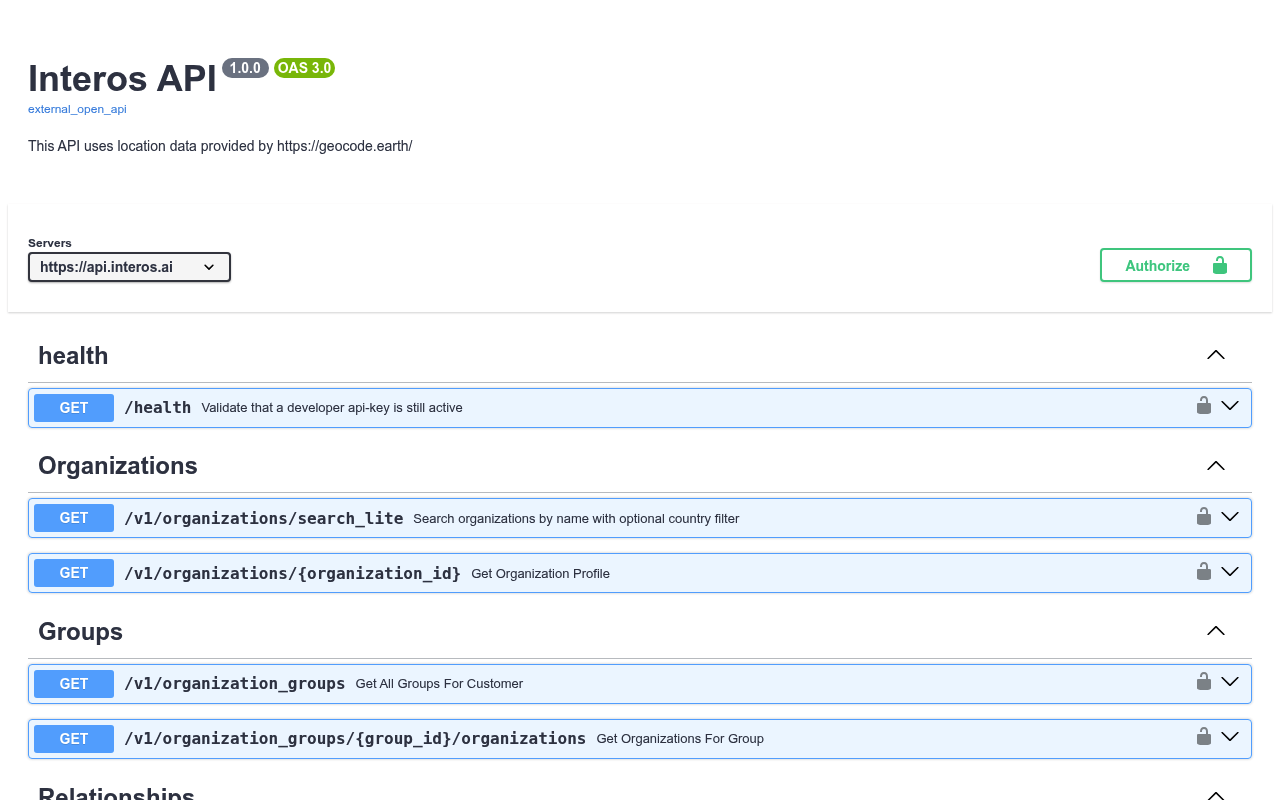
Interos operates an automated supplier-resilience platform that maps and continuously monitors extended, multi-tier supply chains for Fortune 1000 companies and federal agencies. Its cloud-native, multi-tenant SaaS uses AI and a large B2B relationship graph to deliver real-time, multi-domain risk scores and alerts. The public Interos API (REST/JSON, OpenAPI 3.0.2) exposes organization search, organization and risk profiles, the supplier relationship graph, organization groups, custom fields, and scenario watchlists, authenticated with x-api-key and x-customer-id headers. Headquartered in Arlington, Virginia; backed by Kleiner Perkins.
Interos publishes 5 API contracts indexed on the APIs.io network, including Groups API, Health API, Organizations API, and 2 more. Tagged areas include Company, Enterprise, Supply Chain, Risk Management, and Supplier Risk.
Interos’ developer surface includes engineering blog, documentation, API reference, authentication, and 21 more developer resources.
What this lets a business do 1
Business capabilities this provider's published APIs can perform, derived from its own contracts. Browse all capabilities →
Kin Score
 Kin Score
How this is scored →
Kin Score
How this is scored →scored 2026-10-09 · rubric v0.23.0
APIs 5
Individual APIs this provider publishes, each with its own machine-readable definition.
Interos Groups API
The Groups API from Interos — 2 operation(s) for groups.
Interos Health API
The health API from Interos — 1 operation(s) for health.
Interos Organizations API
The Organizations API from Interos — 2 operation(s) for organizations.
Interos Relationships API
The Relationships API from Interos — 2 operation(s) for relationships.
Interos Watchtower API
The Watchtower API from Interos — 3 operation(s) for watchtower.
Open Collections 6
Open, tool-agnostic API collections (OpenAPI-derived and Bruno).
API Collection
OPEN COLLECTIONInteros Groups API
OPEN COLLECTIONInteros Groups health API
OPEN COLLECTIONInteros Groups Organizations API
OPEN COLLECTIONInteros Groups Relationships API
OPEN COLLECTIONInteros Groups Watchtower API
OPEN COLLECTIONRate Limits 1
Documented rate limits and quota policies.
Interos Rate Limits
RATE LIMITSOpenAPI Overlays 1
Overlays applied on top of this provider's contracts. Each card says who wrote it: a document the provider publishes, or one API Evangelist derived or generated.
Interos Openapi Overlay
UNRECORDEDSecurity Posture 2
Authentication, domain security, vulnerability disclosure, and trust-center signals.
Agentic Access 1
Recommended x-agentic-access execution contracts for AI agents.
Resources
Get Started 2
Portal, sign-up, and the first successful call
Documentation 3
Reference material describing how the API behaves
Agent Surfaces 5
MCP servers, agent skills, and machine-readable catalogs
Design & Contract 5
Pagination, idempotency, versioning, errors, and events
Access & Security 2
Authentication, authorization, and security posture
Operate 2
Status, limits, changes, and where to get help
Commercial 2
Pricing, plans, and the legal terms of use
Company 2
The organization behind the API
Other 2
Properties that don't map to a standard resource type
Source (apis.yml)
Work with this as data
Every provider here is available over the APIs.io API and to AI agents over MCP.