Infogram
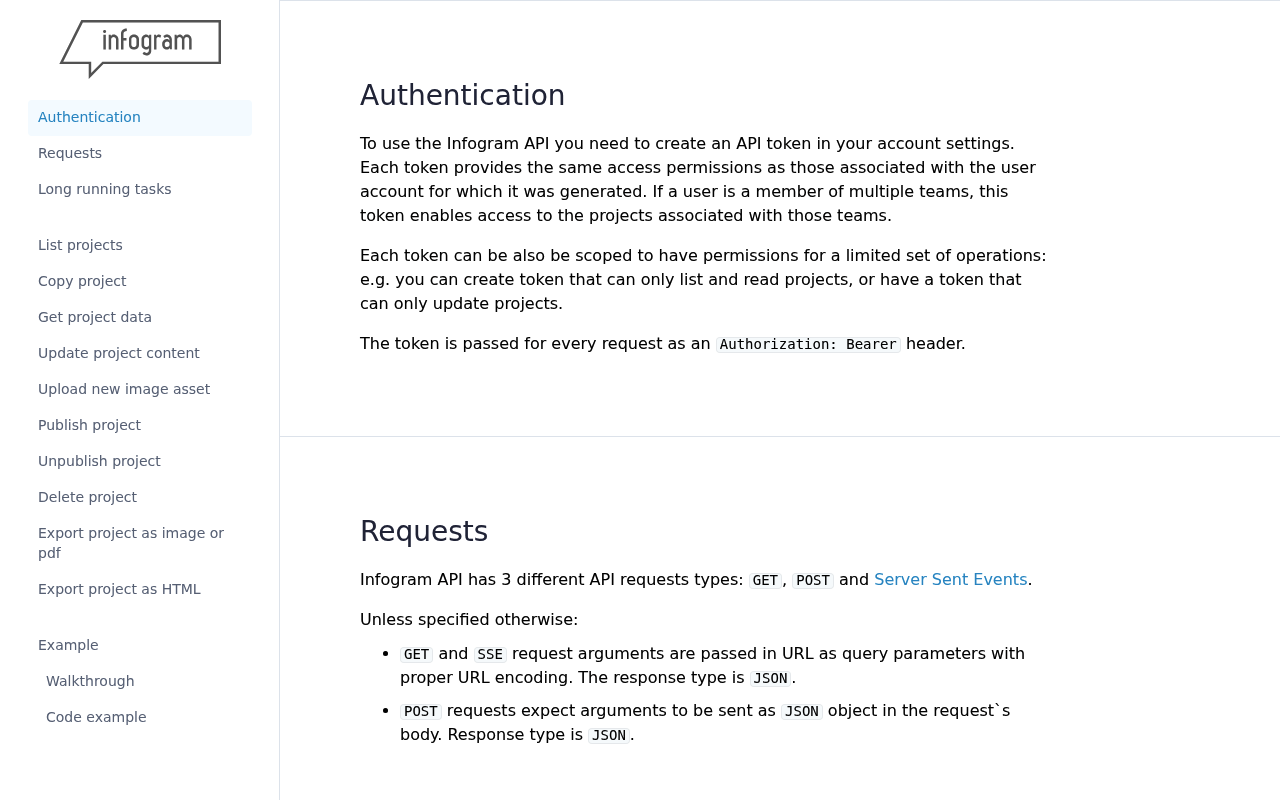
Infogram is a data visualization platform (based in Riga, Latvia, part of the Prezi family) that lets writers, marketers, journalists, researchers, and analysts turn raw data into interactive infographics, charts, maps, reports, and dashboards that can be embedded or shared anywhere. Its REST API at api.infogram.com uses bearer-token authentication and lets developers list and copy projects, read and update project entities (text, charts, images), upload image assets, publish and unpublish projects, delete projects, and export a project as PNG/JPG/PDF or zipped HTML. Long-running export/download tasks are monitored over Server-Sent Events via a task-status stream. First-party client libraries are published for PHP, Java, Node.js, and Ruby.
Infogram is listed with 1 API on the APIs.io network. Tagged areas include Company, Data Visualization, Infographics, Charts, and Dashboards.
Infogram’s developer surface includes documentation, API reference, support, engineering blog, pricing, signup flow, authentication, and 19 more developer resources.
Kin Score
 Kin Score
How this is scored →
scored 2026-10-17 · rubric v0.24.0
Markets this provider is in provisional
The Kin Score Market layer reads a provider inside its market: its position, and how deep its integrations go. Depth is only comparable within a position. Provisional and unweighted: not part of the Kin Score or agent readiness.
| Market | Position | Depth | Registered MCP server | Declares compatibility |
|---|---|---|---|---|
| Business Intelligence, Analytics and Visualization | undeclared | - | - | - |
Registered MCP server and declares compatibility are report only — not weighted. Undeclared means we found nothing we can read, so there is no number: we never infer integrations.
APIs 1
Individual APIs this provider publishes, each with its own machine-readable definition.
Infogram API
REST API for managing Infogram projects programmatically — list and copy projects, read and update project entities, upload image assets, publish and unpublish, delete, and expo...
Security Posture 2
Authentication, domain security, vulnerability disclosure, and trust-center signals.
Resources
Get Started 3
Portal, sign-up, and the first successful call
Documentation 2
Reference material describing how the API behaves
Agent Surfaces 3
MCP servers, agent skills, and machine-readable catalogs
Design & Contract 5
Pagination, idempotency, versioning, errors, and events
Build 3
SDKs, sample code, and the tooling you integrate with
Access & Security 2
Authentication, authorization, and security posture
Operate 2
Status, limits, changes, and where to get help
Commercial 3
Pricing, plans, and the legal terms of use
Company 3
The organization behind the API
Source (apis.yml)
Work with this as data
Every provider here is available over the APIs.io API and to AI agents over MCP.