HAMi
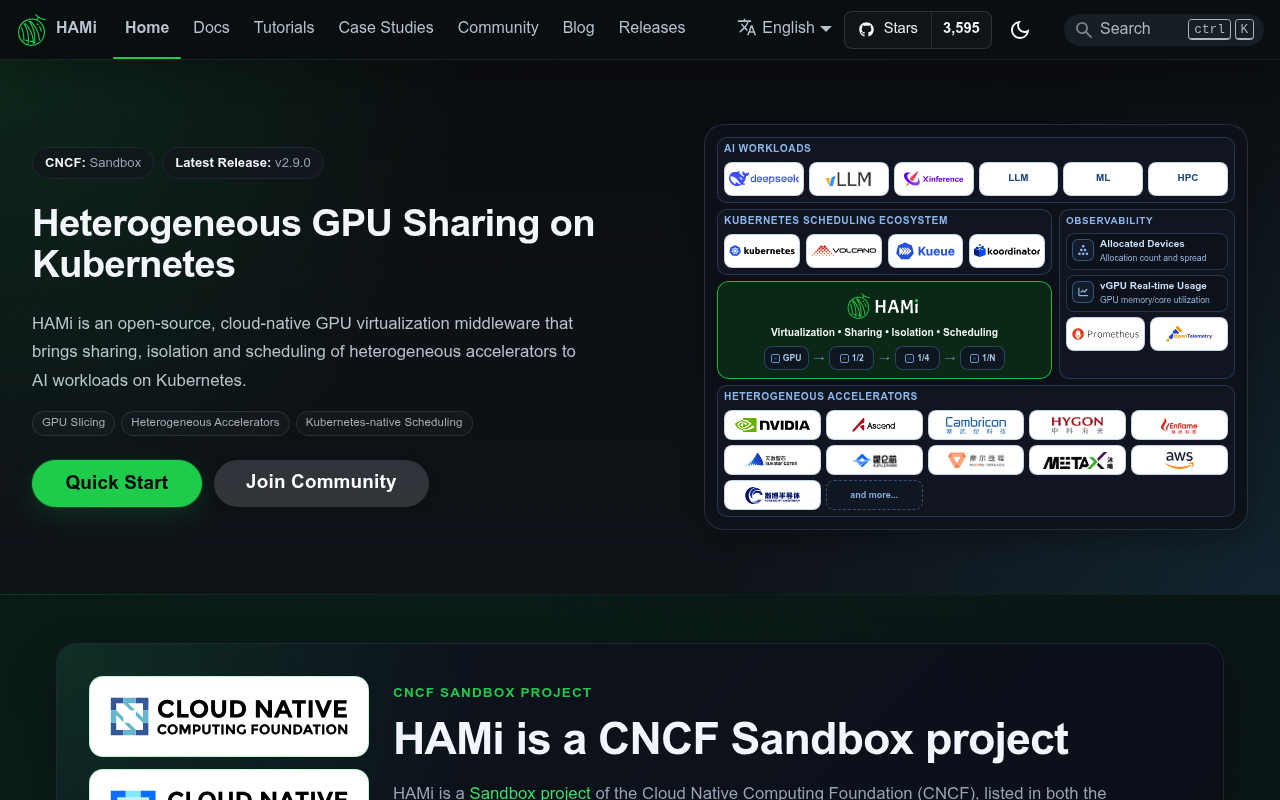
HAMi (Heterogeneous AI Computing Virtualization Middleware) is a CNCF incubating open-source project that brings device sharing, memory and core isolation, and topology-aware scheduling to heterogeneous AI accelerators on Kubernetes. It lets several containers share one physical GPU or NPU with hard memory limits and enforced compute quotas, across NVIDIA, Huawei Ascend, Cambricon MLU, Hygon DCU, Enflame GCU, Iluvatar, Moore Threads, MetaX, Kunlunxin and Vastai devices. HAMi ships a scheduler, a device plugin, an in-container enforcement library (HAMi-core/libvgpu), a DRA driver, and HAMi WebUI — an observability dashboard whose backend exposes a gRPC and grpc-gateway REST API over cluster GPU, node, workload and Prometheus-backed monitoring data. The project also publishes a machine-readable discovery surface on its documentation site: an RFC 9727 API catalog, an OpenAPI 3.1 service description, an Agent Skills discovery index, and Content-Signal directives in robots.txt.
HAMi publishes 3 API contracts indexed on the APIs.io network, including Robots.txt API, .well Known API, and 1 more. Tagged areas include AI Computing, CNCF, GPU Virtualization, Kubernetes, and GPU Sharing.
HAMi’s developer surface includes documentation, engineering blog, getting-started guide, support, changelog, authentication, and 24 more developer resources.
Kin Score
 Kin Score
How this is scored →
Kin Score
How this is scored →scored 2026-10-17 · rubric v0.24.0
APIs 3
Individual APIs this provider publishes, each with its own machine-readable definition.
HAMi WebUI API
The HAMi WebUI backend API. Four gRPC services — Card, Node, Container and Monitor — expose cluster accelerator inventory, node inventory, GPU-consuming workloads and Prometheus...
HAMi Robots.txt API
The Robots.txt API from HAMi — 1 operation(s) for robots.txt.
HAMi .well Known API
The .well Known API from HAMi — 3 operation(s) for .well known.
Pricing Plans 1
Published pricing tiers and plan structures.
Hami Plans Pricing
PLANSRate Limits 1
Documented rate limits and quota policies.
Hami Rate Limits
RATE LIMITSOpenAPI Overlays 1
Overlays applied on top of this provider's contracts. Each card says who wrote it: a document the provider publishes, or one API Evangelist derived or generated.
Hami Website Discovery Overlay
GENERATEDSecurity Posture 3
Authentication, domain security, vulnerability disclosure, and trust-center signals.
Resources
Get Started 2
Portal, sign-up, and the first successful call
Documentation 1
Reference material describing how the API behaves
Agent Surfaces 4
MCP servers, agent skills, and machine-readable catalogs
Design & Contract 5
Pagination, idempotency, versioning, errors, and events
Build 2
SDKs, sample code, and the tooling you integrate with
Access & Security 5
Authentication, authorization, and security posture
Operate 5
Status, limits, changes, and where to get help
Commercial 3
Pricing, plans, and the legal terms of use
Company 2
The organization behind the API
Other 1
Properties that don't map to a standard resource type
Source (apis.yml)
Work with this as data
Every provider here is available over the APIs.io API and to AI agents over MCP.