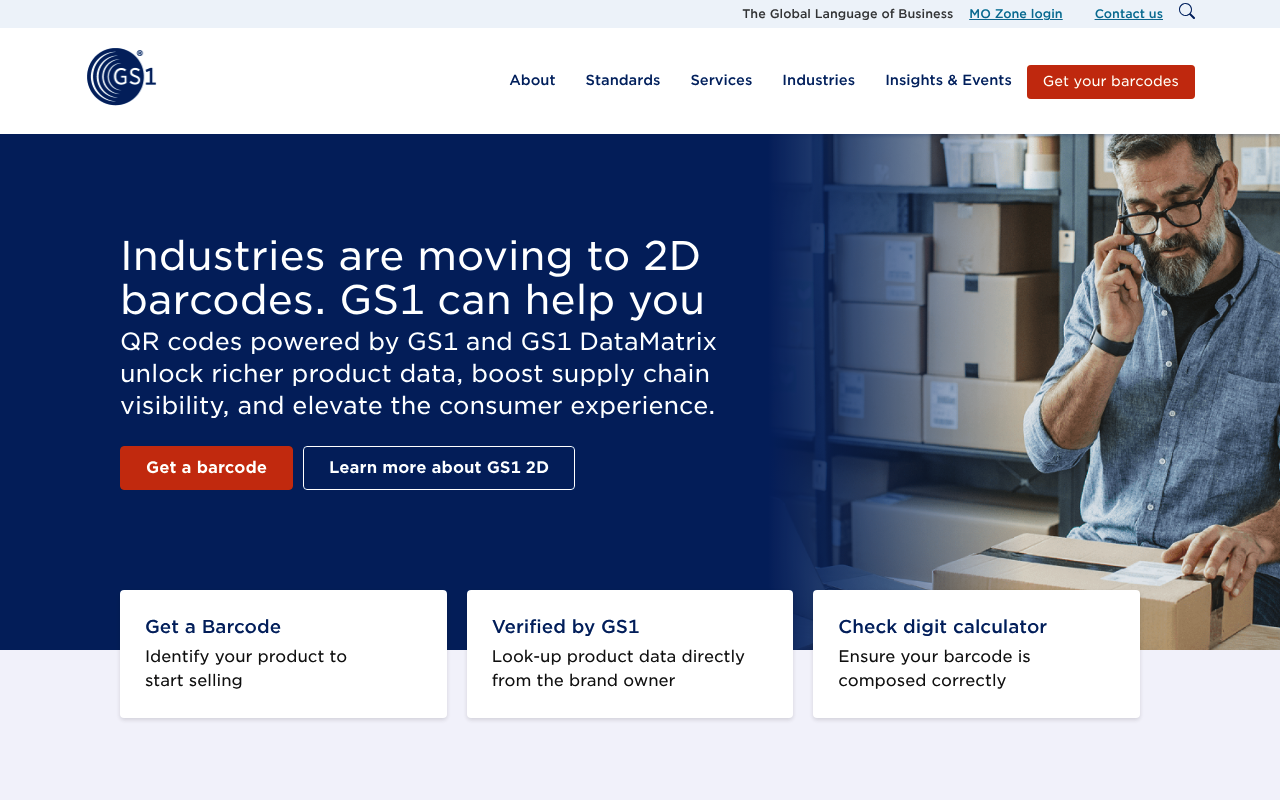
GS1 website screenshot

GS1

GS1 (GS1 AISBL) is the not-for-profit, neutral standards body headquartered at Avenue Louise 523, 1050 Brussels, Belgium, that maintains the identification keys and data standards the rest of the supply chain hangs its transactions on — GTIN, GLN, SSCC, GINC and GSIN, the barcode and EPC/RFID capture standards, EPCIS and the Core Business Vocabulary for supply chain visibility events, GS1 Digital Link, and EANCOM, GS1's own subset of UN/EDIFACT. GS1 does not run a commercial logistics service; it sits underneath every party in the chain, defining the identifiers a shipper, forwarder, carrier, terminal, customs authority and last-mile network all quote at each other. Its API posture is unusually open for a standards body: the full standards library is downloadable free as PDF from ref.gs1.org with no login, EPCIS 2.0.1 ships a normative OpenAPI 3.0.3 REST binding plus JSON Schema, XSD, WSDL, SHACL and JSON-LD ontologies, and GS1 AISBL itself operates a live, unauthenticated GS1-Conformant Resolver at id.gs1.org. What is gated is the other half — issuing GS1 identifiers and querying the Verified by GS1 registry are federated to national GS1 Member Organisations and sold under paid membership or a commercial API subscription, not offered self-serve by the Global Office.

GS1 publishes 6 APIs on the APIs.io network, including Capture API, Discovery API, Events API, and 3 more. Tagged areas include Logistics, Supply Chain, Belgium, Standards, and Track and Trace.

The GS1 catalog on APIs.io includes 1 JSON-LD context.

GS1’s developer surface includes documentation, tooling, and 20 more developer resources.

23.4/100 emerging ▬ flat Agent 20/100 agent aware Full breakdown ↓
scored 2026-09-14 · rubric v0.22.0
1 APIs
LogisticsSupply ChainBelgiumStandardsTrack and TraceTraceabilityIdentifiersBarcodesFreight ForwardingRetail

Kin Score

Kin Score Kin Score How this is scored →
scored 2026-09-14 · rubric v0.22.0
Create-or-Update Ergonomics applies to this provider. This API accepts writes, so it carries 10 points of the composite. It is scored from the published contracts themselves: whether a caller can create-or-update in one call, whether the write accepts a key the caller already holds, and whether the response says which branch ran. Without that, every write needs a search-and-branch in front of it, and the first time that check is skipped a duplicate record is created. Scored against the observed mean rather than raw — a provider at the catalog average is unchanged by this facet, not penalised by it.
Improve this rating by publishing the missing artifacts — every area above can be raised, and the full rubric is at apis.io/rating/. Every facet and dimension name above is a link: it opens that measurement's own page — what it means, the exact checks that feed it, how the whole catalog distributes on it, and the providers at the top of it. This rating is computed from github.com/api-evangelist/gs1: open an issue to ask a question, or submit a pull request to add artifacts. Submit an artifact on GitHub — free → Manage your own listing — the Influence plan, $499/mo →

APIs 7

Individual APIs this provider publishes, each with its own machine-readable definition.

GS1 Digital Link Resolver (id.gs1.org)

GS1 AISBL's own live, unauthenticated GS1-Conformant Resolver, implementing the GS1-Conformant Resolver Standard 1.2.0. It takes a GS1 Digital Link URI built from a GS1 identifi...

GS1 Capture API

Endpoints to capture EPCIS events in bulk or individually.

GS1 Discovery API

Endpoints to obtain information about the endpoint, such as EPCIS and CBV versions or custom vocabularies.

GS1 Events API

Endpoints that allow you to retrieve EPCIS events as Web resources.

GS1 Queries API

Endpoints to create large named or anonymous queries using the EPCIS Query Language. Named queries have a custom name and are stored until deleted by the user. Anonymous queries...

GS1 Subscriptions API

EPCIS 2.0 supports query subscriptions using Webhooks or Websockets.

GS1 Top Level API

Endpoints to browse or retrieve information about EPCIS resources: - events - types of events - electronic product codes - business steps - business locations - read points - di...

Scroll for all 7

Open Collections 1

Open, tool-agnostic API collections (OpenAPI-derived and Bruno).

EPCIS 2.0 REST Bindings

OPEN COLLECTION

Semantic Vocabularies 1

JSON-LD contexts and semantic vocabularies used across these APIs.

Gs1 Resolver Linkset Context

3 classes · 7 properties

JSON-LD

JSON Schema 4

Standalone JSON Schema definitions for this provider's data models.

Gs1 Epcis Json

1 properties

JSON SCHEMA

EPCIS Query Schema

0 properties

JSON SCHEMA

Gs1 Resolver Description File

10 properties

JSON SCHEMA

Resources

Get Started 2

Portal, sign-up, and the first successful call

Documentation 2

Reference material describing how the API behaves

Design & Contract 1

Pagination, idempotency, versioning, errors, and events

Build 3

SDKs, sample code, and the tooling you integrate with

Operate 1

Status, limits, changes, and where to get help

Commercial 1

Pricing, plans, and the legal terms of use

Company 2

The organization behind the API

Other 10

Properties that don't map to a standard resource type

Scroll for all 10

Source (apis.yml)

apis.yml Raw ↑
aid: gs1
url: https://raw.githubusercontent.com/api-evangelist/gs1/refs/heads/main/apis.yml
name: GS1
kind: company
description: 'GS1 (GS1 AISBL) is the not-for-profit, neutral standards body headquartered at Avenue Louise 523, 1050 Brussels,
  Belgium, that maintains the identification keys and data standards the rest of the supply chain hangs its transactions on
  — GTIN, GLN, SSCC, GINC and GSIN, the barcode and EPC/RFID capture standards, EPCIS and the Core Business Vocabulary for
  supply chain visibility events, GS1 Digital Link, and EANCOM, GS1''s own subset of UN/EDIFACT. GS1 does not run a commercial
  logistics service; it sits underneath every party in the chain, defining the identifiers a shipper, forwarder, carrier,
  terminal, customs authority and last-mile network all quote at each other. Its API posture is unusually open for a standards
  body: the full standards library is downloadable free as PDF from ref.gs1.org with no login, EPCIS 2.0.1 ships a normative
  OpenAPI 3.0.3 REST binding plus JSON Schema, XSD, WSDL, SHACL and JSON-LD ontologies, and GS1 AISBL itself operates a live,
  unauthenticated GS1-Conformant Resolver at id.gs1.org. What is gated is the other half — issuing GS1 identifiers and querying
  the Verified by GS1 registry are federated to national GS1 Member Organisations and sold under paid membership or a commercial
  API subscription, not offered self-serve by the Global Office.'
deliveryModel:
  model: unknown
  open_source: unknown
  commercial: false
  callable_host: false
  label: Delivery model not determined — needs a product licence on record
  confidence: low
  source:
  - openapi
  - repository-unlicensed
  generated: '2026-08-28'
  method: derived
image: https://ref.gs1.org/favicon-196x196.png
tags:
- Logistics
- Supply Chain
- Belgium
- Standards
- Track and Trace
- Traceability
- Identifiers
- Barcodes
- Freight Forwarding
- Retail
created: '2026-07-30'
modified: '2026-07-30'
specificationVersion: '0.23'
apis:
- aid: gs1:gs1-digital-link-resolver
  name: GS1 Digital Link Resolver (id.gs1.org)
  description: GS1 AISBL's own live, unauthenticated GS1-Conformant Resolver, implementing the GS1-Conformant Resolver Standard
    1.2.0. It takes a GS1 Digital Link URI built from a GS1 identification key and returns either a 303 redirect to the brand
    owner's target resource or, on request, an RFC 9264 linkset enumerating every registered link type for that key. The resolver
    description document at /.well-known/gs1resolver declares the supported primary keys — 00 (SSCC), 01 (GTIN), 253 (GDTI),
    255 (GCN), 401 (GINC), 402 (GSIN), 414/415/417 (GLN), 8003 (GRAI), 8004 (GIAI), 8006 (ITIP), 8010 (CPID), 8013 (GMN) and
    8017/8018 (GSRN) — which includes the consignment and shipment keys logistics parties actually quote. No key, no signup
    and no contract is required to call it.
  humanURL: https://ref.gs1.org/standards/resolver/
  baseURL: https://id.gs1.org
  tags:
  - GS1 Digital Link
  - Resolver
  - Identifiers
  - Linked Data
  - Track and Trace
  - Standards
  properties:
  - type: Specification
    url: https://ref.gs1.org/standards/resolver/1.2.0/
  - type: JSONSchema
    url: json-schema/gs1-resolver-linkset-schema.json
  - type: JSONSchema
    url: json-schema/gs1-resolver-description-file-schema.json
  - type: WellKnown
    url: well-known/gs1-resolver-description.json
  - type: JSONLD
    url: json-ld/gs1-resolver-linkset-context.jsonld
  - type: Vocabulary
    url: json-ld/gs1-web-vocabulary-linktypes.json
  - type: Documentation
    url: https://www.gs1.org/standards/gs1-digital-link
  - type: Artefacts
    url: https://ref.gs1.org/standards/resolver/artefacts
  - type: TestSuite
    url: https://ref.gs1.org/test-suites/resolver/
  - type: SourceCode
    url: https://github.com/gs1/GS1_DigitalLink_Resolver_CE
- aid: gs1:gs1-capture-api
  name: GS1 Capture API
  description: Endpoints to capture EPCIS events in bulk or individually.
  humanURL: https://ref.gs1.org/standards/epcis/
  baseURL: https://id.gs1.org
  tags:
  - Capture
  properties:
  - type: OpenAPI
    url: openapi/gs1-capture-api-openapi.yml
  - type: JSONSchema
    url: json-schema/gs1-epcis-json-schema.json
  - type: JSONSchema
    url: json-schema/gs1-epcis-query-schema.json
  - type: Specification
    url: https://ref.gs1.org/standards/epcis/2.0.1/
  - type: Documentation
    url: https://www.gs1.org/standards/epcis
  - type: Artefacts
    url: https://ref.gs1.org/standards/epcis/artefacts
  - type: Vocabulary
    url: https://ref.gs1.org/cbv/
  - type: SourceCode
    url: https://github.com/gs1/EPCIS
- aid: gs1:gs1-discovery-api
  name: GS1 Discovery API
  description: Endpoints to obtain information about the endpoint, such as EPCIS and CBV versions or custom vocabularies.
  humanURL: https://ref.gs1.org/standards/epcis/
  baseURL: https://id.gs1.org
  tags:
  - Discovery
  properties:
  - type: OpenAPI
    url: openapi/gs1-discovery-api-openapi.yml
  - type: JSONSchema
    url: json-schema/gs1-epcis-json-schema.json
  - type: JSONSchema
    url: json-schema/gs1-epcis-query-schema.json
  - type: Specification
    url: https://ref.gs1.org/standards/epcis/2.0.1/
  - type: Documentation
    url: https://www.gs1.org/standards/epcis
  - type: Artefacts
    url: https://ref.gs1.org/standards/epcis/artefacts
  - type: Vocabulary
    url: https://ref.gs1.org/cbv/
  - type: SourceCode
    url: https://github.com/gs1/EPCIS
- aid: gs1:gs1-events-api
  name: GS1 Events API
  description: Endpoints that allow you to retrieve EPCIS events as Web resources.
  humanURL: https://ref.gs1.org/standards/epcis/
  baseURL: https://id.gs1.org
  tags:
  - Event
  tags_raw:
  - Events
  properties:
  - type: OpenAPI
    url: openapi/gs1-events-api-openapi.yml
  - type: JSONSchema
    url: json-schema/gs1-epcis-json-schema.json
  - type: JSONSchema
    url: json-schema/gs1-epcis-query-schema.json
  - type: Specification
    url: https://ref.gs1.org/standards/epcis/2.0.1/
  - type: Documentation
    url: https://www.gs1.org/standards/epcis
  - type: Artefacts
    url: https://ref.gs1.org/standards/epcis/artefacts
  - type: Vocabulary
    url: https://ref.gs1.org/cbv/
  - type: SourceCode
    url: https://github.com/gs1/EPCIS
- aid: gs1:gs1-queries-api
  name: GS1 Queries API
  description: 'Endpoints to create large named or anonymous queries using the EPCIS Query Language. Named queries have a
    custom

    name and are stored until deleted by the user. Anonymous queries are not persisted and only available to the caller.

    EPCIS events queries also support query subscription.'
  humanURL: https://ref.gs1.org/standards/epcis/
  baseURL: https://id.gs1.org
  tags:
  - Query
  tags_raw:
  - Queries
  properties:
  - type: OpenAPI
    url: openapi/gs1-queries-api-openapi.yml
  - type: JSONSchema
    url: json-schema/gs1-epcis-json-schema.json
  - type: JSONSchema
    url: json-schema/gs1-epcis-query-schema.json
  - type: Specification
    url: https://ref.gs1.org/standards/epcis/2.0.1/
  - type: Documentation
    url: https://www.gs1.org/standards/epcis
  - type: Artefacts
    url: https://ref.gs1.org/standards/epcis/artefacts
  - type: Vocabulary
    url: https://ref.gs1.org/cbv/
  - type: SourceCode
    url: https://github.com/gs1/EPCIS
- aid: gs1:gs1-subscriptions-api
  name: GS1 Subscriptions API
  description: EPCIS 2.0 supports query subscriptions using Webhooks or Websockets.
  humanURL: https://ref.gs1.org/standards/epcis/
  baseURL: https://id.gs1.org
  tags:
  - Subscription
  tags_raw:
  - Subscriptions
  properties:
  - type: OpenAPI
    url: openapi/gs1-subscriptions-api-openapi.yml
  - type: JSONSchema
    url: json-schema/gs1-epcis-json-schema.json
  - type: JSONSchema
    url: json-schema/gs1-epcis-query-schema.json
  - type: Specification
    url: https://ref.gs1.org/standards/epcis/2.0.1/
  - type: Documentation
    url: https://www.gs1.org/standards/epcis
  - type: Artefacts
    url: https://ref.gs1.org/standards/epcis/artefacts
  - type: Vocabulary
    url: https://ref.gs1.org/cbv/
  - type: SourceCode
    url: https://github.com/gs1/EPCIS
- aid: gs1:gs1-top-level-api
  name: GS1 Top Level API
  description: 'Endpoints to browse or retrieve information about EPCIS resources:

    - events

    - types of events

    - electronic product codes

    - business steps

    - business locations

    - read points

    - dispositions'
  humanURL: https://ref.gs1.org/standards/epcis/
  baseURL: https://id.gs1.org
  tags:
  - Top-level
  properties:
  - type: OpenAPI
    url: openapi/gs1-top-level-api-openapi.yml
  - type: JSONSchema
    url: json-schema/gs1-epcis-json-schema.json
  - type: JSONSchema
    url: json-schema/gs1-epcis-query-schema.json
  - type: Specification
    url: https://ref.gs1.org/standards/epcis/2.0.1/
  - type: Documentation
    url: https://www.gs1.org/standards/epcis
  - type: Artefacts
    url: https://ref.gs1.org/standards/epcis/artefacts
  - type: Vocabulary
    url: https://ref.gs1.org/cbv/
  - type: SourceCode
    url: https://github.com/gs1/EPCIS
common:
- type: License
  name: Apache-2.0
  url: https://github.com/gs1/GS1_DigitalLink_Resolver_CE/blob/master/LICENSE
- type: CapabilityMap
  url: capabilities/gs1-capability-edges.yml
  name: GS1 Business Capability Map
- type: IssueTracker
  url: https://github.com/gs1/EPCIS/issues
- type: CodeOfConduct
  url: https://github.com/gs1/EPCIS/blob/master/CODE_OF_CONDUCT.md
- type: Website
  url: https://www.gs1.org/
- type: Documentation
  url: https://ref.gs1.org/
- type: SpecificationsRepository
  url: https://ref.gs1.org/standards/
  name: GS1 standards repository — every ratified standard, free PDF, no login
- type: GitHubOrganization
  url: https://github.com/gs1
- type: Vocabulary
  url: https://ref.gs1.org/voc/
  name: GS1 Web Vocabulary (JSON-LD and Turtle ontologies)
- type: Governance
  url: https://www.gs1.org/standards/development-work-groups
  name: Global Standards Management Process (GSMP) work groups
- type: Standard
  url: https://ref.gs1.org/standards/genspecs/
  name: GS1 General Specifications 26.0.0
- type: Standard
  url: https://ref.gs1.org/standards/digital-link/uri-syntax/
  name: GS1 Digital Link URI Syntax 1.4.0
- type: Standard
  url: https://ref.gs1.org/standards/cbv/
  name: Core Business Vocabulary (CBV) 2.0.0
- type: Standard
  url: https://ref.gs1.org/standards/eancom/
  name: EANCOM 2022 — GS1 subset of UN/EDIFACT
- type: Standard
  url: https://ref.gs1.org/standards/edi-business-terms/
  name: GS1 EDI Business Terms 1.0.0
- type: Standard
  url: https://ref.gs1.org/standards/logistics-interoperability/
  name: GS1 Logistics Interoperability Model 1.1.1
- type: Standard
  url: https://ref.gs1.org/standards/tds/
  name: EPC Tag Data Standard (TDS) 2.3.0
- type: Standard
  url: https://ref.gs1.org/standards/gdm/
  name: GS1 Global Data Model 2.17.0
- type: Tools
  url: https://ref.gs1.org/tools/gs1-barcode-syntax-resource/
  name: GS1 Barcode Syntax Resource (Dictionary, Tests, Engine)
- type: Registry
  url: https://www.gs1.org/services/verified-by-gs1
  name: Verified by GS1 — global registry lookup (web UI; APIs sold by Member Organisations)
- type: Industry
  url: https://www.gs1.org/industries/transport-and-logistics
- type: LinkedIn
  url: https://www.linkedin.com/company/gs1
maintainers:
- FN: Kin Lane
  email: kin@apievangelist.com

Work with this as data

Every provider here is available over the APIs.io API and to AI agents over MCP.

MCP server

One button, every client — Claude, Cursor, VS Code and the rest.

https://apis.io/mcp

Tools for providers

9 MCP tools reach this
  • find_providersBrowse and filter every provider in the catalog.
  • get_provider_artifactsEvery artifact this provider publishes, grouped by type.
  • get_provider_operationsEvery operation across all of their OpenAPIs — one call instead of parsing every spec.
  • get_provider_toolsEvery MCP tool they ship, with the operation each wraps.
  • get_provider_evidenceHow each part of their score was established. Free — the basis for a claim should not sit behind it.
  • get_provider_ratingPRO — composite, band, trend and facet scores.
  • apis_io_searchSTART HERE — APIs, providers and tags for one query, each with its total.
  • resolveTurn a domain, URL or GitHub org into the provider it belongs to.
  • find_cohortsEvery scored population of providers in the catalog.
All 92 tools →

Call it yourself

curl for this page
This provider
curl "https://apis.io/api/v1/providers/gs1"
All providers
curl "https://apis.io/api/v1/providers?limit=25"
Every operation they expose
curl "https://apis.io/api/v1/providers/gs1/operations?limit=25"
How their score was established
curl "https://apis.io/api/v1/providers/gs1/evidence"

Discovery needs no key. Ratings and market analysis are Pro.

Get an API key

Free tier, no form to fill in. Signing in shares your email address with us — we store it to create your key and to recognise you if you sign in with another provider. See our Privacy Policy and Terms.
A second provider on the same verified email joins the account you already have.