Funnel Leasing
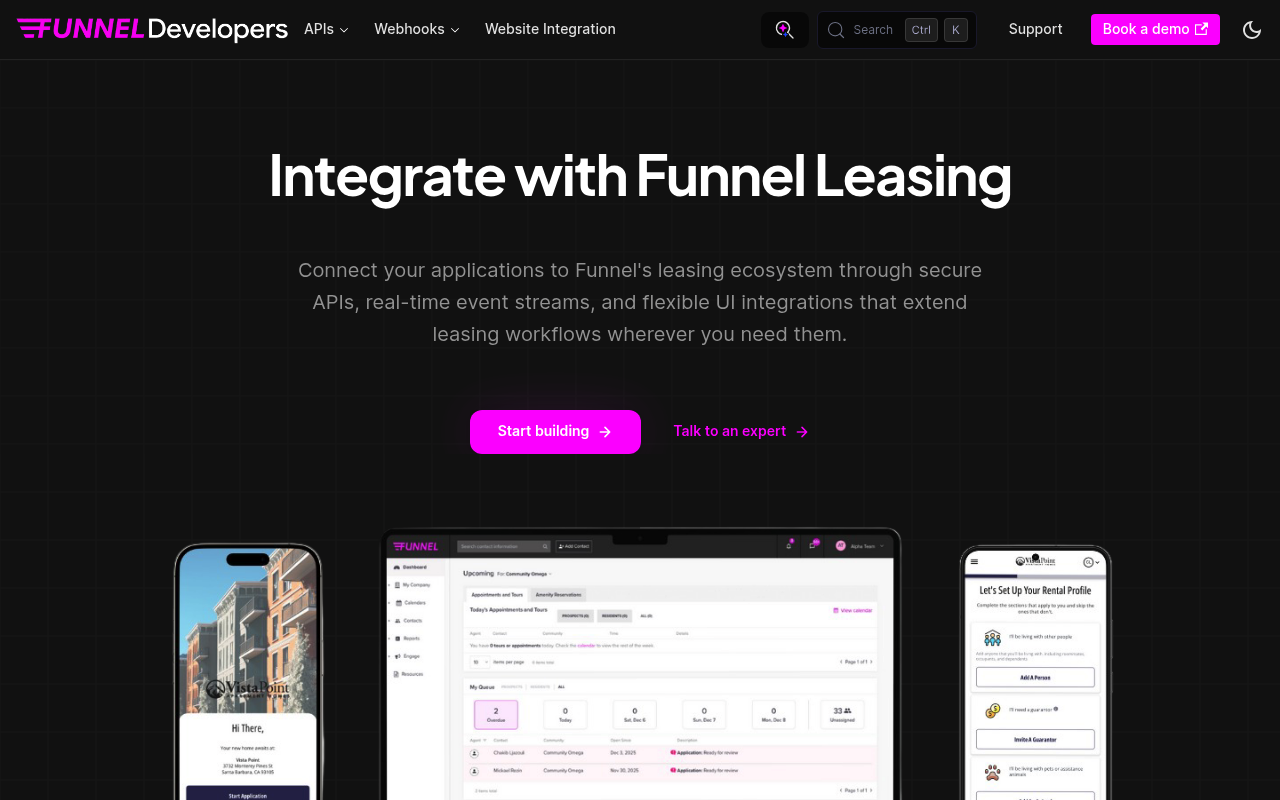
Funnel Leasing provides AI-infused CRM and property management software for multifamily (apartment) operators. The platform centralizes the leasing lifecycle from prospect to resident with a next-generation CRM, an AI Virtual Leasing Agent, voice AI insights, marketing automation, and a resident portal (Nestio ResApp), and integrates with property management systems including Yardi, RentManager, and Entrata. Funnel exposes a Customer API for single-account integrations (creating prospects, scheduling tours, and processing lease applications) and a Partner API for reusable, multi-customer integrations, plus an outbound webhooks surface. Formerly known as Nestio.
Funnel Leasing is listed with 2 APIs on the APIs.io network. Tagged areas include Company, Real Estate, PropTech, Property Management, and Multifamily.
The Funnel Leasing catalog on APIs.io includes 1 event-driven AsyncAPI specification.
Funnel Leasing’s developer surface includes documentation, API reference, getting-started guide, authentication, pricing, support, and 11 more developer resources.
Kin Score
 Kin Score
How this is scored →
Kin Score
How this is scored →scored 2026-10-09 · rubric v0.23.0
APIs 2
Individual APIs this provider publishes, each with its own machine-readable definition.
Funnel Customer API
Single-customer integration API for the Funnel leasing platform — create prospects in the CRM, schedule property tours/appointments, and process lease applications. Resources in...
Funnel Partner API
Reusable, multi-customer integration API for partners and platform providers (not tied to a single customer account). Areas include Appointment Booking, Community Details, Prosp...
Event Specifications 1
AsyncAPI definitions for this provider's event-driven and streaming APIs.
Funnel Leasing Webhooks
ASYNCAPISecurity Posture 2
Authentication, domain security, vulnerability disclosure, and trust-center signals.
Resources
Get Started 3
Portal, sign-up, and the first successful call
Documentation 2
Reference material describing how the API behaves
Agent Surfaces 1
MCP servers, agent skills, and machine-readable catalogs
Design & Contract 5
Pagination, idempotency, versioning, errors, and events
Access & Security 2
Authentication, authorization, and security posture
Operate 1
Status, limits, changes, and where to get help
Commercial 2
Pricing, plans, and the legal terms of use
Company 1
The organization behind the API
Source (apis.yml)
Work with this as data
Every provider here is available over the APIs.io API and to AI agents over MCP.