FlexAI
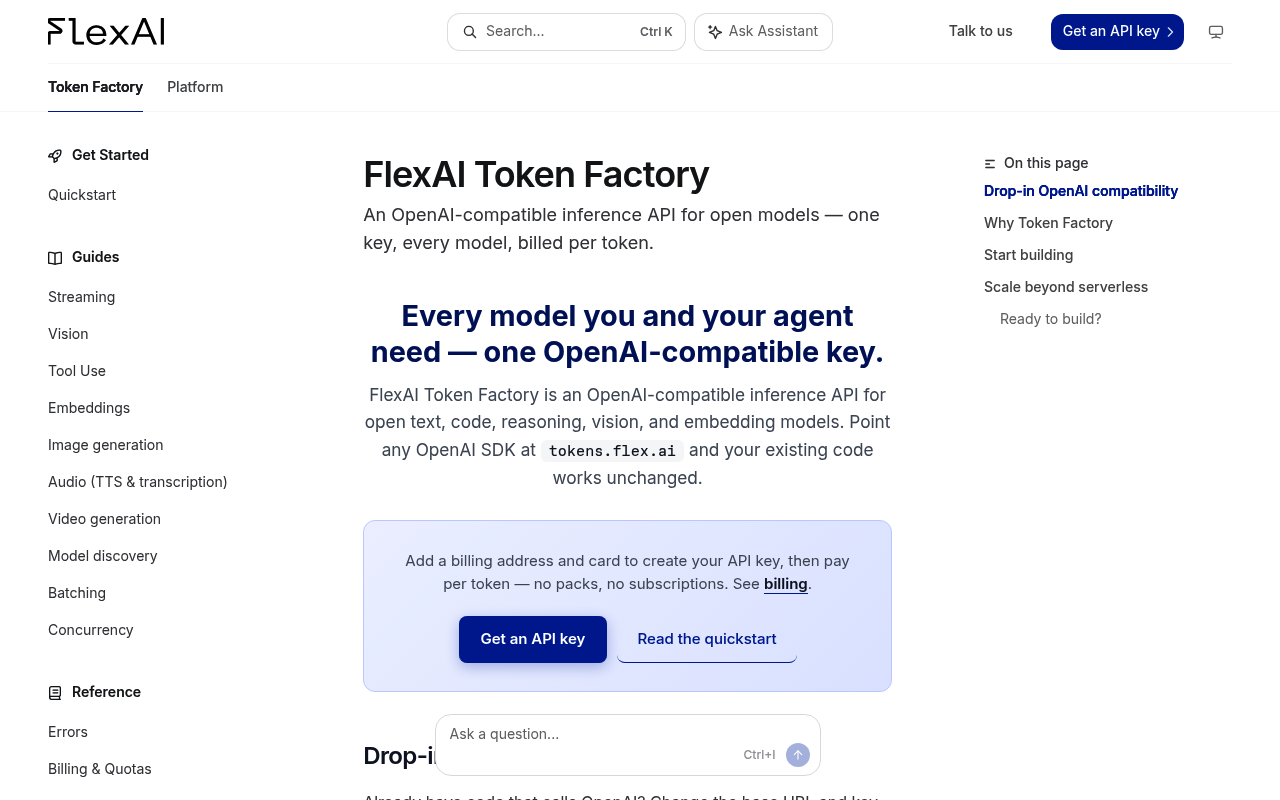
FlexAI is managed inference for builders — an OpenAI-compatible API (Token Factory) that provides a single API key across open models for text, code, reasoning, vision, embeddings, image, video, and audio, priced by usage per model. Beyond serverless inference the platform offers dedicated GPU endpoints, managed LoRA/QLoRA fine-tuning, distributed training, an Agent SDK (in trial), and a private AI cloud (AI Factory) deployable to VPC, on-prem, or air-gapped environments. Because the inference API is a drop-in OpenAI replacement, teams point the OpenAI SDK at the FlexAI base URL and change only the key. FlexAI is backed by Partech and profiled in the API Evangelist network for its developer surface and agent-native infrastructure.
FlexAI publishes 7 API contracts indexed on the APIs.io network, including Audio API, Completions API, Embeddings API, and 4 more. Tagged areas include Company, Artificial Intelligence, Machine Learning, Inference, and LLM.
FlexAI’s developer surface includes documentation, API reference, getting-started guide, engineering blog, pricing, signup flow, support, and 22 more developer resources.
Kin Score
 Kin Score
How this is scored →
Kin Score
How this is scored →scored 2026-10-17 · rubric v0.24.0
Standards implemented 1
Standards this provider implements or carries. De facto ones are profiled and measured by the API Commons; formal ones come from the standards directory and are linked by the provider's own tags. The evidence column says how each claim was established — not that it was made.
APIs 7
Individual APIs this provider publishes, each with its own machine-readable definition.
FlexAI Audio API
Speech-to-text and text-to-speech
FlexAI Completions API
Legacy text completions
FlexAI Embeddings API
Vector embeddings
FlexAI Images API
Image generation
FlexAI Models API
Model catalog
FlexAI Video API
Video generation
FlexAI Chat Completions API
Chat completions
Scroll for all 7
Postman Collections 7
Ready-to-run Postman collections for exercising this provider's APIs.
Scroll for all 7
Open Collections 8
Open, tool-agnostic API collections (OpenAPI-derived and Bruno).
API Collection
OPEN COLLECTIONFlexAI Token Factory Audio API
OPEN COLLECTIONFlexAI Token Factory Audio Chat API
OPEN COLLECTIONFlexAI Token Factory Audio Completions API
OPEN COLLECTIONFlexAI Token Factory Audio Embeddings API
OPEN COLLECTIONFlexAI Token Factory Audio Images API
OPEN COLLECTIONFlexAI Token Factory Audio Models API
OPEN COLLECTIONFlexAI Token Factory Audio Video API
OPEN COLLECTIONScroll for all 8
Pricing Plans 1
Published pricing tiers and plan structures.
Flexai Plans
PLANSRate Limits 1
Documented rate limits and quota policies.
Flexai Rate Limits
RATE LIMITSOpenAPI Overlays 1
Overlays applied on top of this provider's contracts. Each card says who wrote it: a document the provider publishes, or one API Evangelist derived or generated.
Flexai Token Factory Overlay
GENERATEDSecurity Posture 2
Authentication, domain security, vulnerability disclosure, and trust-center signals.
Agentic Access 1
Recommended x-agentic-access execution contracts for AI agents.
Resources
Get Started 3
Portal, sign-up, and the first successful call
Documentation 3
Reference material describing how the API behaves
Agent Surfaces 4
MCP servers, agent skills, and machine-readable catalogs
Design & Contract 5
Pagination, idempotency, versioning, errors, and events
Build 1
SDKs, sample code, and the tooling you integrate with
Access & Security 3
Authentication, authorization, and security posture
Operate 3
Status, limits, changes, and where to get help
Commercial 4
Pricing, plans, and the legal terms of use
Company 2
The organization behind the API
Other 1
Properties that don't map to a standard resource type
Source (apis.yml)
Work with this as data
Every provider here is available over the APIs.io API and to AI agents over MCP.