DualEntry
DualEntry is an AI-native ERP (enterprise resource planning) platform for finance and accounting teams, positioned as a modern replacement for NetSuite, QuickBooks, and Xero. It covers core financials (general ledger, accounts payable and receivable, cash management, bank and account reconciliation, tax, and month-end close), advanced accounting (ASC 606 revenue recognition, subscription billing, prepaid amortization, fixed-asset and multi-book depreciation), and enterprise scale (multi-entity consolidation, multi-currency, intercompany journal entries, budgeting, and reporting), layered with AI automation for categorization, anomaly detection, OCR document capture, and continuous close. Developers integrate through the DualEntry Public API (V1 and V2 REST), a hosted MCP server for AI assistants, a first-party Python CLI, and signed webhooks. The company raised a $90M Series A and is backed by GV, Khosla Ventures, and Lightspeed Venture Partners.
DualEntry is listed with 1 API on the APIs.io network. Tagged areas include Company, Artificial Intelligence, Accounting, ERP, and Finance.
The DualEntry catalog on APIs.io includes 1 event-driven AsyncAPI specification.
DualEntry’s developer surface includes documentation, API reference, getting-started guide, engineering blog, pricing, signup flow, CLI, and 22 more developer resources.
Kin Score
 Kin Score
How this is scored →
Kin Score
How this is scored →scored 2026-10-09 · rubric v0.23.0
APIs 1
Individual APIs this provider publishes, each with its own machine-readable definition.
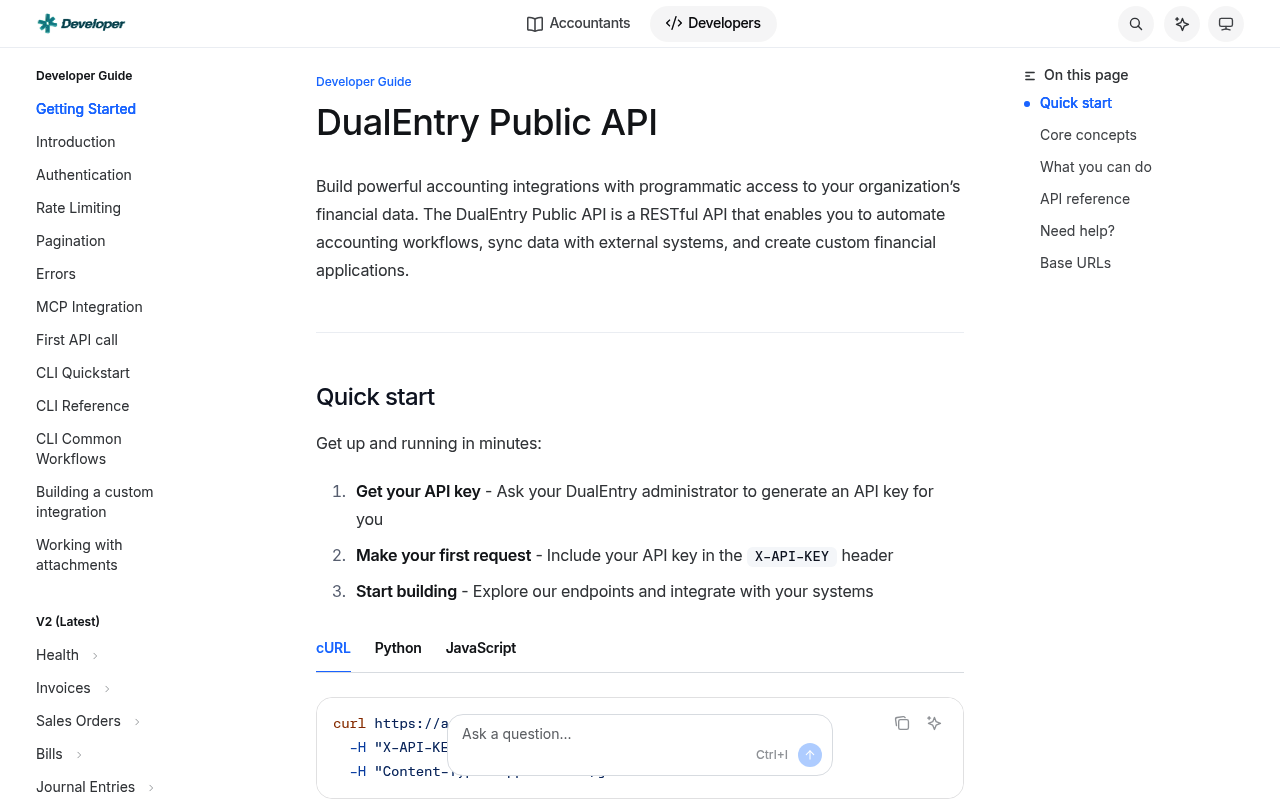
DualEntry Public API
REST API for programmatic access to an organization's accounting data across setup (accounts, items, classifications), master data (companies, customers, vendors), transactions ...
MCP Servers 1
Model Context Protocol servers that expose these APIs to AI agents.
Pricing Plans 1
Published pricing tiers and plan structures.
Rate Limits 1
Documented rate limits and quota policies.
Dualentry Rate Limits
RATE LIMITSEvent Specifications 1
AsyncAPI definitions for this provider's event-driven and streaming APIs.
Dualentry Webhooks
ASYNCAPISecurity Posture 2
Authentication, domain security, vulnerability disclosure, and trust-center signals.
Resources
Get Started 5
Portal, sign-up, and the first successful call
Documentation 2
Reference material describing how the API behaves
Agent Surfaces 2
MCP servers, agent skills, and machine-readable catalogs
Design & Contract 6
Pagination, idempotency, versioning, errors, and events
Build 3
SDKs, sample code, and the tooling you integrate with
Access & Security 3
Authentication, authorization, and security posture
Operate 2
Status, limits, changes, and where to get help
Commercial 4
Pricing, plans, and the legal terms of use
Company 2
The organization behind the API
Source (apis.yml)
Work with this as data
Every provider here is available over the APIs.io API and to AI agents over MCP.