Digger
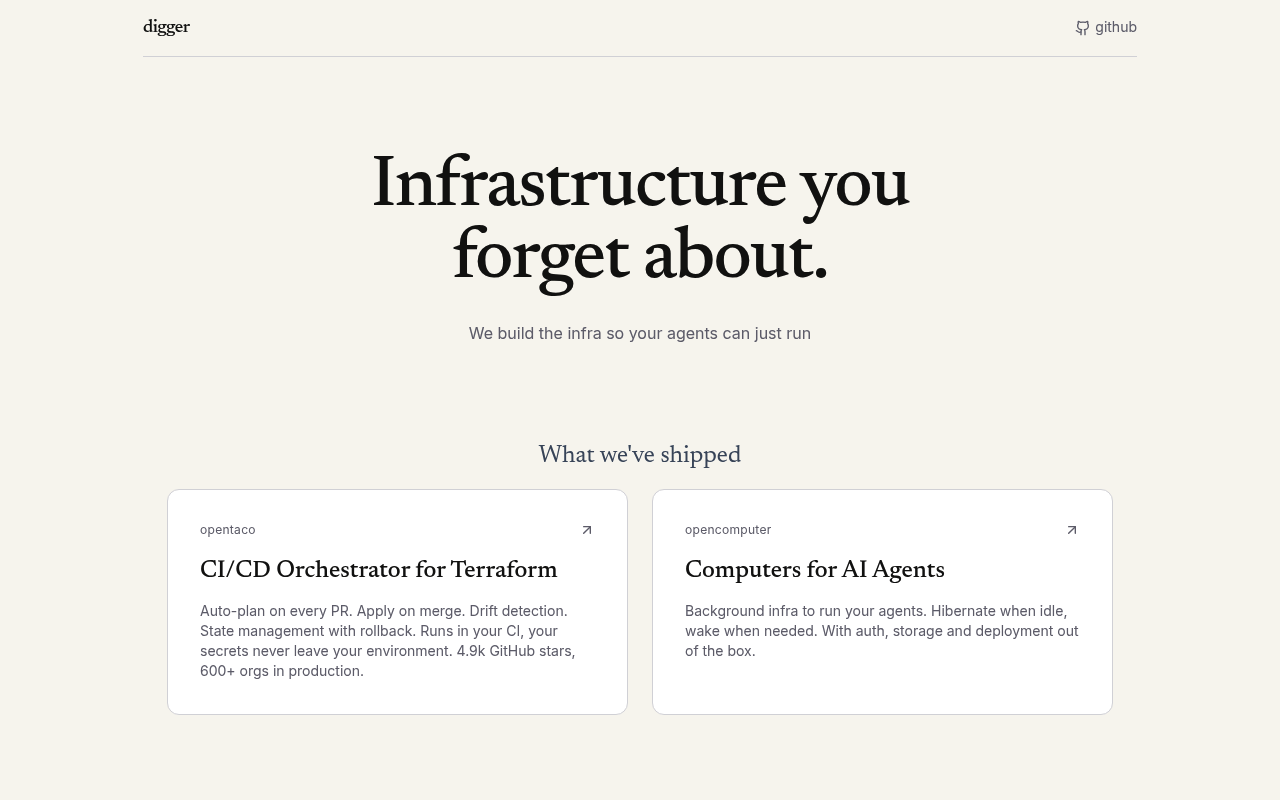
Digger (diggerhq), backed by Initialized Capital, builds developer infrastructure across two open-source-rooted product lines. OpenTaco (formerly the Digger CE project) is an Infrastructure-as-Code orchestration and Terraform/OpenTofu state-management platform that runs plan/apply inside your existing CI pipeline, with PR automation, PR-level locks, drift detection and remediation, RBAC via Open Policy Agent, and FIPS 140 support; it is self-hostable via Docker Compose, Railway, and Kubernetes. OpenComputer is the company's flagship agent-infrastructure product: persistent, long-running cloud VMs for AI agents — real Linux machines that hibernate when idle and wake in seconds, with checkpoints, preview URLs, per-tenant package control, a REST API, TypeScript and Python SDKs, the oc CLI, durable agent sessions, and signed, retriable webhooks for sandbox lifecycle events.
Digger is listed with 1 API on the APIs.io network. Tagged areas include Company, AI Agents, Cloud Sandbox, Compute, and Infrastructure as Code.
The Digger catalog on APIs.io includes 1 event-driven AsyncAPI specification.
Digger’s developer surface includes documentation, API reference, getting-started guide, engineering blog, pricing, signup flow, support, and 14 more developer resources.
Kin Score
 Kin Score
How this is scored →
Kin Score
How this is scored →scored 2026-10-17 · rubric v0.24.0
APIs 1
Individual APIs this provider publishes, each with its own machine-readable definition.
OpenComputer API
REST API for OpenComputer — create and manage persistent cloud sandbox VMs, run commands and files inside them, checkpoint/fork, expose preview URLs, run durable agent sessions,...
Event Specifications 1
AsyncAPI definitions for this provider's event-driven and streaming APIs.
Digger Opencomputer Webhooks
ASYNCAPISecurity Posture 2
Authentication, domain security, vulnerability disclosure, and trust-center signals.
Resources
Get Started 2
Portal, sign-up, and the first successful call
Documentation 2
Reference material describing how the API behaves
Agent Surfaces 1
MCP servers, agent skills, and machine-readable catalogs
Design & Contract 4
Pagination, idempotency, versioning, errors, and events
Build 4
SDKs, sample code, and the tooling you integrate with
Access & Security 3
Authentication, authorization, and security posture
Operate 2
Status, limits, changes, and where to get help
Commercial 1
Pricing, plans, and the legal terms of use
Company 2
The organization behind the API
Source (apis.yml)
Work with this as data
Every provider here is available over the APIs.io API and to AI agents over MCP.