Demodesk
Demodesk is an AI Sales Agent platform for B2B revenue teams, founded in 2018 in Munich, Germany. Four AI agents (Assistant, Coach, Analyst, CRM Concierge) plus a custom AI Agent Builder record and transcribe sales conversations, generate summaries and scorecards, update CRMs (Salesforce, HubSpot, Pipedrive), coach reps, and flag at-risk deals. The company exposes a public REST API (v2, OpenAPI 3.1) for recordings, transcripts, AI summaries, scorecards, and users, authenticated with Bearer API keys, plus a webhook event surface for meeting and recording lifecycle events and an official hosted MCP server (OAuth2) at demodesk.com/mcp. GDPR-native with EU-only data residency (Azure Frankfurt) and ISO 27001:2022 certification.
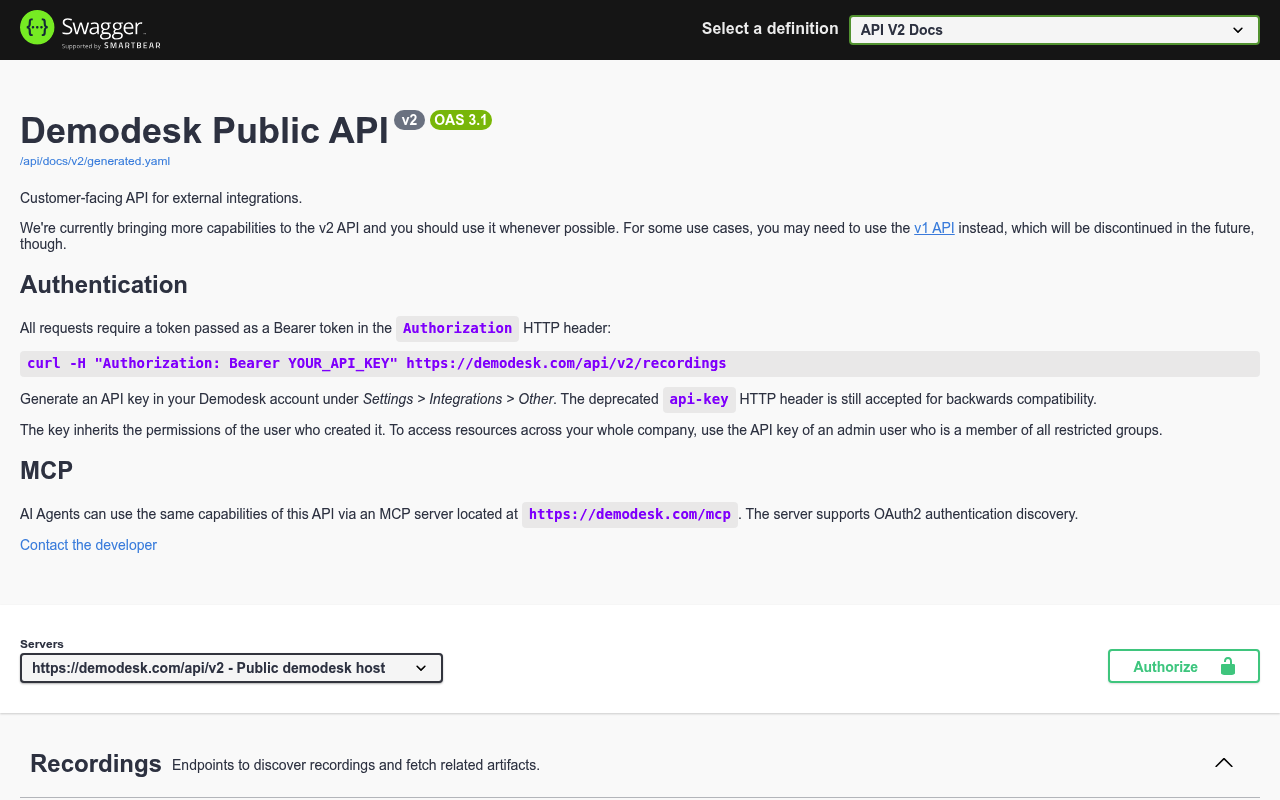
Demodesk publishes 4 API contracts indexed on the APIs.io network, including Externally recorded demos API, Recordings API, Users API, and 1 more. Tagged areas include Company, Sales, Artificial Intelligence, Conversation Intelligence, and Video Conferencing.
The Demodesk catalog on APIs.io includes 1 event-driven AsyncAPI specification.
Demodesk’s developer surface includes documentation, API reference, support, engineering blog, pricing, signup flow, authentication, and 27 more developer resources.
Kin Score
 Kin Score
How this is scored →
Kin Score
How this is scored →scored 2026-10-17 · rubric v0.24.0
APIs 4
Individual APIs this provider publishes, each with its own machine-readable definition.
Demodesk Externally recorded demos API
The Externally recorded demos API from Demodesk — 3 operation(s) for externally recorded demos.
Demodesk Recordings API
Endpoints to discover recordings and fetch related artifacts.
Demodesk Users API
Endpoints regarding user management.
Demodesk Public API
The Demodesk Public API API from Demodesk — 0 operation(s) for demodesk public api.
Open Collections 4
Open, tool-agnostic API collections (OpenAPI-derived and Bruno).
API Collection
OPEN COLLECTIONAPI V1 Externally recorded demos API
OPEN COLLECTIONAPI V1 Externally recorded demos Recordings API
OPEN COLLECTIONAPI V1 Externally recorded demos Users API
OPEN COLLECTIONMCP Servers 1
Model Context Protocol servers that expose these APIs to AI agents.
Demodesk MCP Server
Official hosted, read-only MCP server. Exposes Demodesk meeting recordings, transcripts, AI summaries and coaching scorecards to any MCP client. The company runs a dedicated mic...
MCP SERVERPricing Plans 1
Published pricing tiers and plan structures.
Rate Limits 1
Documented rate limits and quota policies.
Demodesk Rate Limits
RATE LIMITSEvent Specifications 1
AsyncAPI definitions for this provider's event-driven and streaming APIs.
OpenAPI Overlays 2
Overlays applied on top of this provider's contracts. Each card says who wrote it: a document the provider publishes, or one API Evangelist derived or generated.
Demodesk V1 Overlay
UNRECORDEDDemodesk V2 Overlay
UNRECORDEDSecurity Posture 3
Authentication, domain security, vulnerability disclosure, and trust-center signals.
Scopes 1
OAuth scopes governing access to this provider's APIs.
Resources
Get Started 2
Portal, sign-up, and the first successful call
Documentation 2
Reference material describing how the API behaves
Agent Surfaces 5
MCP servers, agent skills, and machine-readable catalogs
Design & Contract 4
Pagination, idempotency, versioning, errors, and events
Build 3
SDKs, sample code, and the tooling you integrate with
Access & Security 5
Authentication, authorization, and security posture
Operate 5
Status, limits, changes, and where to get help
Commercial 4
Pricing, plans, and the legal terms of use
Company 2
The organization behind the API
Other 2
Properties that don't map to a standard resource type
Source (apis.yml)
Work with this as data
Every provider here is available over the APIs.io API and to AI agents over MCP.