DataRobot
DataRobot is an enterprise AI platform for building, deploying, governing, and monitoring predictive and generative AI models and agentic workflows. It exposes a public REST API (v2), first-party Python and R clients, a `dr` command-line tool, and an MCP surface (Global MCP plus deployable standalone servers) that lets agentic coding environments call DataRobot tools and resources. Developers authenticate with personal API keys (bearer tokens) against regional endpoints (US/EU/JP), while OAuth 2.0 / OIDC via app.datarobot.com backs agent and integration auth. The platform covers AutoML, MLOps deployment and monitoring, model governance and compliance documentation, and code-first GenAI/agent development. Surfaced as a portfolio company of Norwest Venture Partners, Sapphire Ventures, and Techstars, and enriched by the API Evangelist pipeline.
DataRobot is listed with 12 APIs on the APIs.io network, including DataRobot API, Datarobot Oss API, Homebrew API, and 9 more. Tagged areas include Company, Artificial Intelligence, Machine Learning, MLOps, and Data Science.
The DataRobot catalog on APIs.io includes 1 JSON-LD context and 1 Spectral governance ruleset.
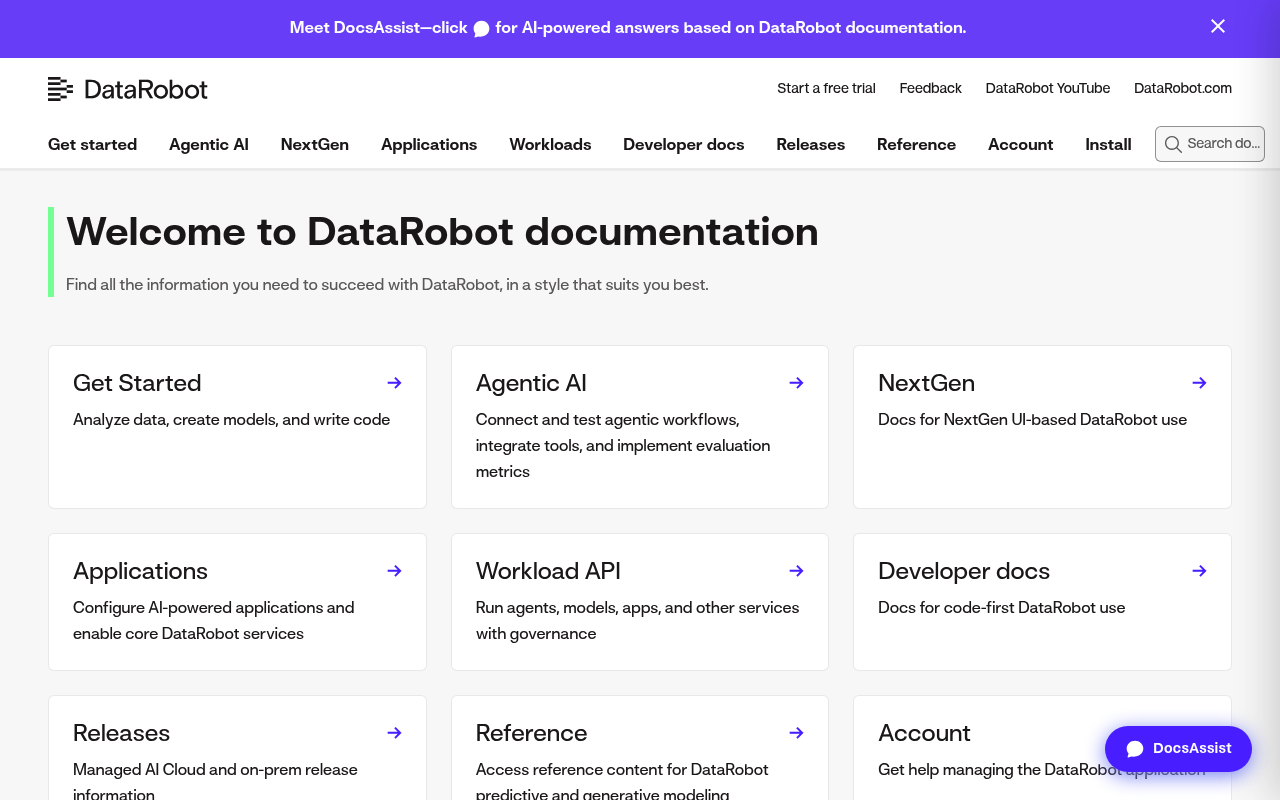
DataRobot’s developer surface includes documentation, API reference, getting-started guide, support, engineering blog, pricing, changelog, and 31 more developer resources.
Kin Score
 Kin Score
How this is scored →
Kin Score
How this is scored →scored 2026-10-09 · rubric v0.23.0
APIs 12
Individual APIs this provider publishes, each with its own machine-readable definition.
DataRobot REST API v2
DataRobot's public REST API (v2) for projects, modeling, predictions, deployments, MLOps monitoring, governance, and agentic workflows. Personal API keys are sent as bearer toke...
DataRobot DataRobot API
The DataRobot API API from DataRobot — 2 operation(s) for datarobot api.
DataRobot Datarobot Oss API
The Datarobot Oss API from DataRobot — 2 operation(s) for datarobot oss.
DataRobot Homebrew API
The Homebrew API from DataRobot — 1 operation(s) for homebrew.
DataRobot Info API
The Info API from DataRobot — 1 operation(s) for info.
DataRobot Install API
The Install API from DataRobot — 2 operation(s) for install.
DataRobot MCP API
The Mcp API from DataRobot — 1 operation(s) for mcp.
DataRobot Memory API
The Memory API from DataRobot — 1 operation(s) for memory.
DataRobot Oauth2 API
The Oauth2 API from DataRobot — 2 operation(s) for oauth2.
DataRobot Projects API
The Projects API from DataRobot — 1 operation(s) for projects.
DataRobot Registereddeployments API
The Registereddeployments API from DataRobot — 2 operation(s) for registereddeployments.
DataRobot Uv API
The Uv API from DataRobot — 1 operation(s) for uv.
Scroll for all 12
Semantic Vocabularies 1
JSON-LD contexts and semantic vocabularies used across these APIs.
Datarobot Context
JSON-LDSpectral Rules 1
Spectral governance rulesets for linting and validating these APIs.
DataRobot API Rules
SPECTRALJSON Schema 6
Standalone JSON Schema definitions for this provider's data models.
GetRegistereddeploymentsResponse
JSON SCHEMAPostApiV2ProjectsRequest
JSON SCHEMAPostApiV2ProjectsResponse
JSON SCHEMAPostOauth2TokenRequest
JSON SCHEMAPostOauth2TokenResponse
JSON SCHEMASecurity Posture 3
Authentication, domain security, vulnerability disclosure, and trust-center signals.
Scopes 1
OAuth scopes governing access to this provider's APIs.
Resources
Get Started 2
Portal, sign-up, and the first successful call
Documentation 2
Reference material describing how the API behaves
Agent Surfaces 4
MCP servers, agent skills, and machine-readable catalogs
Design & Contract 7
Pagination, idempotency, versioning, errors, and events
Scroll for all 7
Build 4
SDKs, sample code, and the tooling you integrate with
Access & Security 6
Authentication, authorization, and security posture
Operate 4
Status, limits, changes, and where to get help
Commercial 3
Pricing, plans, and the legal terms of use
Company 3
The organization behind the API
Other 3
Properties that don't map to a standard resource type
Source (apis.yml)
Work with this as data
Every provider here is available over the APIs.io API and to AI agents over MCP.