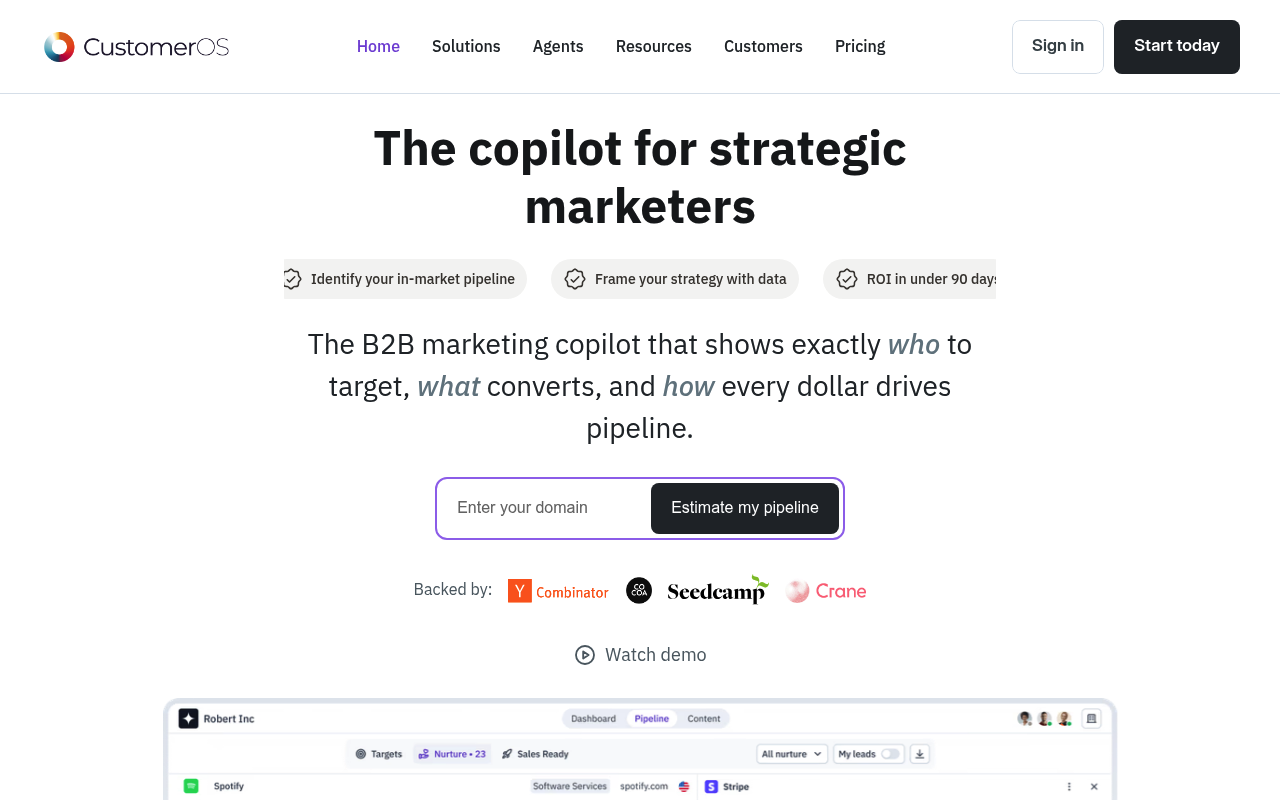
CustomerOS
CustomerOS (formerly Openline) is a London-based revenue-intelligence platform for B2B go-to-market teams. It identifies anonymous website visitors, scores them against an ideal customer profile, infers buying stage from page engagement, and attributes content and ad spend to real pipeline. The developer surface spans a first-party JavaScript website tracker installed behind a customer-owned reverse-proxy CNAME, a set of key-authenticated REST APIs published as OpenAPI in the company monorepo (CustomerBASE contacts and organizations, person and organization enrichment, email verification and IP intelligence, Mailstack sending domains and mailboxes, billing invoices, outreach tracking), a 34-operation Flow API for outbound sequencing, and the open-source customer-os-api GraphQL server that predates the pivot. CustomerOS also runs a live anonymous MCP server and serves an A2A agent card from its documentation host.
CustomerOS publishes 11 API contracts indexed on the APIs.io network, including Billing API, CustomerBASE API, Domains API, and 8 more. Tagged areas include CRM, Revenue, Go-To-Market, Lead Intelligence, and Visitor Identification.
CustomerOS’s developer surface includes documentation, getting-started guide, engineering blog, pricing, changelog, authentication, support, and 38 more developer resources.
What this lets a business do 1
Business capabilities this provider's published APIs can perform, derived from its own contracts. Browse all capabilities →
Kin Score
 Kin Score
How this is scored →
Kin Score
How this is scored →scored 2026-10-17 · rubric v0.24.0
Standards implemented 1
Standards this provider implements or carries. De facto ones are profiled and measured by the API Commons; formal ones come from the standards directory and are linked by the provider's own tags. The evidence column says how each claim was established — not that it was made.
APIs 11
Individual APIs this provider publishes, each with its own machine-readable definition.
CustomerOS Website Tracker
Client-side JavaScript tracker that captures page views and custom events, exposes window.cos.identify() for attaching identity and properties, and matches visitor IPs to compan...
CustomerOS Billing API
The Billing API API from CustomerOS — 1 operation(s) for billing api.
CustomerOS CustomerBASE API
The CustomerBASE API API from CustomerOS — 6 operation(s) for customerbase api.
CustomerOS Domains API
The Domains API from CustomerOS — 2 operation(s) for domains.
CustomerOS Email Verification API
The Email Verification API from CustomerOS — 4 operation(s) for email verification.
CustomerOS Enrichment API
The Enrichment API API from CustomerOS — 3 operation(s) for enrichment api.
CustomerOS Flows API
The Flows API from CustomerOS — 18 operation(s) for flows.
CustomerOS IP Intelligence API
The IP Intelligence API from CustomerOS — 1 operation(s) for ip intelligence.
CustomerOS Mailboxes API
The Mailboxes API from CustomerOS — 1 operation(s) for mailboxes.
CustomerOS Outreach API
The Outreach API from CustomerOS — 1 operation(s) for outreach.
CustomerOS Graph QL API
Single GraphQL endpoint for all CustomerOS operations.
Scroll for all 11
Open Collections 10
Open, tool-agnostic API collections (OpenAPI-derived and Bruno).
API Collection
OPEN COLLECTIONCustomerOS API
OPEN COLLECTIONCustomerOS API
OPEN COLLECTIONCustomerOS API
OPEN COLLECTIONCustomerOS API
OPEN COLLECTIONCustomerOS API
OPEN COLLECTIONCustomerOS GraphQL API
OPEN COLLECTIONCustomerOS API
OPEN COLLECTIONCustomerOS API
OPEN COLLECTIONCustomerOS GraphQL API
OPEN COLLECTIONScroll for all 10
MCP Servers 1
Model Context Protocol servers that expose these APIs to AI agents.
CustomerOS MCP Server
CustomerOS runs a live, anonymous, remote MCP server on its documentation host. It is a DOCUMENTATION server (search + a read-only virtual filesystem over the docs pages and the...
MCP SERVERGraphQL 1
GraphQL schemas published by this provider.
CustomerOS GraphQL Schema
Representative GraphQL schema for the [CustomerOS](https://customeros.ai/) (formerly Openline)
GRAPHQLPricing Plans 1
Published pricing tiers and plan structures.
Rate Limits 1
Documented rate limits and quota policies.
Customeros Rate Limits
RATE LIMITSFinOps 1
Cost, billing, and metering signals for API financial operations.
Customeros Finops
FINOPSOpenAPI Overlays 8
Overlays applied on top of this provider's contracts. Each card says who wrote it: a document the provider publishes, or one API Evangelist derived or generated.
Customeros Billing Overlay
PUBLISHED BY PROVIDERCustomeros Customerbase Overlay
PUBLISHED BY PROVIDERCustomeros Domains Overlay
PUBLISHED BY PROVIDERCustomeros Enrich Overlay
PUBLISHED BY PROVIDERCustomeros Flow Api Overlay
PUBLISHED BY PROVIDERCustomeros Graphql Api Overlay
PUBLISHED BY PROVIDERCustomeros Outreach Overlay
PUBLISHED BY PROVIDERCustomeros Verify Overlay
PUBLISHED BY PROVIDERScroll for all 8
Security Posture 3
Authentication, domain security, vulnerability disclosure, and trust-center signals.
Agentic Access 1
Recommended x-agentic-access execution contracts for AI agents.
Resources
Get Started 2
Portal, sign-up, and the first successful call
Documentation 1
Reference material describing how the API behaves
Agent Surfaces 5
MCP servers, agent skills, and machine-readable catalogs
Design & Contract 6
Pagination, idempotency, versioning, errors, and events
Build 3
SDKs, sample code, and the tooling you integrate with
Access & Security 4
Authentication, authorization, and security posture
Operate 5
Status, limits, changes, and where to get help
Commercial 5
Pricing, plans, and the legal terms of use
Company 3
The organization behind the API
Other 11
Properties that don't map to a standard resource type
Scroll for all 11
Source (apis.yml)
Work with this as data
Every provider here is available over the APIs.io API and to AI agents over MCP.