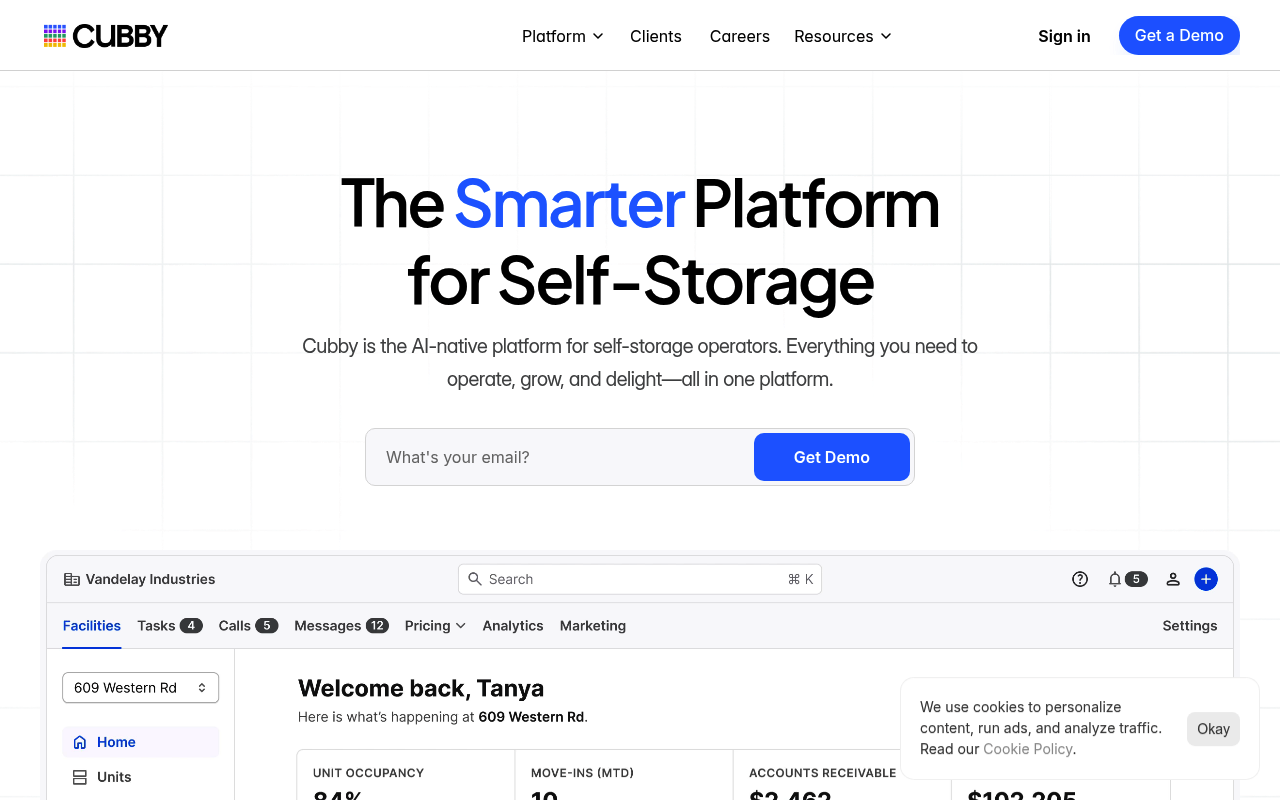
Cubby is a New York City based software company building an AI-native facility management platform for self-storage operators, replacing legacy FMS systems with facility operations, tenant management, revenue management, e-commerce storefronts, embedded payment processing and AI-driven tenant communications. Cubby publishes a public developer documentation site covering a JSON HTTP Operator API of roughly 70 action-oriented endpoints across facilities, units, leases, customers, leads, payments, coverage, auctions and reporting, a BigQuery analytics data warehouse, Make.com outbound webhooks, embeddable Lit storefront web components, and an OAuth-protected Model Context Protocol server. The company was founded in 2022 by Matt Engfer and Adam Fleming and raised a $63M Series A led by Growth Equity at Goldman Sachs Alternatives in January 2026.
Cubby is listed with 3 APIs on the APIs.io network. Tagged areas include Company, Self Storage, Property Management, Facility Management, and Real Estate.
The Cubby catalog on APIs.io includes 1 event-driven AsyncAPI specification.
Cubby’s developer surface includes documentation, API reference, engineering blog, support, signup flow, authentication, changelog, and 23 more developer resources.
40.7/100developing▬ flatAgent51/100agent readyFront door AI5/6
prominent
Heartbeat93/100
alive
saas
Full breakdown ↓
scored 2026-11-06 · rubric v0.27.0 · Show this score on your site →
Regulatory Posture applies to this provider. Its tags matched the
Payments regime, so
Regulatory Posture carries 15 points of the composite.
If this regime is wrong for your business, say so on your
provider repo — the
applicability map is public and we will correct it.
Create-or-Update Ergonomics could not be measured. We hold no machine-readable contract for
this provider to read, so there is nothing to measure a write surface against. Excluded rather than scored zero:
never-measured and measured-empty are different facts. Publishing an OpenAPI is what makes this facet — and
several others — scorable at all.
The six quality facets above are damped to 85 points between them,
because the conditional facet above carries the other
15. That is why each facet's contribution is shown against a damped
maximum: raising a quality facet moves the composite by 85% of its nominal
weight, not 100%. The full arithmetic is at apis.io/rating/.
Show this score on your site.
It updates itself when the score changes. Paste this where you link to your API docs:
<a href="https://apis.io/providers/cubby/"><img src="https://apis.io/badge/cubby/card.svg" alt="Cubby on APIs.io — Kin Score by API Evangelist"></a>
Other styles, a README pill and a shields.io endpoint are on the badge page.
Raise your score.
Agent readiness — checks not met, largest first (exact, from this profile):
Idempotency+9 pts — OpenAPI mutating operations declare an idempotency key — a header, a request-body property, or a named de-duplication token whose own description says so (verified); else common[].type matches /idempoten/i (documented)
A2A Agent Card+8 pts — a2a/-a2a.yml manifest, graded on conformance.grade against A2A 1.0.0
Documented Reversibility+6 pts — a reversal operation in the contract, graded up when a window is documented too
Agent Skills+5 pts — skills artifact present, graded by who authored it
Agentic Commerce Well-Known Document+5 pts — a parsing /.well-known/ucp.json or acp.json declaring a version and at least one service, OR (0.27) a live x402 payment challenge from _data/x402-adoption.json — `self` when its endpoints are on the provider's own domain, `platform` when they are on a vendor's
3 more unmet checks in the Agent Readiness table above.
Kin Score — facets with the most composite points still available (weight × headroom):
Access Clarityscores 21.1 — up to +15.8 composite points
Standards this provider implements or carries. De facto ones are profiled and measured by the API Commons; formal ones come from the standards directory and are linked by the provider's own tags. The evidence column says how each claim was established — not that it was made.
The Cubby Operator API is a JSON HTTP API — explicitly not RESTful — oriented around actions performed on system entities rather than transfer of state. Roughly 70 POST endpoint...
The Cubby Storefront API is the public, unauthenticated-tenant-facing slice of the Cubby platform used to power online rental storefronts — facility search and pricing-group sea...
Cubby operates a hosted Model Context Protocol server at api.cubbystorage.com/mcp. The endpoint is live and OAuth-protected: an unauthenticated JSON-RPC tools/list call returns ...
Cubby operates a hosted, remote Model Context Protocol server on its production API host. The endpoint is live and OAuth-protected. An anonymous JSON-RPC tools/list call returns...
aid: cubby
name: Cubby
description: Cubby is a New York City based software company building an AI-native facility management platform for self-storage
operators, replacing legacy FMS systems with facility operations, tenant management, revenue management, e-commerce storefronts,
embedded payment processing and AI-driven tenant communications. Cubby publishes a public developer documentation site covering
a JSON HTTP Operator API of roughly 70 action-oriented endpoints across facilities, units, leases, customers, leads, payments,
coverage, auctions and reporting, a BigQuery analytics data warehouse, Make.com outbound webhooks, embeddable Lit storefront
web components, and an OAuth-protected Model Context Protocol server. The company was founded in 2022 by Matt Engfer and
Adam Fleming and raised a $63M Series A led by Growth Equity at Goldman Sachs Alternatives in January 2026.
deliveryModel:
model: saas
open_source: false
commercial: true
callable_host: false
label: Hosted service · you call their endpoint
confidence: medium
source:
- pricing
generated: '2026-08-28'
method: derived
accessModel:
pricing: unknown
onboarding: unknown
trial: false
try_now: false
public: false
label: Unknown
confidence: low
source:
- authentication
- scopes
- rate-limits
- security
generated: '2026-11-06'
method: derived
image: https://www.cubbystorage.com/og-logo.png
url: https://raw.githubusercontent.com/api-evangelist/cubby/refs/heads/main/apis.yml
x-type: company
x-source: harvest:secondary-market
specificationVersion: '0.23'
created: '2026-08-11'
modified: '2026-08-11'
tags:
- Company
- Self Storage
- Property Management
- Facility Management
- Real Estate
- Payments
- Software-as-a-Service
- Artificial Intelligence
- Revenue Management
- E-Commerce
tags_raw:
- Company
- Self Storage
- Property Management
- Facility Management
- Real Estate
- Payments
- SaaS
- Artificial Intelligence
- Revenue Management
- E-Commerce
- Real-Estate
apis:
- name: Cubby Operator API
description: The Cubby Operator API is a JSON HTTP API — explicitly not RESTful — oriented around actions performed on system
entities rather than transfer of state. Roughly 70 POST endpoints cover access codes, locks, organizations, managers,
facilities, facility groups, units, pricing groups, customers, leads, leases, payment methods, ledgers, coverage, payments,
auctions, notes, tasks, reports, storefront search, messaging and checkout. Responses are wrapped in a {status, data}
envelope, money is expressed as integer cents, timestamps are ISO-8601 with facility-local or UTC semantics, and related
entities are retrieved through explicit expansions.
humanURL: https://cubbystorage.github.io/docs/api/
baseURL: https://api.cubbystorage.com/v1
tags:
- Self Storage
- Facility Management
- Leases
- Payments
- Property Management
properties:
- type: Documentation
url: https://cubbystorage.github.io/docs/api/
- type: APIReference
url: https://cubbystorage.github.io/docs/api/
- type: Authentication
url: authentication/cubby-authentication.yml
- type: ErrorCatalog
url: errors/cubby-problem-types.yml
- type: Conventions
url: conventions/cubby-conventions.yml
- type: DataModel
url: data-model/cubby-data-model.yml
- type: Examples
url: examples/cubby-examples.yml
- name: Cubby Storefront API
description: The Cubby Storefront API is the public, unauthenticated-tenant-facing slice of the Cubby platform used to power
online rental storefronts — facility search and pricing-group search — and is the same API key surface consumed by the
Cubby storefront web components and the embeddable checkout flow.
humanURL: https://cubbystorage.github.io/docs/api/#storefront-2
baseURL: https://api.cubbystorage.com/v1/storefront
tags:
- E-Commerce
- Self Storage
- Checkout
properties:
- type: Documentation
url: https://cubbystorage.github.io/docs/api/#storefront-2
- type: Components
url: components/cubby-components.yml
- name: Cubby MCP Server
description: 'Cubby operates a hosted Model Context Protocol server at api.cubbystorage.com/mcp. The endpoint is live and
OAuth-protected: an unauthenticated JSON-RPC tools/list call returns HTTP 401 with a WWW-Authenticate Bearer challenge
pointing at the RFC 9728 protected-resource metadata document. The authorization server metadata advertises authorization-code
and refresh-token grants, PKCE S256, dynamic client registration and a single `mcp` scope.'
humanURL: https://api.cubbystorage.com/.well-known/oauth-protected-resource
baseURL: https://api.cubbystorage.com/mcp
tags:
- MCP
- Artificial Intelligence
- Agents
properties:
- type: MCPServer
url: mcp/cubby-mcp.yml
- type: OAuthScopes
url: scopes/cubby-scopes.yml
maintainers:
- FN: Kin Lane
email: kin@apievangelist.com
- FN: APIs.json
email: info@apis.io
common:
- type: DomainSecurity
url: security/cubby-domain-security.yml
- type: Website
url: https://www.cubbystorage.com/
- type: DeveloperPortal
url: https://cubbystorage.github.io/docs/
- type: Documentation
url: https://cubbystorage.github.io/docs/
- type: APIReference
url: https://cubbystorage.github.io/docs/api/
- type: GitHubOrganization
url: https://github.com/cubbystorage
- type: Blog
url: https://www.cubbystorage.com/blog
- type: Support
url: https://help.cubbystorage.com/en/
- type: SignUp
url: https://app.cubbystorage.com/signin
- type: TermsOfService
url: https://www.cubbystorage.com/api-terms-of-service
- type: PrivacyPolicy
url: https://www.cubbystorage.com/privacy-policy
- type: Authentication
url: authentication/cubby-authentication.yml
- type: OAuthScopes
url: scopes/cubby-scopes.yml
- type: MCPServer
url: mcp/cubby-mcp.yml
- type: WellKnown
url: well-known/cubby-well-known.yml
- type: LLMsTxt
url: llms/cubby-llms.txt
- type: Webhooks
url: asyncapi/cubby-webhooks.yml
- type: ChangeLog
url: changelog/cubby-changelog.yml
- type: Lifecycle
url: lifecycle/cubby-lifecycle.yml
- type: Deprecation
url: lifecycle/cubby-lifecycle.yml
- type: ErrorCatalog
url: errors/cubby-problem-types.yml
- type: DeclineCodes
url: errors/cubby-decline-codes.yml
- type: Conventions
url: conventions/cubby-conventions.yml
- type: DataModel
url: data-model/cubby-data-model.yml
- type: Conformance
url: conformance/cubby-conformance.yml
- type: Packages
url: packages/cubby-packages.yml
- type: Components
url: components/cubby-components.yml
- type: Examples
url: examples/cubby-examples.yml
- type: Plans
url: plans/cubby-plans-pricing.yml
- type: RateLimits
url: rate-limits/cubby-rate-limits.yml
x-enrichment:
date: '2026-08-11'
status: enriched
artifacts_added: 18
pass: local-v1
Cubby API — frequently asked questions
Does Cubby have an API?
Yes. APIs.io lists 3 APIs from Cubby, including Cubby Operator API, Cubby Storefront API and Cubby MCP Server.
How do I authenticate with the Cubby API?
Cubby documents its authentication (2 schemes). The details are profiled on APIs.io as Cubby Authentication.
Does Cubby have an MCP server?
Yes. APIs.io lists 1 MCP server for Cubby: Cubby operates a hosted, remote Model Context Protocol server on its production API host. The endpoint is live and OAuth-protected. An anonymous JSON-RPC tools/list call returns HTTP 401 with a WWW-Au
Is the Cubby API ready for AI agents?
Cubby has a Kin Score of 40.7 out of 100 (developing) and an Agent Readiness score of 51.3 (agent-ready), scored by API Evangelist on 2026-11-06.
Calls without X-API-Key need no key. Calls with it need a paid plan — get a key.
Get an API key
Free tier, no form to fill in. Signing in shares your email address with us — we
store it to create your key and to recognise you if you sign in with another
provider. See our Privacy Policy and
Terms.