
Carepatron
Carepatron is a cloud-based healthcare practice management and EHR platform for therapists, counselors, psychologists, health coaches, nutritionists, and other practitioners. It brings client records, appointment scheduling and online booking, telehealth, AI-assisted clinical notes and documentation, and billing/invoicing with insurance claims into one workspace, and markets HIPAA/SOC/GDPR compliance across 100,000+ clinicians in 120+ countries. As of this review Carepatron does NOT publish a documented public developer API - its pricing page lists "API (coming soon)" on the Advanced plan, and there is no developer portal, API reference, published base URL, OpenAPI definition, or SDK. Third-party connectivity today is limited to a handful of native integrations (Zoom, accounting software, Google Tag Manager). The APIs listed below are logical/product-area groupings modeled from Carepatron's own feature set; their endpoints are NOT documented and are marked as modeled, not confirmed.
Carepatron publishes no API. The 3 entries listed on the APIs.io network are product areas recorded for completeness, each marked as not an API. Tagged areas include Healthcare, Practice Management, Electronic Health Records, Therapy, and Telehealth.
Carepatron’s developer surface includes engineering blog, documentation, pricing, and 6 more developer resources.
Kin Score
 Kin Score
How this is scored →
Kin Score
How this is scored →scored 2026-10-23 · rubric v0.25.0
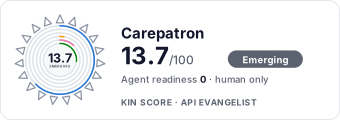 It updates itself when the score changes. Paste this where you link to your API docs:
<a href="https://apis.io/providers/carepatron/"><img src="https://apis.io/badge/carepatron/card.svg" alt="Carepatron on APIs.io — Kin Score by API Evangelist"></a>Other styles, a README pill and a shields.io endpoint are on the badge page.
Markets this provider is in provisional
The Kin Score Market layer reads a provider inside its market: its position, and how deep its integrations go. Depth is only comparable within a position. Provisional and unweighted: not part of the Kin Score or agent readiness.
| Market | Position | Depth | Registered MCP server | Declares compatibility |
|---|---|---|---|---|
| Stripe App Marketplace and Partner Ecosystem (builders on Stripe) | undeclared | - | - | - |
| Zoom App Marketplace and Partner Ecosystem (builders and partners on Zoom) | undeclared | - | - | - |
Registered MCP server and declares compatibility are report only — not weighted. Undeclared means we found nothing we can read, so there is no number: we never infer integrations.
APIs 3
This provider publishes no API. The entries below are product areas listed for completeness. Each one is marked NOT AN API and is not counted.
Carepatron Clients API (Modeled)
Modeled product-area API for client/patient records - the people a practice serves, their demographics, contact details, and intake information. endpointsModeled: true. Carepatr...
NOT AN APICarepatron Notes and Documentation API (Modeled)
Modeled product-area API for clinical notes, forms, intakes, templates, and AI-assisted documentation (the AI scribe / note taker). endpointsModeled: true. Carepatron does not p...
NOT AN APICarepatron Billing API (Modeled)
Modeled product-area API for billing - invoices, payments, and insurance claim management. endpointsModeled: true. Carepatron does not publish a developer API for this surface; ...
NOT AN APIPricing Plans 1
Published pricing tiers and plan structures.
Security Posture 2
Authentication, domain security, vulnerability disclosure, and trust-center signals.
Resources
Documentation 1
Reference material describing how the API behaves
Build 1
SDKs, sample code, and the tooling you integrate with
Access & Security 2
Authentication, authorization, and security posture
Commercial 2
Pricing, plans, and the legal terms of use
Company 3
The organization behind the API
Source (apis.yml)
Work with this as data
Every provider here is available over the APIs.io API and to AI agents over MCP.