
Blink Charging
Blink Charging Co. (Nasdaq BLNK) operates the Blink Network of Level 2 and DC Fast electric vehicle chargers across North America and Europe, alongside brands acquired via SemaConnect, Blue Corner, BlueLA, and Envoy. Blink's charger hardware (Series 7/8/9) is OCPP 2.0.1 certified for CSMS interoperability, and in 2025 Blink joined Hubject's Intercharge eRoaming platform as a charge point operator using the OCPI protocol so third-party e-mobility service providers can route drivers and billing to Blink stations. Blink also runs a gated BlinkMap API developer program (station locations, hours, and live network status) and a Blink Fleet platform that partners such as Presto and BetterFleet integrate with via API for fleet charging, sessions, and billing. None of these programs currently publish a full public self-serve API reference; access requires signing up directly with Blink.
Blink Charging publishes 3 API contracts indexed on the APIs.io network: Locations API, Search API, and Status API. Tagged areas include EV Charging, Electric Vehicles, Charging Stations, OCPI, and OCPP.
Blink Charging’s developer surface includes authentication, documentation, product news, engineering blog, and 6 more developer resources.
Kin Score
 Kin Score
How this is scored →
Kin Score
How this is scored →scored 2026-10-23 · rubric v0.25.0
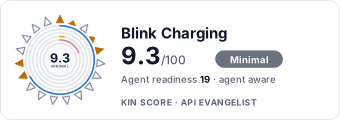 It updates itself when the score changes. Paste this where you link to your API docs:
<a href="https://apis.io/providers/blink/"><img src="https://apis.io/badge/blink/card.svg" alt="Blink Charging on APIs.io — Kin Score by API Evangelist"></a>Other styles, a README pill and a shields.io endpoint are on the badge page.
Markets this provider is in provisional
The Kin Score Market layer reads a provider inside its market: its position, and how deep its integrations go. Depth is only comparable within a position. Provisional and unweighted: not part of the Kin Score or agent readiness.
| Market | Position | Depth | Registered MCP server | Declares compatibility |
|---|---|---|---|---|
| EV Charging (charging, roaming, e-mobility) | undeclared | - | - | - |
| LF Energy Projects and Members (grid, DER, EV charging open source) | undeclared | - | - | - |
Registered MCP server and declares compatibility are report only — not weighted. Undeclared means we found nothing we can read, so there is no number: we never infer integrations.
Standards implemented 2
Standards this provider implements or carries. De facto ones are profiled and measured by the API Commons; formal ones come from the standards directory and are linked by the provider's own tags. The evidence column says how each claim was established — not that it was made.
APIs 3
Individual APIs this provider publishes, each with its own machine-readable definition.
Blink Charging Locations API
Geo-radius search for Blink charging station locations.
Blink Charging Search API
Name-based search for Blink charging station locations.
Blink Charging Status API
Live status lookup for a single Blink charging location.
Open Collections 3
Open, tool-agnostic API collections (OpenAPI-derived and Bruno).
Blink Charging & Status API (BlinkMap API) Locations API
OPEN COLLECTIONBlink Charging & API (BlinkMap API) Locations Status API
OPEN COLLECTIONSecurity Posture 2
Authentication, domain security, vulnerability disclosure, and trust-center signals.
Agentic Access 1
Recommended x-agentic-access execution contracts for AI agents.
Resources
Documentation 1
Reference material describing how the API behaves
Agent Surfaces 1
MCP servers, agent skills, and machine-readable catalogs
Build 1
SDKs, sample code, and the tooling you integrate with
Access & Security 2
Authentication, authorization, and security posture
Company 5
The organization behind the API
Source (apis.yml)
Work with this as data
Every provider here is available over the APIs.io API and to AI agents over MCP.