Azure Service Bus
Azure Service Bus is a fully managed enterprise message broker with message queues and publish-subscribe topics, providing reliable message delivery for decoupling applications and services in cloud and hybrid environments.
Azure Service Bus publishes 6 API contracts indexed on the APIs.io network, including Namespaces API, Queues API, Subscriptions API, and 3 more. Tagged areas include Microsoft Azure, Cloud, Enterprise, Message Broker, and Messaging.
The Azure Service Bus catalog on APIs.io includes 1 event-driven AsyncAPI specification, 1 JSON-LD context, and 3 Spectral governance rulesets.
Azure Service Bus’ developer surface includes support, Stack Overflow tag, authentication, developer portal, documentation, getting-started guide, pricing, and 24 more developer resources.
What this lets a business do 1
Business capabilities this provider's published APIs can perform, derived from its own contracts. Browse all capabilities →
What people ask Azure Service Bus 5
The questions people put to an LLM, and the jobs they hand an agent, that Azure Service Bus's APIs answer — each one linked to the operation that does it. Generated by API Evangelist
Kin Score
 Kin Score
How this is scored →
scored 2026-11-06 · rubric v0.27.0
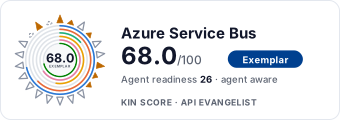 It updates itself when the score changes. Paste this where you link to your API docs:
<a href="https://apis.io/providers/azure-service-bus/"><img src="https://apis.io/badge/azure-service-bus/card.svg" alt="Azure Service Bus on APIs.io — Kin Score by API Evangelist"></a>Other styles, a README pill and a shields.io endpoint are on the badge page.
- MCP Server +12 pts — deployment.mode + probe verdict on the mcp/ manifest, not the pointer; an unprobed slug falls back to authorship
- Idempotency +9 pts — OpenAPI mutating operations declare an idempotency key — a header, a request-body property, or a named de-duplication token whose own description says so (verified); else common[].type matches /idempoten/i (documented)
- Stable Error Semantics +8 pts — OpenAPI $refs a shared error schema across 4xx/5xx responses (verified), else common[].type includes ErrorCatalog / ErrorCodes / DeclineCodes
- A2A Agent Card +8 pts — a2a/
-a2a.yml manifest, graded on conformance.grade against A2A 1.0.0 - Registration Without a Human +6 pts — a `registration_endpoint` in the served RFC 8414 / OIDC discovery document
- Delegated User Identity +6 pts — a served discovery document listing authorization_code in grant_types_supported (served), else an oauth2 authorizationCode flow or openIdConnect declared in an OpenAPI (documented)
- Contract Governance scores 13.6 — up to +10.4 composite points
- Contract Quality scores 62.8 — up to +9.3 composite points
- Developer Ergonomics scores 65.5 — up to +6.9 composite points
Standards implemented 3
Standards this provider implements or carries. De facto ones are profiled and measured by the API Commons; formal ones come from the standards directory and are linked by the provider's own tags. The evidence column says how each claim was established — not that it was made.
APIs 6
Individual APIs this provider publishes, each with its own machine-readable definition.
Azure Service Bus Namespaces API
Service Bus namespace operations
Azure Service Bus Queues API
Service Bus queue operations
Azure Service Bus Subscriptions API
Service Bus topic subscription operations
Azure Service Bus Topics API
Service Bus topic operations
Azure Service Bus Management REST API
The management REST API enables namespace, queue, topic, and subscription configuration through Azure Resource Manager, including SKU, network rules, authorization rules, and di...
Azure Service Bus Messages API
The Messages API from Azure Service Bus — 3 operation(s) for messages.
Postman Collections 4
Ready-to-run Postman collections for exercising this provider's APIs.
Open Collections 5
Open, tool-agnostic API collections (OpenAPI-derived and Bruno).
Azure Service Bus Management Namespaces API
OPEN COLLECTIONAzure Service Bus Management Namespaces Queues API
OPEN COLLECTIONAzure Service Bus Management Namespaces Subscriptions API
OPEN COLLECTIONAzure Service Bus Management Namespaces Topics API
OPEN COLLECTIONAzure Service Bus Management API
OPEN COLLECTIONAzure Service Bus API pricing
Prices published by Azure Service Bus, read 2026-09-20 from azure.microsoft.com/en-us/pricing/details/service-bus/.
| Plan | Price |
|---|---|
| Premium Geo-Replication Zone 1 (North America and Europe) | $0.09/GB |
| Premium Geo-Replication Zone 2 (Asia, Oceania, Middle East, and Africa) | $0.12/GB |
| Premium Geo-Replication Zone 3 (South America) | $0.23/GB |
| Basic Operations | $- per million operations |
| Standard Base charge | $-/hour Includes: First 13M ops/month Included; 1,000 brokered connections |
| Premium Hourly | $-/hour Includes: Operations included up to purchased capacity; brokered connections not charged |
| Hybrid Connection | $- per listener Includes: includes 5 GB of data/month |
| WCF Relay | $- for every 100 relay hours |
Plan details, limits and sources →
Rate limits
- Free Tier Default: 10 requests per minute
- Free Tier Monthly Quota: 1000 requests per month
- Professional Tier Default: 100 requests per minute
Compiled by API Evangelist, not yet checked against Azure Service Bus's documentation. All 5 limits →
Billed by: gb replicated · FinOps profile →
Pricing Plans 1
Published pricing tiers and plan structures.
Rate Limits 1
Documented rate limits and quota policies.
Azure Service Bus Rate Limits
RATE LIMITSService Levels 1
Uptime the provider promises or reports, as SLA4OAI. Read from its own pages; APIs.io runs no monitors.
FinOps 1
Cost, billing, and metering signals for API financial operations.
Azure Service Bus Finops
FINOPSFeatures 6
Notable capabilities this provider offers.
Message Queues
Point-to-point messaging with FIFO delivery, sessions, dead-lettering, and duplicate detection for reliable asynchronous communication.
Publish-Subscribe Topics
One-to-many messaging with topic subscriptions, filters, and actions for event-driven architectures.
Dead-Letter Queue
Automatic routing of undeliverable or failed messages to a secondary queue for inspection and reprocessing.
Scheduled Delivery
Schedule messages for future delivery at a specified time without requiring sender availability.
Transactions
ACID transaction support for grouping multiple operations across queues and topics into atomic units.
Auto-Forwarding
Automatically forward messages from one queue or subscription to another entity for chaining processing stages.
Event Specifications 1
AsyncAPI definitions for this provider's event-driven and streaming APIs.
Azure Service Bus Messaging
Azure Service Bus is a fully managed enterprise message broker with message queues and publish-subscribe topics. This AsyncAPI spec describes the messaging patterns for sending ...
ASYNCAPISemantic Vocabularies 1
JSON-LD contexts and semantic vocabularies used across these APIs.
Azure Service Bus Context
JSON-LDSpectral Rules 3
Spectral governance rulesets for linting and validating these APIs.
Azure Service Bus — asyncapi rules
SPECTRALAzure Service Bus — jsonschema rules
SPECTRALAzure Service Bus API Rules
SPECTRALOpenAPI Overlays 5
Overlays applied on top of this provider's contracts. Each card says who wrote it: a document the provider publishes, or one API Evangelist derived or generated.
JSON Schema 8
Standalone JSON Schema definitions for this provider's data models.
SBNamespaceListResult
JSON SCHEMASBNamespace
JSON SCHEMASBQueueListResult
JSON SCHEMASBQueue
JSON SCHEMASBSubscriptionListResult
JSON SCHEMASBSubscription
JSON SCHEMASBTopicListResult
JSON SCHEMASBTopic
JSON SCHEMAScroll for all 8
JSON Structure 8
JSON Structure definitions describing this provider's data shapes.
Azure Service Bus Sb Namespace List Result Structure
JSON STRUCTUREAzure Service Bus Sb Namespace Structure
JSON STRUCTUREAzure Service Bus Sb Queue List Result Structure
JSON STRUCTUREAzure Service Bus Sb Queue Structure
JSON STRUCTUREAzure Service Bus Sb Subscription List Result Structure
JSON STRUCTUREAzure Service Bus Sb Subscription Structure
JSON STRUCTUREAzure Service Bus Sb Topic List Result Structure
JSON STRUCTUREAzure Service Bus Sb Topic Structure
JSON STRUCTUREScroll for all 8
Examples 8
Example request and response payloads for these APIs.
Scroll for all 8
Security Posture 3
Authentication, domain security, vulnerability disclosure, and trust-center signals.
Scopes 1
OAuth scopes governing access to this provider's APIs.
Agentic Access 1
Recommended x-agentic-access execution contracts for AI agents.
Use Cases 4
What developers build with this provider.
Application Decoupling
Decouple microservices and distributed applications using asynchronous messaging for independent scaling and deployment.
Load Leveling
Buffer incoming requests during traffic spikes to protect backend services from overload.
Event-Driven Architecture
Build event-driven systems using publish-subscribe topics to broadcast events to multiple subscribers.
Workflow Orchestration
Coordinate multi-step business processes using message sessions and scheduled delivery for reliable workflow execution.
Integrations 3
Pre-built integrations with other platforms and tools.
Azure Functions
Trigger serverless functions automatically when messages arrive in queues or topic subscriptions.
Azure Logic Apps
Build automated workflows that send and receive Service Bus messages with no-code connectors.
Azure Event Grid
Route Service Bus events to other Azure services for real-time event processing and monitoring.
Resources
Get Started 2
Portal, sign-up, and the first successful call
Documentation 2
Reference material describing how the API behaves
Agent Surfaces 2
MCP servers, agent skills, and machine-readable catalogs
Build 5
SDKs, sample code, and the tooling you integrate with
Access & Security 5
Authentication, authorization, and security posture
Operate 6
Status, limits, changes, and where to get help
Commercial 6
Pricing, plans, and the legal terms of use
Company 2
The organization behind the API
Other 1
Properties that don't map to a standard resource type
Source (apis.yml)
Azure Service Bus API — frequently asked questions
Does Azure Service Bus have an API?
Yes. APIs.io lists 6 APIs from Azure Service Bus, including Azure Service Bus Namespaces API, Azure Service Bus Queues API and Azure Service Bus Subscriptions API, and 3 more.
Is there an OpenAPI specification for the Azure Service Bus API?
Yes. APIs.io indexes 5 OpenAPI specifications for Azure Service Bus, each linked for download from this page.
How do I authenticate with the Azure Service Bus API?
Azure Service Bus uses bearer-token authentication (oauth2 · 1 scheme). The details are profiled on APIs.io as Azure Service Bus Authentication.
How much does the Azure Service Bus API cost?
Azure Service Bus publishes its prices; its Premium Geo-Replication Zone 1 (North America and Europe) plan is $0.09/GB as of 2026-09-20. APIs.io lists 8 pricing plans for Azure Service Bus, with each plan's price, limits and inclusions under Pricing on this page.
Is the Azure Service Bus API ready for AI agents?
Azure Service Bus has a Kin Score of 68.0 out of 100 (exemplar) and an Agent Readiness score of 25.6 (agent-aware), scored by API Evangelist on 2026-11-06.
Work with this as data
Every provider here is available over the APIs.io API and to AI agents over MCP.