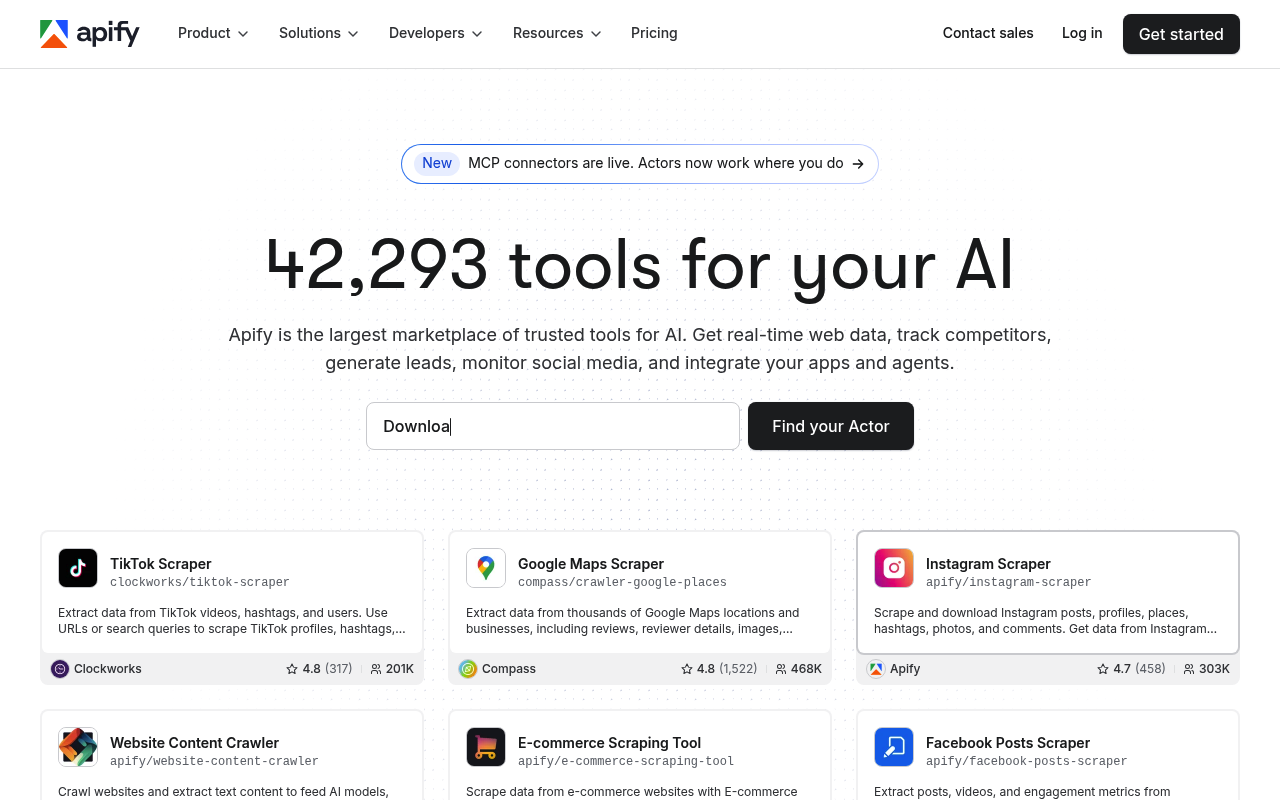
Apify is a full-stack web scraping and browser automation platform that enables developers to build, run, and scale web scrapers, crawlers, and data extraction tools using a cloud-based infrastructure with built-in proxy management, scheduling, and storage. The platform hosts thousands of ready-made Actors for scraping social media, search engines, maps, e-commerce sites, and more.
Apify publishes 42 API contracts indexed on the APIs.io network, including Actor Runs API, Actors API, Datasets API, and 39 more. Tagged areas include Actors, Browser Automation, Crawling, Data Aggregation, and Data Extraction.
The Apify catalog on APIs.io includes 1 JSON-LD context and 3 Spectral governance rulesets.
Apify’s developer surface includes authentication, documentation, getting-started guide, pricing, engineering blog, signup flow, academy / training, and 18 more developer resources.
48.0/100developing▬ flatAgent59/100agent readyFront door AI6/6
dominant
Heartbeat100/100
alive
saas
Full breakdown ↓
scored 2026-11-06 · rubric v0.27.0 · Show this score on your site →
AccessFreemiumSelf serve⚡ Free to try
1 published contract2 MCP Servers5 Agent Skills8 Features5 Use Cases
Regulatory Posture applies to this provider. Its tags matched the
Horizontal (data, software, accessibility, platform) regime, so
Regulatory Posture carries 15 points of the composite.
If this regime is wrong for your business, say so on your
provider repo — the
applicability map is public and we will correct it.
Create-or-Update Ergonomics applies to this provider. This API accepts writes, so it
carries 10 points of the composite. It is scored from the published contracts
themselves: whether a caller can create-or-update in one call, whether the write accepts a key the caller already
holds, and whether the response says which branch ran. Without that, every write needs a search-and-branch in
front of it, and the first time that check is skipped a duplicate record is created.
Scored against the observed mean rather than raw — a provider at the catalog average is unchanged by this facet,
not penalised by it.
The six quality facets above are damped to 75 points between them,
because the conditional facet above carries the other
25. That is why each facet's contribution is shown against a damped
maximum: raising a quality facet moves the composite by 75% of its nominal
weight, not 100%. The full arithmetic is at apis.io/rating/.
Show this score on your site.
It updates itself when the score changes. Paste this where you link to your API docs:
<a href="https://apis.io/providers/apify/"><img src="https://apis.io/badge/apify/card.svg" alt="Apify on APIs.io — Kin Score by API Evangelist"></a>
Other styles, a README pill and a shields.io endpoint are on the badge page.
Raise your score.
Agent readiness — checks not met, largest first (exact, from this profile):
Stable Error Semantics+8 pts — OpenAPI $refs a shared error schema across 4xx/5xx responses (verified), else common[].type includes ErrorCatalog / ErrorCodes / DeclineCodes
A2A Agent Card+8 pts — a2a/-a2a.yml manifest, graded on conformance.grade against A2A 1.0.0
Typed Event Surface+6 pts — AsyncAPI document, OR webhooks/callbacks objects in the as-published OpenAPI, OR common[].type includes Webhooks
Documented Reversibility+6 pts — a reversal operation in the contract, graded up when a window is documented too
Agentic Commerce Well-Known Document+5 pts — a parsing /.well-known/ucp.json or acp.json declaring a version and at least one service, OR (0.27) a live x402 payment challenge from _data/x402-adoption.json — `self` when its endpoints are on the provider's own domain, `platform` when they are on a vendor's
Apify is an area vendor: providers adopt it to run part of their developer surface. This is the Kin Score checks its features can move for a provider that adopts it, what each one really earns, and what it earns nothing for.
mcp hostingcapability map5 features checked 2026-09-25 · rubric v0.22.0
Apify is an Actor marketplace with a hosted MCP server that lets agents discover and run Actors; an Actor that scrapes or wraps a company’s site or API earns that company nothing. A provider that builds its own Actor with an MCP endpoint in Standby mode writes its own tools, but they are served on apify.actor, so a declared server grades platform (0.25 of 12 agent-readiness points). Apify’s Agent Skills, plugins and llms.txt describe Apify.
Agent Readiness3.0 of 139 pts
Check
Earns
Through
MCP Serverconditional Agent ReadinessOnly if the provider builds the Actor itself and declares its apify.actor MCP endpoint in its own mcp/ manifest. A third party’s Actor about the provider’s site or API earns the provider nothing.
Across 8977 providers that publish a contract, adopting Apify would move 0. Median lift: composite +0.0 (90th percentile +0.0), agent readiness +0.0 (+0.0). Conditional rows excluded.
What Apify ships that earns nothing (5)
Apify MCP server — mcp.apify.com is Apify’s server over Apify’s Actor catalogue; it is not any provider’s MCP server.
Actor web server schema (OpenAPI) — The OpenAPI describes an Actor endpoint on apify.actor, not the provider’s API, and lives on Apify’s surface.
Apify plugins and Agent Skills — The skills teach agents to use Apify; they are not provider-authored skills for the provider’s API.
Apify MCP server — OAuth runs against Apify’s authorization server for mcp.apify.com; nothing is served on the provider’s host.
Actor publishing and pay-per-event monetization — Pay-per-event billing runs through Apify’s platform billing; the dimension reads a ucp.json/acp.json on the provider’s .well-known, which Apify does not produce.
A model, not a score. Adopting this vendor changes a provider's Kin Score only when the provider publishes the resulting artifacts on its own surface; nothing here writes a score, and no sponsorship or partnership can. The rating is not for sale → · Full vendor facets artifact
Markets this provider is in provisional
The Kin Score Market layer reads a provider inside its market:
its position, and how deep its integrations go. Depth is only comparable within a position. Provisional and unweighted:
not part of the Kin Score or agent readiness.
Registered MCP server and declares compatibility are report only — not weighted.
Undeclared means we found nothing we can read, so there is no number: we never infer integrations.
Standards this provider implements or carries. De facto ones are profiled and measured by the API Commons; formal ones come from the standards directory and are linked by the provider's own tags. The evidence column says how each claim was established — not that it was made.
The API endpoints described in this section enable you to manage, and delete Apify Actor builds. Note that if any returned build object contains usage in dollars, your effective...
The API endpoints described in this section enable you to create, manage, delete, and run Apify Actor tasks. For more information, see the [Actor tasks documentation](https://do...
The API endpoints in this section allow you to manage your Apify Actors runs. Some API endpoints return run objects. If a run object includes usage costs in dollars, note that t...
The API endpoints in this section allow you to manage your Apify Actors versions. - The version object contains the source code of a specific version of an Actor. - The `sourceT...
The API endpoints described in this section are convenience endpoints that provide access to Actor run's default dataset without the need to resolve the dataset ID first. Subset...
The API endpoints described in this section are convenience endpoints that provide access to Actor run's default key-value store without the need to resolve the key-value store ...
The API endpoints described in this section are convenience endpoints that provide access to Actor run's default request queue without the need to resolve the request queue ID f...
The API endpoint described in this section is a convenience endpoint that aborts the Actor's last run. Same as of functionality described in: [Abort run](/api/v2/actor-run-abort...
The API endpoints described in this section are convenience endpoints that provide access to Actor's last run's default dataset without the need to resolve the dataset ID first....
The API endpoints described in this section are convenience endpoints that provide access to Actor's last run's default key-value store without the need to resolve the key-value...
The API endpoints described in this section are convenience endpoints that provide access to Actor's last run's default request queue without the need to resolve the request que...
The API endpoint described in this section is convenience endpoint that provides access to last Actor run's log. Same as of functionality described in: [Logs](/api/v2/logs)
The API endpoint described in this section is a convenience endpoint that metamorphs the Actor's last run into a run of another Actor. Same as of functionality described in: [Me...
The API endpoint described in this section is a convenience endpoint that reboots the Actor's last run. Same as of functionality described in: [Reboot run](/api/v2/actor-run-reb...
The API endpoint described in this section is a convenience endpoint that aborts the Actor task's last run. Same as of functionality described in: [Abort run](/api/v2/actor-run-...
The API endpoints described in this section are convenience endpoints that provide access to Actor task's last run's default dataset without the need to resolve the dataset ID f...
The API endpoints described in this section are convenience endpoints that provide access to Actor task's last run's default key-value store without the need to resolve the key-...
The API endpoints described in this section are convenience endpoints that provide access to Actor task's last run's default request queue without the need to resolve the reques...
The API endpoint described in this section is convenience endpoint that provides access to last Actor task run's log. Same as of functionality described in: [Logs](/api/v2/logs)
The API endpoint described in this section is a convenience endpoint that metamorphs the Actor task's last run into a run of another Actor. Same as of functionality described in...
The API endpoint described in this section is a convenience endpoint that reboots the Actor task's last run. Same as of functionality described in: [Reboot run](/api/v2/actor-ru...
The API endpoints described in this section are used the download the logs generated by Actor builds and runs. Note that only the trailing 5M characters of the log are stored, t...
This section describes API endpoints for managing schedules. Schedules are used to automatically start your Actors at certain times. Each schedule can be associated with a numbe...
This section describes API endpoints to manage Datasets. Dataset is a storage for structured data, where each record stored has the same attributes, such as online store product...
This section describes API endpoints to manage Key-value stores. Key-value store is a simple storage for saving and reading data records or files. Each data record is represente...
This section describes API endpoints to create, manage, and delete request queues. Request queue is a storage for a queue of HTTP URLs to crawl, which is typically used for deep...
This section describes API endpoints to create, manage, and delete requests within request queues. Request queue is a storage for a queue of HTTP URLs to crawl, which is typical...
This section describes API endpoints to create, manage, and delete request locks within request queues. Request queue is a storage for a queue of HTTP URLs to crawl, which is ty...
[Apify Store](https://apify.com/store) is home to thousands of public Actors available to the Apify community. The API endpoints described in this section are used to retrieve t...
The API endpoints described in this section let you test your proxy connection. For details, see the [Apify Proxy](https://docs.apify.com/platform/proxy).
The API endpoints described in this section return your account's usage for the current monthly cycle and let you view and update your account limits. For details, see the [Limi...
This section describes API endpoints to manage webhooks. Webhooks provide an easy and reliable way to configure the Apify platform to carry out an action (e.g. a HTTP request to...
Not yet checked against Apify's own pricing page. Compiled by API Evangelist on 2026-05-04; confirm before you rely on a figure. A free plan or tier is listed.
aid: apify
name: Apify
description: Apify is a full-stack web scraping and browser automation platform that enables developers to build, run, and
  scale web scrapers, crawlers, and data extraction tools using a cloud-based infrastructure with built-in proxy management,
  scheduling, and storage. The platform hosts thousands of ready-made Actors for scraping social media, search engines, maps,
  e-commerce sites, and more.
type: Index
deliveryModel:
  model: saas
  open_source: false
  commercial: true
  callable_host: true
  label: Hosted service · you call their endpoint
  confidence: high
  source:
  - openapi
  - pricing
  generated: '2026-08-28'
  method: derived
accessModel:
  pricing: freemium
  onboarding: self-serve
  trial: false
  try_now: true
  public: false
  gated: none
  gated_source:
  - onboarding
  label: Freemium · Self-serve signup
  confidence: medium
  source:
  - plans
  - authentication
  - security
  generated: '2026-11-06'
  method: derived
image: https://kinlane-images.s3.amazonaws.com/shared/apis-json/icons/apify.png
x-docs-platform: docusaurus
x-docs-platform-confidence: medium
x-docs-platform-checked: 2026-09-19
tags:
- Actors
- Browser Automation
- Crawling
- Data Aggregation
- Data Extraction
- Web Scraping
tags_raw:
- Actors
- Browser Automation
- Crawling
- Data Aggregation
- Data Extraction
- Web Automation
- Web Scraping
url: https://raw.githubusercontent.com/api-evangelist/apify/refs/heads/main/apis.yml
created: '2026-03-26'
modified: '2026-05-19'
specificationVersion: '0.23'
apis:
- aid: apify:apify-actor-runs-api
  name: Apify Actor Runs API
  description: Monitor and manage Actor run executions.
  humanURL: https://apify.com
  baseURL: https://api.apify.com/v2
  tags:
  - Actor Runs
  properties:
  - type: OpenAPI
    url: openapi/apify-actor-runs-api-openapi.yml
  - type: Documentation
    url: https://docs.apify.com/api/v2
  - type: GettingStarted
    url: https://docs.apify.com/api/v2/getting-started
  - type: Authentication
    url: https://docs.apify.com/api/v2#authentication
  - type: RateLimits
    url: https://docs.apify.com/api/v2#rate-limiting-and-scaling
  - type: JSONSchema
    url: json-schema/apify-actor-schema.json
  - type: JSONSchema
    url: json-schema/apify-run-schema.json
  - type: JSONSchema
    url: json-schema/apify-dataset-schema.json
  - type: JSONSchema
    url: json-schema/apify-key-value-store-schema.json
  - type: JSONLD
    url: json-ld/apify-context.jsonld
  - type: SDKs
    url: https://www.npmjs.com/package/apify-client
  - type: SDKs
    url: https://pypi.org/project/apify-client/
- aid: apify:apify-actors-api
  name: Apify Actors API
  description: Manage and run Apify Actors.
  humanURL: https://apify.com
  baseURL: https://api.apify.com/v2
  tags:
  - Actors
  properties:
  - type: OpenAPI
    url: openapi/apify-actors-api-openapi.yml
  - type: Documentation
    url: https://docs.apify.com/api/v2
  - type: GettingStarted
    url: https://docs.apify.com/api/v2/getting-started
  - type: Authentication
    url: https://docs.apify.com/api/v2#authentication
  - type: RateLimits
    url: https://docs.apify.com/api/v2#rate-limiting-and-scaling
  - type: JSONSchema
    url: json-schema/apify-actor-schema.json
  - type: JSONSchema
    url: json-schema/apify-run-schema.json
  - type: JSONSchema
    url: json-schema/apify-dataset-schema.json
  - type: JSONSchema
    url: json-schema/apify-key-value-store-schema.json
  - type: JSONLD
    url: json-ld/apify-context.jsonld
  - type: SDKs
    url: https://www.npmjs.com/package/apify-client
  - type: SDKs
    url: https://pypi.org/project/apify-client/
- aid: apify:apify-datasets-api
  name: Apify Datasets API
  description: Manage structured data storage from Actor runs.
  humanURL: https://apify.com
  baseURL: https://api.apify.com/v2
  tags:
  - Datasets
  properties:
  - type: OpenAPI
    url: openapi/apify-datasets-api-openapi.yml
  - type: Documentation
    url: https://docs.apify.com/api/v2
  - type: GettingStarted
    url: https://docs.apify.com/api/v2/getting-started
  - type: Authentication
    url: https://docs.apify.com/api/v2#authentication
  - type: RateLimits
    url: https://docs.apify.com/api/v2#rate-limiting-and-scaling
  - type: JSONSchema
    url: json-schema/apify-actor-schema.json
  - type: JSONSchema
    url: json-schema/apify-run-schema.json
  - type: JSONSchema
    url: json-schema/apify-dataset-schema.json
  - type: JSONSchema
    url: json-schema/apify-key-value-store-schema.json
  - type: JSONLD
    url: json-ld/apify-context.jsonld
  - type: SDKs
    url: https://www.npmjs.com/package/apify-client
  - type: SDKs
    url: https://pypi.org/project/apify-client/
- aid: apify:apify-key-value-stores-api
  name: Apify Key-Value Stores API
  description: Manage persistent key-value storage.
  humanURL: https://apify.com
  baseURL: https://api.apify.com/v2
  tags:
  - Key-Value Stores
  properties:
  - type: OpenAPI
    url: openapi/apify-key-value-stores-api-openapi.yml
  - type: Documentation
    url: https://docs.apify.com/api/v2
  - type: GettingStarted
    url: https://docs.apify.com/api/v2/getting-started
  - type: Authentication
    url: https://docs.apify.com/api/v2#authentication
  - type: RateLimits
    url: https://docs.apify.com/api/v2#rate-limiting-and-scaling
  - type: JSONSchema
    url: json-schema/apify-actor-schema.json
  - type: JSONSchema
    url: json-schema/apify-run-schema.json
  - type: JSONSchema
    url: json-schema/apify-dataset-schema.json
  - type: JSONSchema
    url: json-schema/apify-key-value-store-schema.json
  - type: JSONLD
    url: json-ld/apify-context.jsonld
  - type: SDKs
    url: https://www.npmjs.com/package/apify-client
  - type: SDKs
    url: https://pypi.org/project/apify-client/
- aid: apify:apify-request-queues-api
  name: Apify Request Queues API
  description: Manage URL queues for web crawling.
  humanURL: https://apify.com
  baseURL: https://api.apify.com/v2
  tags:
  - Request Queues
  properties:
  - type: OpenAPI
    url: openapi/apify-request-queues-api-openapi.yml
  - type: Documentation
    url: https://docs.apify.com/api/v2
  - type: GettingStarted
    url: https://docs.apify.com/api/v2/getting-started
  - type: Authentication
    url: https://docs.apify.com/api/v2#authentication
  - type: RateLimits
    url: https://docs.apify.com/api/v2#rate-limiting-and-scaling
  - type: JSONSchema
    url: json-schema/apify-actor-schema.json
  - type: JSONSchema
    url: json-schema/apify-run-schema.json
  - type: JSONSchema
    url: json-schema/apify-dataset-schema.json
  - type: JSONSchema
    url: json-schema/apify-key-value-store-schema.json
  - type: JSONLD
    url: json-ld/apify-context.jsonld
  - type: SDKs
    url: https://www.npmjs.com/package/apify-client
  - type: SDKs
    url: https://pypi.org/project/apify-client/
- aid: apify:apify-users-api
  name: Apify Users API
  description: User and account management.
  humanURL: https://apify.com
  baseURL: https://api.apify.com/v2
  tags:
  - User
  tags_raw:
  - Users
  properties:
  - type: OpenAPI
    url: openapi/apify-users-api-openapi.yml
  - type: Documentation
    url: https://docs.apify.com/api/v2
  - type: GettingStarted
    url: https://docs.apify.com/api/v2/getting-started
  - type: Authentication
    url: https://docs.apify.com/api/v2#authentication
  - type: RateLimits
    url: https://docs.apify.com/api/v2#rate-limiting-and-scaling
  - type: JSONSchema
    url: json-schema/apify-actor-schema.json
  - type: JSONSchema
    url: json-schema/apify-run-schema.json
  - type: JSONSchema
    url: json-schema/apify-dataset-schema.json
  - type: JSONSchema
    url: json-schema/apify-key-value-store-schema.json
  - type: JSONLD
    url: json-ld/apify-context.jsonld
  - type: SDKs
    url: https://www.npmjs.com/package/apify-client
  - type: SDKs
    url: https://pypi.org/project/apify-client/
- aid: apify:apify-actor-builds-api
  name: Apify Actor builds API
  description: 'The API endpoints described in this section enable you to manage, and delete Apify Actor builds.


    Note that if any returned build object contains usage in dollars, your effective

    unit pricing at the time of query has been used for computation of this dollar equivalent, and hence it should be

    used only for informative purposes.


    You can learn more about platform usage in the [documentation](https://docs.apify.com/platform/actors/running/usage-and-resources#usage).'
  humanURL: https://apify.com
  baseURL: https://api.apify.com
  tags:
  - Actor builds
  properties:
  - type: OpenAPI
    url: openapi/apify-actor-builds-api-openapi.yml
- aid: apify:apify-actor-tasks-api
  name: Apify Actor tasks API
  description: 'The API endpoints described in this section enable you to create, manage, delete, and run Apify Actor tasks.

    For more information, see the [Actor tasks documentation](https://docs.apify.com/platform/actors/running/tasks).


    :::note


    For all the API endpoints that accept the `actorTaskId` parameter to

    specify a task, you can pass either the task ID (e.g. `HG7ML7M8z78YcAPEB`) or a tilde-separated

    username of the task''s owner and the task''s name (e.g. `janedoe~my-task`).


    :::


    Some of the API endpoints return run objects. If any such run object

    contains usage in dollars, your effective unit pricing at the time of query

    has been used for computation of this dollar equivalent, and hence it should be

    used only for informative purposes.


    You can learn more about platform usage in the [documentation](https://docs.apify.com/platform/actors/running/usage-and-resources#usage).'
  humanURL: https://apify.com
  baseURL: https://api.apify.com
  tags:
  - Actor tasks
  properties:
  - type: OpenAPI
    url: openapi/apify-actor-tasks-api-openapi.yml
- aid: apify:apify-actors-actor-builds-api
  name: Apify Actors/Actor builds API
  description: The API endpoints in this section allow you to manage your Apify Actors builds.
  humanURL: https://apify.com
  baseURL: https://api.apify.com
  tags:
  - Actors/Actor builds
  properties:
  - type: OpenAPI
    url: openapi/apify-actors-actor-builds-api-openapi.yml
- aid: apify:apify-actors-actor-runs-api
  name: Apify Actors/Actor runs API
  description: 'The API endpoints in this section allow you to manage your Apify Actors runs.


    Some API endpoints return run objects. If a run object includes usage costs in dollars, note that these values are calculated
    based on your effective unit pricing at the time of the query. As a result, the dollar amounts should be treated as informational
    only and not as exact figures.


    For completed runs, aggregated fields such as `stats` or dollar usage totals are eventually consistent and update within
    a few seconds. For values that must match finalized totals, wait about 10 seconds after the run completed, then fetch
    the run again.


    For more information about platform usage and resource calculations, see the [Usage and Resources documentation](https://docs.apify.com/platform/actors/running/usage-and-resources#usage).'
  humanURL: https://apify.com
  baseURL: https://api.apify.com
  tags:
  - Actors/Actor runs
  properties:
  - type: OpenAPI
    url: openapi/apify-actors-actor-runs-api-openapi.yml
- aid: apify:apify-actors-actor-versions-api
  name: Apify Actors/Actor versions API
  description: 'The API endpoints in this section allow you to manage your Apify Actors versions.


    - The version object contains the source code of a specific version of an Actor.

    - The `sourceType` property indicates where the source code is hosted, and based

    on its value the Version object has the following additional property:


    | **Value** | **Description**  |

    |---|---|

    | `"SOURCE_FILES"`   | Source code is comprised of multiple files specified in the `sourceFiles` array. Each item of the
    array is an object with the following fields:<br/> - `name`: File path and name<br/> - `format`: Format of the content,
    can be either `"TEXT"` or `"BASE64"`<br/> - `content`: File content<br/><br/>Source files can be shown and edited in the
    Apify Console''s Web IDE. |

    | `"GIT_REPO"` | Source code is cloned from a Git repository, whose URL is specified in the `gitRepoUrl` field. |

    | `"TARBALL"` | Source code is downloaded using a tarball or Zip file from a URL specified in the `tarballUrl` field.  |

    |`"GITHUB_GIST"`| Source code is taken from a GitHub Gist, whose URL is specified in the `gitHubGistUrl` field. |


    For more information about source code and Actor versions, check out [Source code](https://docs.apify.com/platform/actors/development/actor-definition/source-code)

    in Actors documentation.'
  humanURL: https://apify.com
  baseURL: https://api.apify.com
  tags:
  - Actors/Actor versions
  properties:
  - type: OpenAPI
    url: openapi/apify-actors-actor-versions-api-openapi.yml
- aid: apify:apify-actors-webhook-collection-api
  name: Apify Actors/Webhook collection API
  description: The API endpoint in this section allows you to get a list of webhooks of a specific Actor.
  humanURL: https://apify.com
  baseURL: https://api.apify.com
  tags:
  - Actors/Webhook collection
  properties:
  - type: OpenAPI
    url: openapi/apify-actors-webhook-collection-api-openapi.yml
- aid: apify:apify-default-dataset-api
  name: Apify Default dataset API
  description: 'The API endpoints described in this section are convenience endpoints that provide access to Actor run''s
    default dataset without the need to resolve the dataset ID first.


    Subset of functionality described in: [Datasets](/api/v2/storage-datasets)'
  humanURL: https://apify.com
  baseURL: https://api.apify.com
  tags:
  - Default dataset
  properties:
  - type: OpenAPI
    url: openapi/apify-default-dataset-api-openapi.yml
- aid: apify:apify-default-key-value-store-api
  name: Apify Default key-value store API
  description: 'The API endpoints described in this section are convenience endpoints that provide access to Actor run''s
    default key-value store without the need to resolve the key-value store ID first.


    Subset of functionality described in: [Key-value stores](/api/v2/storage-key-value-stores)'
  humanURL: https://apify.com
  baseURL: https://api.apify.com
  tags:
  - Default key-value store
  properties:
  - type: OpenAPI
    url: openapi/apify-default-key-value-store-api-openapi.yml
- aid: apify:apify-default-request-queue-api
  name: Apify Default request queue API
  description: 'The API endpoints described in this section are convenience endpoints that provide access to Actor run''s
    default request queue without the need to resolve the request queue ID first.


    Subset of functionality described in: [Request queues](/api/v2/storage-request-queues)'
  humanURL: https://apify.com
  baseURL: https://api.apify.com
  tags:
  - Default request queue
  properties:
  - type: OpenAPI
    url: openapi/apify-default-request-queue-api-openapi.yml
- aid: apify:apify-last-actor-run-s-abort-api
  name: Apify Last Actor run's abort API
  description: 'The API endpoint described in this section is a convenience endpoint that aborts the Actor''s last run.


    Same as of functionality described in: [Abort run](/api/v2/actor-run-abort-post)'
  humanURL: https://apify.com
  baseURL: https://api.apify.com
  tags:
  - Last Actor run's abort
  properties:
  - type: OpenAPI
    url: openapi/apify-last-actor-run-s-abort-api-openapi.yml
- aid: apify:apify-last-actor-run-s-default-dataset-api
  name: Apify Last Actor run's default dataset API
  description: 'The API endpoints described in this section are convenience endpoints that provide access to Actor''s last
    run''s default dataset without the need to resolve the dataset ID first.


    Subset of functionality described in: [Datasets](/api/v2/storage-datasets)'
  humanURL: https://apify.com
  baseURL: https://api.apify.com
  tags:
  - Last Actor run's default dataset
  properties:
  - type: OpenAPI
    url: openapi/apify-last-actor-run-s-default-dataset-api-openapi.yml
- aid: apify:apify-last-actor-run-s-default-key-value-store-api
  name: Apify Last Actor run's default key-value store API
  description: 'The API endpoints described in this section are convenience endpoints that provide access to Actor''s last
    run''s default key-value store without the need to resolve the key-value store ID first.


    Subset of functionality described in: [Key-value stores](/api/v2/storage-key-value-stores)'
  humanURL: https://apify.com
  baseURL: https://api.apify.com
  tags:
  - Last Actor run's default key-value store
  properties:
  - type: OpenAPI
    url: openapi/apify-last-actor-run-s-default-key-value-store-api-openapi.yml
- aid: apify:apify-last-actor-run-s-default-request-queue-api
  name: Apify Last Actor run's default request queue API
  description: 'The API endpoints described in this section are convenience endpoints that provide access to Actor''s last
    run''s default request queue without the need to resolve the request queue ID first.


    Subset of functionality described in: [Request queues](/api/v2/storage-request-queues)'
  humanURL: https://apify.com
  baseURL: https://api.apify.com
  tags:
  - Last Actor run's default request queue
  properties:
  - type: OpenAPI
    url: openapi/apify-last-actor-run-s-default-request-queue-api-openapi.yml
- aid: apify:apify-last-actor-run-s-log-api
  name: Apify Last Actor run's log API
  description: 'The API endpoint described in this section is convenience endpoint that provides access to last Actor run''s
    log.


    Same as of functionality described in: [Logs](/api/v2/logs)'
  humanURL: https://apify.com
  baseURL: https://api.apify.com
  tags:
  - Last Actor run's log
  properties:
  - type: OpenAPI
    url: openapi/apify-last-actor-run-s-log-api-openapi.yml
- aid: apify:apify-last-actor-run-s-metamorph-api
  name: Apify Last Actor run's metamorph API
  description: 'The API endpoint described in this section is a convenience endpoint that metamorphs the Actor''s last run
    into a run of another Actor.


    Same as of functionality described in: [Metamorph run](/api/v2/actor-run-metamorph-post)'
  humanURL: https://apify.com
  baseURL: https://api.apify.com
  tags:
  - Last Actor run's metamorph
  properties:
  - type: OpenAPI
    url: openapi/apify-last-actor-run-s-metamorph-api-openapi.yml
- aid: apify:apify-last-actor-run-s-reboot-api
  name: Apify Last Actor run's reboot API
  description: 'The API endpoint described in this section is a convenience endpoint that reboots the Actor''s last run.


    Same as of functionality described in: [Reboot run](/api/v2/actor-run-reboot-post)'
  humanURL: https://apify.com
  baseURL: https://api.apify.com
  tags:
  - Last Actor run's reboot
  properties:
  - type: OpenAPI
    url: openapi/apify-last-actor-run-s-reboot-api-openapi.yml
- aid: apify:apify-last-actor-task-run-s-abort-api
  name: Apify Last Actor task run's abort API
  description: 'The API endpoint described in this section is a convenience endpoint that aborts the Actor task''s last run.


    Same as of functionality described in: [Abort run](/api/v2/actor-run-abort-post)'
  humanURL: https://apify.com
  baseURL: https://api.apify.com
  tags:
  - Last Actor task run's abort
  properties:
  - type: OpenAPI
    url: openapi/apify-last-actor-task-run-s-abort-api-openapi.yml
- aid: apify:apify-last-actor-task-run-s-default-dataset-api
  name: Apify Last Actor task run's default dataset API
  description: 'The API endpoints described in this section are convenience endpoints that provide access to Actor task''s
    last run''s default dataset without the need to resolve the dataset ID first.


    Subset of functionality described in: [Datasets](/api/v2/storage-datasets)'
  humanURL: https://apify.com
  baseURL: https://api.apify.com
  tags:
  - Last Actor task run's default dataset
  properties:
  - type: OpenAPI
    url: openapi/apify-last-actor-task-run-s-default-dataset-api-openapi.yml
- aid: apify:apify-last-actor-task-run-s-default-key-value-store-api
  name: Apify Last Actor task run's default key-value store API
  description: 'The API endpoints described in this section are convenience endpoints that provide access to Actor task''s
    last run''s default key-value store without the need to resolve the key-value store ID first.


    Subset of functionality described in: [Key-value stores](/api/v2/storage-key-value-stores)'
  humanURL: https://apify.com
  baseURL: https://api.apify.com
  tags:
  - Last Actor task run's default key-value store
  properties:
  - type: OpenAPI
    url: openapi/apify-last-actor-task-run-s-default-key-value-store-api-openapi.yml
- aid: apify:apify-last-actor-task-run-s-default-request-queue-api
  name: Apify Last Actor task run's default request queue API
  description: 'The API endpoints described in this section are convenience endpoints that provide access to Actor task''s
    last run''s default request queue without the need to resolve the request queue ID first.


    Subset of functionality described in: [Request queues](/api/v2/storage-request-queues)'
  humanURL: https://apify.com
  baseURL: https://api.apify.com
  tags:
  - Last Actor task run's default request queue
  properties:
  - type: OpenAPI
    url: openapi/apify-last-actor-task-run-s-default-request-queue-api-openapi.yml
- aid: apify:apify-last-actor-task-run-s-log-api
  name: Apify Last Actor task run's log API
  description: 'The API endpoint described in this section is convenience endpoint that provides access to last Actor task
    run''s log.


    Same as of functionality described in: [Logs](/api/v2/logs)'
  humanURL: https://apify.com
  baseURL: https://api.apify.com
  tags:
  - Last Actor task run's log
  properties:
  - type: OpenAPI
    url: openapi/apify-last-actor-task-run-s-log-api-openapi.yml
- aid: apify:apify-last-actor-task-run-s-metamorph-api
  name: Apify Last Actor task run's metamorph API
  description: 'The API endpoint described in this section is a convenience endpoint that metamorphs the Actor task''s last
    run into a run of another Actor.


    Same as of functionality described in: [Metamorph run](/api/v2/actor-run-metamorph-post)'
  humanURL: https://apify.com
  baseURL: https://api.apify.com
  tags:
  - Last Actor task run's metamorph
  properties:
  - type: OpenAPI
    url: openapi/apify-last-actor-task-run-s-metamorph-api-openapi.yml
- aid: apify:apify-last-actor-task-run-s-reboot-api
  name: Apify Last Actor task run's reboot API
  description: 'The API endpoint described in this section is a convenience endpoint that reboots the Actor task''s last run.


    Same as of functionality described in: [Reboot run](/api/v2/actor-run-reboot-post)'
  humanURL: https://apify.com
  baseURL: https://api.apify.com
  tags:
  - Last Actor task run's reboot
  properties:
  - type: OpenAPI
    url: openapi/apify-last-actor-task-run-s-reboot-api-openapi.yml
- aid: apify:apify-logs-api
  name: Apify Logs API
  description: 'The API endpoints described in this section are used the download the logs

    generated by Actor builds and runs. Note that only the trailing 5M characters

    of the log are stored, the rest is discarded.


    :::note


    Note that the endpoints do not require the authentication token, the calls

    are authenticated using a hard-to-guess ID of the Actor build or run.


    :::'
  humanURL: https://apify.com
  baseURL: https://api.apify.com
  tags:
  - Logs
  properties:
  - type: OpenAPI
    url: openapi/apify-logs-api-openapi.yml
- aid: apify:apify-schedules-api
  name: Apify Schedules API
  description: 'This section describes API endpoints for managing schedules.


    Schedules are used to automatically start your Actors at certain times. Each schedule

    can be associated with a number of Actors and Actor tasks. It is also possible

    to override the settings of each Actor (task) similarly to when invoking the Actor

    (task) using the API.

    For more information, see [Schedules documentation](https://docs.apify.com/platform/schedules).


    Each schedule is assigned actions for it to perform. Actions can be of two types

    - `RUN_ACTOR` and `RUN_ACTOR_TASK`.


    For details, see the documentation of the [Get schedule](#/reference/schedules/schedule-object/get-schedule) endpoint.'
  humanURL: https://apify.com
  baseURL: https://api.apify.com
  tags:
  - Schedules
  properties:
  - type: OpenAPI
    url: openapi/apify-schedules-api-openapi.yml
- aid: apify:apify-storage-datasets-api
  name: Apify Storage/Datasets API
  description: 'This section describes API endpoints to manage Datasets.


    Dataset is a storage for structured data, where each record stored has the same attributes,

    such as online store products or real estate offers. You can imagine it as a table,

    where each object is a row and its attributes are columns. Dataset is an append-only

    storage - you can only add new records to it but you cannot modify or remove existing

    records. Typically it is used to store crawling results.


    For more information, see the [Datasets documentation](https://docs.apify.com/platform/storage/dataset).


    :::note


    Some of the endpoints do not require the authentication token, the calls

    are authenticated using the hard-to-guess ID of the dataset.


    :::'
  humanURL: https://apify.com
  baseURL: https://api.apify.com
  tags:
  - Storage/Datasets
  properties:
  - type: OpenAPI
    url: openapi/apify-storage-datasets-api-openapi.yml
- aid: apify:apify-storage-key-value-stores-api
  name: Apify Storage/Key-value stores API
  description: 'This section describes API endpoints to manage Key-value stores.

    Key-value store is a simple storage for saving and reading data records or files.

    Each data record is represented by a unique key and associated with a MIME content type.

    Key-value stores are ideal for saving screenshots, Actor inputs and outputs, web pages,

    PDFs or to persist the state of crawlers.


    For more information, see the [Key-value store documentation](https://docs.apify.com/platform/storage/key-value-store).


    :::note


    Some of the endpoints do not require the authentication token, the calls

    are authenticated using a hard-to-guess ID of the key-value store.


    :::'
  humanURL: https://apify.com
  baseURL: https://api.apify.com
  tags:
  - Storage/Key-value stores
  properties:
  - type: OpenAPI
    url: openapi/apify-storage-key-value-stores-api-openapi.yml
- aid: apify:apify-storage-request-queues-api
  name: Apify Storage/Request queues API
  description: 'This section describes API endpoints to create, manage, and delete request queues.


    Request queue is a storage for a queue of HTTP URLs to crawl, which is typically

    used for deep crawling of websites where you

    start with several URLs and then recursively follow links to other pages.

    The storage supports both breadth-first and depth-first crawling orders.


    For more information, see the [Request queue documentation](https://docs.apify.com/platform/storage/request-queue).


    :::note


    Some of the endpoints do not require the authentication token, the calls

    are authenticated using the hard-to-guess ID of the queue.


    :::'
  humanURL: https://apify.com
  baseURL: https://api.apify.com
  tags:
  - Storage/Request queues
  properties:
  - type: OpenAPI
    url: openapi/apify-storage-request-queues-api-openapi.yml
- aid: apify:apify-storage-request-queues-requests-api
  name: Apify Storage/Request queues/Requests API
  description: 'This section describes API endpoints to create, manage, and delete requests within request queues.


    Request queue is a storage for a queue of HTTP URLs to crawl, which is typically

    used for deep crawling of websites where you

    start with several URLs and then recursively follow links to other pages.

    The storage supports both breadth-first and depth-first crawling orders.


    For more information, see the [Request queue documentation](https://docs.apify.com/platform/storage/request-queue).


    :::note


    Some of the endpoints do not require the authentication token, the calls

    are authenticated using the hard-to-guess ID of the queue.


    :::'
  humanURL: https://apify.com
  baseURL: https://api.apify.com
  tags:
  - Storage/Request queues/Requests
  properties:
  - type: OpenAPI
    url: openapi/apify-storage-request-queues-requests-api-openapi.yml
- aid: apify:apify-storage-request-queues-requests-locks-api
  name: Apify Storage/Request queues/Requests locks API
  description: 'This section describes API endpoints to create, manage, and delete request locks within request queues.


    Request queue is a storage for a queue of HTTP URLs to crawl, which is typically

    used for deep crawling of websites where you

    start with several URLs and then recursively follow links to other pages.

    The storage supports both breadth-first and depth-first crawling orders.


    For more information, see the [Request queue documentation](https://docs.apify.com/platform/storage/request-queue).


    :::note


    Some of the endpoints do not require the authentication token, the calls

    are authenticated using the hard-to-guess ID of the queue.


    :::'
  humanURL: https://apify.com
  baseURL: https://api.apify.com
  tags:
  - Storage/Request queues/Requests locks
  properties:
  - type: OpenAPI
    url: openapi/apify-storage-request-queues-requests-locks-api-openapi.yml
- aid: apify:apify-store-api
  name: Apify Store API
  description: '[Apify Store](https://apify.com/store) is home to thousands of public Actors available

    to the Apify community.

    The API endpoints described in this section are used to retrieve these Actors.


    :::note


    These endpoints do not require the authentication token.


    :::'
  humanURL: https://apify.com
  baseURL: https://api.apify.com
  tags:
  - Store
  properties:
  - type: OpenAPI
    url: openapi/apify-store-api-openapi.yml
- aid: apify:apify-tools-api
  name: Apify Tools API
  description: 'The API endpoints described in this section let you test your proxy connection.


    For details, see the [Apify Proxy](https://docs.apify.com/platform/proxy).'
  humanURL: https://apify.com
  baseURL: https://api.apify.com
  tags:
  - Tools
  properties:
  - type: OpenAPI
    url: openapi/apify-tools-api-openapi.yml
- aid: apify:apify-tools-encoding-api
  name: Apify Tools/Encoding API
  description: The API endpoints described in this section provide utility tools for encoding and decoding data.
  humanURL: https://apify.com
  baseURL: https://api.apify.com
  tags:
  - Tools/Encoding
  properties:
  - type: OpenAPI
    url: openapi/apify-tools-encoding-api-openapi.yml
- aid: apify:apify-users-usage-api
  name: Apify Users/Usage API
  description: 'The API endpoints described in this section return your account''s usage for the

    current monthly cycle and let you view and update your account limits.


    For details, see the [Limits](https://docs.apify.com/account/limits).'
  humanURL: https://apify.com
  baseURL: https://api.apify.com
  tags:
  - Users/Usage
  properties:
  - type: OpenAPI
    url: openapi/apify-users-usage-api-openapi.yml
- aid: apify:apify-webhooks-webhook-dispatches-api
  name: Apify Webhooks/Webhook dispatches API
  description: This section describes API endpoints to get webhook dispatches.
  humanURL: https://apify.com
  baseURL: https://api.apify.com
  tags:
  - Webhooks/Webhook dispatches
  properties:
  - type: OpenAPI
    url: openapi/apify-webhooks-webhook-dispatches-api-openapi.yml
- aid: apify:apify-webhooks-webhooks-api
  name: Apify Webhooks/Webhooks API
  description: 'This section describes API endpoints to manage webhooks.


    Webhooks provide an easy and reliable way to configure the Apify platform

    to carry out an action (e.g. a HTTP request to another service) when a certain

    system event occurs.

    For example, you can use webhooks to start another Actor when an Actor run finishes

    or fails.


    For more information see [Webhooks documentation](https://docs.apify.com/platform/integrations/webhooks).'
  humanURL: https://apify.com
  baseURL: https://api.apify.com
  tags:
  - Webhooks/Webhooks
  properties:
  - type: OpenAPI
    url: openapi/apify-webhooks-webhooks-api-openapi.yml
common:
- type: Plans
  url: plans/apify-plans-pricing.yml
- type: RateLimits
  url: rate-limits/apify-rate-limits.yml
- type: FinOps
  url: finops/apify-finops.yml
- type: VendorFacets
  url: vendor-facets/apify-vendor-facets.yml


# --- truncated at 32 KB (35 KB total) ---
# Full source: https://artifacts.apis.io/apify/apis.yml
Apify — frequently asked questions
Does Apify have an API?
Yes. APIs.io lists 42 APIs from Apify, including Apify Actor Runs API, Apify Actors API and Apify Datasets API, and 39 more.
Is there an OpenAPI specification for the Apify?
Yes. APIs.io indexes 42 OpenAPI specifications for Apify, each linked for download from this page.
How do I authenticate with the Apify?
Apify documents its authentication (http · 1 scheme). The details are profiled on APIs.io as Apify Authentication.
How much does the Apify cost?
APIs.io lists 3 pricing plans for Apify, with each plan's price, limits and inclusions under Pricing on this page.
Does Apify have an MCP server?
Yes. APIs.io lists 2 MCP servers for Apify: Remote MCP server at mcp.apify.com over HTTP.
Is the Apify ready for AI agents?
Apify has a Kin Score of 48.0 out of 100 (developing) and an Agent Readiness score of 58.8 (agent-ready), scored by API Evangelist on 2026-11-06.
Calls without X-API-Key need no key. Calls with it need a paid plan — get a key.
Get an API key
Free tier, no form to fill in. Signing in shares your email address with us — we
store it to create your key and to recognise you if you sign in with another
provider. See our Privacy Policy and
Terms.
 Kin Score
How this is scored →
 It updates itself when the score changes. Paste this where you link to your API docs: