A curated collection of APIs, tools, and platforms for detecting anomalies in data streams, time series, and multivariate metrics. Covers cloud ML services, observability platforms, and open-source frameworks used for fraud detection, predictive maintenance, IoT monitoring, and security analytics.
Anomaly Detection publishes 8 API contracts indexed on the APIs.io network, including ChangePoint API, Multivariate API, Univariate API, and 5 more. Tagged areas include Anomaly Detection, Artificial Intelligence, Data Science, Fraud Prevention, and Machine Learning.
The Anomaly Detection catalog on APIs.io includes 1 JSON-LD context and 1 Spectral governance ruleset.
Anomaly Detection’s developer surface includes authentication, engineering blog, and 18 more developer resources.
Regulatory Posture applies to this provider. Its tags matched the
Horizontal (data, software, accessibility, platform) regime, so
Regulatory Posture carries 15 points of the composite.
If this regime is wrong for your business, say so on your
provider repo — the
applicability map is public and we will correct it.
Open Source Surface applies to this provider. This product is open source and we
read its repository directly, so Open Source Surface carries
10 points of the composite. It is scored from what the repository actually
publishes — a security policy, a contribution guide, a release history, a code of conduct — read live from the
provider rather than inferred from our own catalog pointers.
This facet adds; nothing was taken away to make room for it. An open-source project is not excused from
the commercial facets, because exemption would strip it of the points it does earn.
If we have the wrong repository, or this product is not open source, say so on your
provider repo and we
will drop the facet rather than have you publish against it.
Create-or-Update Ergonomics applies to this provider. This API accepts writes, so it
carries 10 points of the composite. It is scored from the published contracts
themselves: whether a caller can create-or-update in one call, whether the write accepts a key the caller already
holds, and whether the response says which branch ran. Without that, every write needs a search-and-branch in
front of it, and the first time that check is skipped a duplicate record is created.
Scored against the observed mean rather than raw — a provider at the catalog average is unchanged by this facet,
not penalised by it.
The six quality facets above are damped to 65 points between them,
because both conditional facets apply and carry
35 points together. That is why each facet's contribution is shown against a damped
maximum: raising a quality facet moves the composite by 65% of its nominal
weight, not 100%. The full arithmetic is at apis.io/rating/.
Azure AI Anomaly Detector is a managed REST API service that enables monitoring and detection of anomalies in time series data without requiring machine learning expertise. Supp...
Elasticsearch Machine Learning APIs provide a comprehensive suite of anomaly detection capabilities for time series data stored in Elasticsearch indices. Supports creating and m...
Datadog's Monitors API supports anomaly detection monitors that identify unusual metric behavior using historical pattern analysis including trends, day-of-week, and time-of-day...
Amazon Lookout for Metrics is a fully managed ML service that automatically detects anomalies in business and operational data. It connects to data sources including Amazon S3, ...
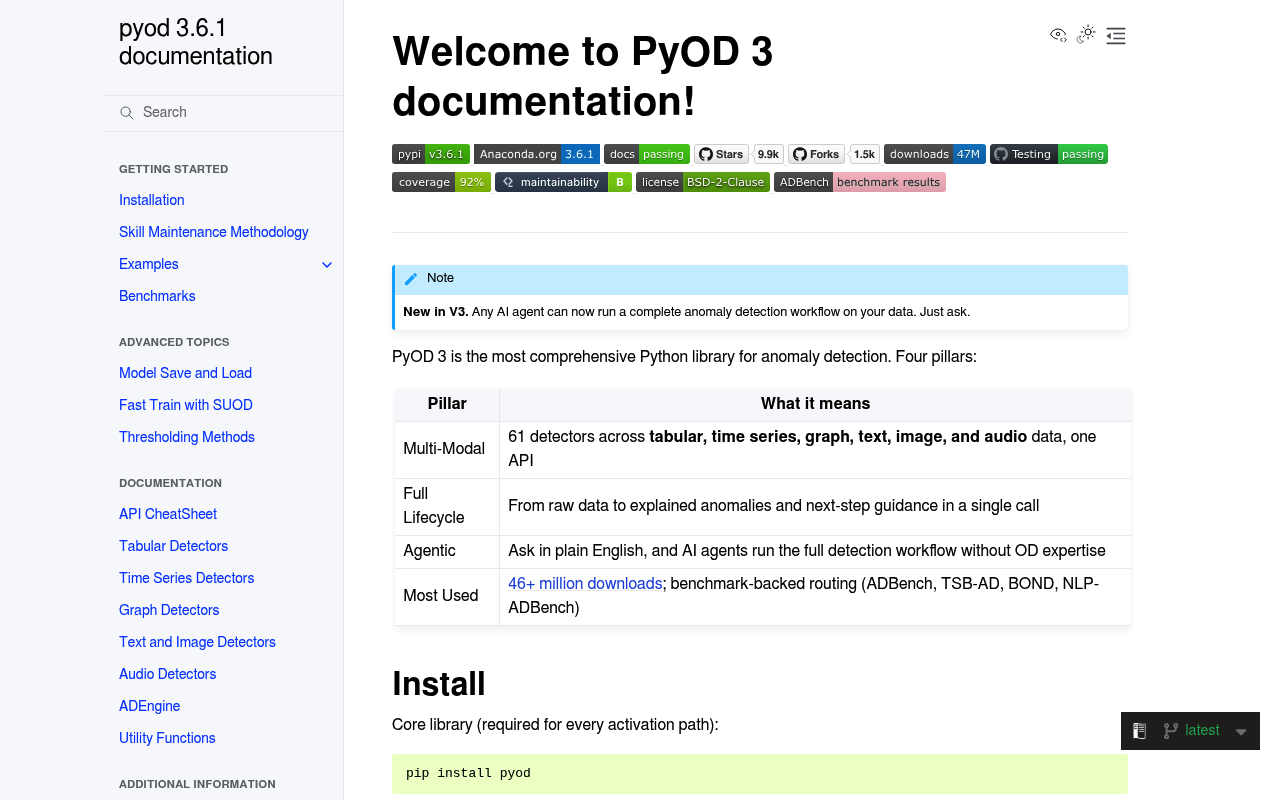
PyOD is a comprehensive and scalable Python library for detecting outliers/anomalies in multivariate data. It includes more than 40 detection algorithms including deep learning ...
Detect anomalies in a single time series metric using statistical algorithms, SARIMA models, and SR-CNN approaches for both batch and real-time streaming use cases.
Multivariate Detection
Identify anomalies across multiple correlated metrics simultaneously using graph attention networks and correlation analysis, capturing system-level failures invisible in indivi...
Streaming and Batch Modes
Support for both real-time streaming anomaly detection on incoming data points and batch retrospective analysis across historical datasets.
Change Point Detection
Identify structural breaks and trend changes in time series data beyond point anomalies, enabling detection of regime shifts and concept drift.
Root Cause Analysis
Group related anomalies and surface likely contributing factors to accelerate diagnosis and response.
Algorithm Diversity
Access to a wide range of detection algorithms from statistical methods to deep learning, including IForest, LOF, OCSVM, AutoEncoder, VAE, and SARIMA.
Discovery needs no key. Ratings and market analysis are Pro.
Get an API key
Free tier, no form to fill in. Signing in shares your email address with us — we
store it to create your key and to recognise you if you sign in with another
provider. See our Privacy Policy and
Terms.
 Kin Score
How this is scored →
Kin Score
How this is scored →