Saleor
Saleor is an open-source, GraphQL-first commerce platform built in Python (Django) with a TypeScript dashboard. The entire commerce surface is exposed through a single GraphQL API used by storefronts, the Saleor Dashboard, and third-party Saleor Apps; mutations and queries cover products, channels, carts (checkout), orders, payments, promotions, taxes, attributes, and warehouses. Developer surface includes Saleor Cloud, the Saleor App SDK and App Template, a starter storefront, language SDKs (saleor-sdk for TS/JS), and an App Store of first-party and partner integrations.
Saleor publishes 9 API contracts indexed on the APIs.io network, including GraphQL API, and 8 more. Tagged areas include Commerce, Headless, E-Commerce, GraphQL, and Open Source.
The Saleor catalog on APIs.io includes 1 Spectral governance ruleset.
Saleor’s developer surface includes authentication, documentation, API reference, GitHub presence, status page, engineering blog, and 16 more developer resources.
Kin Score
 Kin Score
How this is scored →
scored 2026-11-13 · rubric v0.28.0
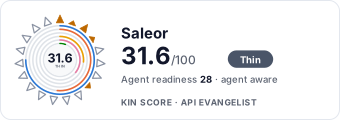 It updates itself when the score changes. Paste this where you link to your API docs:
<a href="https://apis.io/providers/saleor/"><img src="https://apis.io/badge/saleor/card.svg" alt="Saleor on APIs.io — Kin Score by API Evangelist"></a>Other styles, a README pill and a shields.io endpoint are on the badge page.
- Idempotency +9 pts — OpenAPI mutating operations declare an idempotency key — a header, a request-body property, or a named de-duplication token whose own description says so (verified); else common[].type matches /idempoten/i (documented) Ask about this →
- Stable Error Semantics +8 pts — OpenAPI $refs a shared error schema across 4xx/5xx responses (verified), else common[].type includes ErrorCatalog / ErrorCodes / DeclineCodes Ask about this →
- A2A Agent Card +8 pts — a2a/
-a2a.yml manifest, graded on conformance.grade against A2A 1.0.0 Ask about this → - Request/Response Examples +7 pts — share of operations carrying request/response examples; else an Examples / Code Samples link Ask about this →
- Registration Without a Human +6 pts — a `registration_endpoint` in the served RFC 8414 / OIDC discovery document Ask about this →
- Delegated User Identity +6 pts — a served discovery document listing authorization_code in grant_types_supported (served), else an oauth2 authorizationCode flow or openIdConnect declared in an OpenAPI (documented) Ask about this →
- Access Clarity scores 10.6 — up to +17.9 composite points Ask about this →
- Developer Ergonomics scores 35.7 — up to +12.9 composite points Ask about this →
- Contract Quality scores 51.4 — up to +12.2 composite points Ask about this →
Markets this provider is in provisional
The Kin Score Market layer reads a provider inside its market: its position, and how deep its integrations go. Depth is only comparable within a position. Provisional and unweighted: not part of the Kin Score or agent readiness.
| Market | Position | Depth | Registered MCP server | Declares compatibility |
|---|---|---|---|---|
| GraphQL Ecosystem (Foundation, graphql.org listings, public GraphQL APIs) | standard | 34.5 (thin) | - | - |
Registered MCP server and declares compatibility are report only — not weighted. Undeclared means we found nothing we can read, so there is no number: we never infer integrations.
Standards implemented 3
Standards this provider implements or carries. De facto ones are profiled and measured by the API Commons; formal ones come from the standards directory and are linked by the provider's own tags. The evidence column says how each claim was established — not that it was made.
APIs 9
Individual APIs this provider publishes, each with its own machine-readable definition.
Saleor GraphQL API
Single GraphQL endpoint exposing the entire Saleor commerce model - products, variants, categories, collections, channels, checkout, orders, payments, promotions, taxes, attribu...
Saleor App SDK
TypeScript SDK for building Saleor Apps - background services that extend Saleor over the GraphQL API and react to webhooks. Handles app installation, auth, async webhooks, and ...
Saleor App Template
Reference Next.js project for bootstrapping a Saleor App - install flow, webhook handlers, GraphQL clients, and a config UI mounted inside the Saleor Dashboard via the App Bridge.
saleor-sdk (TypeScript / JavaScript)
Official TypeScript / JavaScript SDK wrapping the Saleor GraphQL API for storefronts and Apps - typed operations, auth, cart, and checkout helpers.
Saleor Storefront (Next.js Starter)
Reference Next.js storefront talking to the Saleor GraphQL API - product browse, cart, checkout, account, and payments. Used as the canonical starting point for headless storefr...
Saleor Dashboard
Official React / TypeScript admin dashboard for Saleor - a thick client built entirely against the Saleor GraphQL API.
Saleor Cloud
Hosted, managed Saleor service - provisions Saleor cores per store with the same GraphQL API surface, plus environment management, deploys, and Apps marketplace.
Saleor Core (Server) Repository
Source repository for the Saleor server - the Django / Python backend that implements the GraphQL API, business logic, persistence, and webhooks.
Saleor GraphQL API
The Saleor GraphQL API API from Saleor — 1 operation(s) for saleor graphql api.
Scroll for all 9
Open Collections 2
Open, tool-agnostic API collections (OpenAPI-derived and Bruno).
Saleor GraphQL Saleor GraphQL API API
OPEN COLLECTIONSaleor GraphQL API
OPEN COLLECTIONMCP Servers 1
Model Context Protocol servers that expose these APIs to AI agents.
GraphQL 1
GraphQL schemas published by this provider.
Saleor GraphQL API
Single GraphQL endpoint exposing the entire Saleor commerce model - products, variants, categories, collections, channels, checkout, orders, payments, promotions, taxes, attribu...
GRAPHQLSaleor API pricing
Not yet checked against Saleor's own pricing page. Compiled by API Evangelist on 2026-05-22; confirm before you rely on a figure. A free plan or tier is listed.
| Plan | Price |
|---|---|
| Free freemium | Free |
Plan details, limits and sources →
Rate limits
- Free Tier Default: 10 requests per minute
- Pro Tier Default: 120 requests per minute
Compiled by API Evangelist, not yet checked against Saleor's documentation. Rate-limit details →
Pricing Plans 1
Published pricing tiers and plan structures.
Saleor Plans Pricing
PLANSRate Limits 1
Documented rate limits and quota policies.
Saleor Rate Limits
RATE LIMITSTerms of Service 1
What its API terms permit and prohibit, quoted from its own page.
Data License 1
How its data and outputs may be reused, quoted from its own terms.
FinOps 1
Cost, billing, and metering signals for API financial operations.
Saleor Finops
FINOPSSpectral Rules 1
Spectral governance rulesets for linting and validating these APIs. Counts are the severity each rule declares, not results of running them.
Saleor API Rules
SPECTRALSecurity Posture 2
Authentication, domain security, vulnerability disclosure, and trust-center signals.
Agentic Access (API Evangelist recommendations) 1
Recommended x-agentic-access execution contracts for AI agents.
Resources
Documentation 2
Reference material describing how the API behaves
Agent Surfaces 2
MCP servers, agent skills, and machine-readable catalogs
Build 2
SDKs, sample code, and the tooling you integrate with
Access & Security 2
Authentication, authorization, and security posture
Operate 5
Status, limits, changes, and where to get help
Commercial 5
Pricing, plans, and the legal terms of use
Company 3
The organization behind the API
Other 1
Properties that don't map to a standard resource type
Source (apis.yml)
Saleor API — frequently asked questions
Does Saleor have an API?
Yes. APIs.io lists 9 APIs from Saleor, including Saleor GraphQL API, Saleor App SDK and Saleor App Template, and 6 more.
Is there an OpenAPI specification for the Saleor API?
Yes. APIs.io indexes 1 OpenAPI specification for Saleor, each linked for download from this page.
How do I authenticate with the Saleor API?
Saleor uses bearer-token authentication (apiKey/http · 2 schemes). The details are profiled on APIs.io as Saleor Authentication.
How much does the Saleor API cost?
APIs.io lists 1 pricing plan for Saleor, with each plan's price, limits and inclusions under Pricing on this page.
Does Saleor have an MCP server?
Yes. APIs.io lists 1 MCP server for Saleor: Remote MCP server at mcp.saleor.app over HTTP; 8 tools listed.
Is the Saleor API ready for AI agents?
Saleor has a Kin Score of 32.8 out of 100 (thin) and an Agent Readiness score of 31.0 (agent-ready), scored by API Evangelist on 2026-11-13.
Work with this as data
Every provider here is available over the APIs.io API and to AI agents over MCP.