Pickle Robot Company
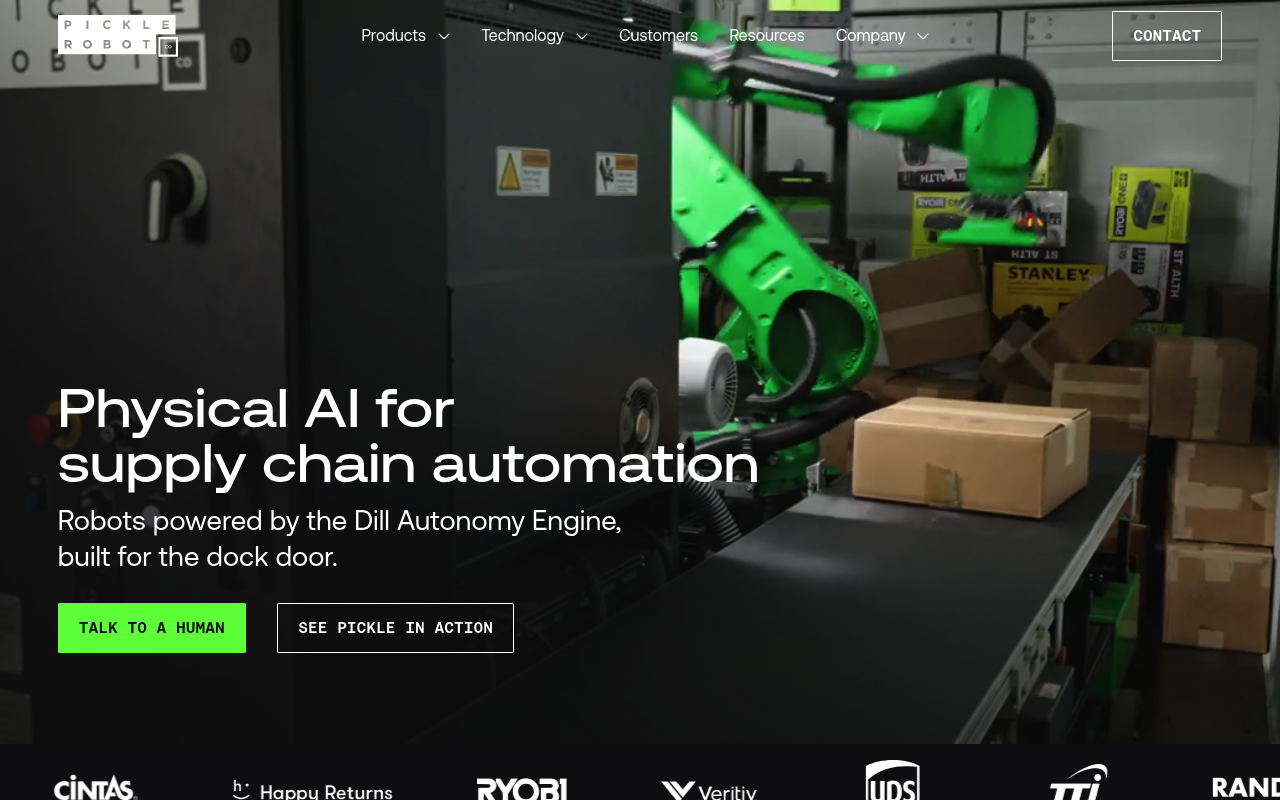
Pickle Robot Company builds Physical AI robots for supply chain automation, focused on autonomously unloading non-palletized goods (floor-loaded boxes and parcels) from trucks and shipping containers at warehouse speed. Its Dill Autonomy Engine (DAE) combines classical optimal control with generative AI and machine vision so fleets improve continuously across deployments, with operational dashboards reporting picks-per-hour, unload times, and package-mix analysis. Customers include UPS and Cintas. Headquartered in the Boston, Massachusetts area, Pickle Robot is a DCVC portfolio company backed by investors including Teradyne Robotics Ventures, Toyota Ventures, Catapult Ventures, Hyperplane, and VersionOne. The company publishes no public developer API, documentation portal, or SDK; its GitHub organization hosts robotics tooling (mostly ROS/SLAM forks) rather than API client libraries.
Pickle Robot Company is profiled on the APIs.io network. Tagged areas include Company, Robotics, Physical AI, Supply Chain, and Logistics.
Pickle Robot Company’s developer surface includes engineering blog, support, and 11 more developer resources.
Kin Score
 Kin Score
How this is scored →
scored 2026-11-21 · rubric v0.28.1
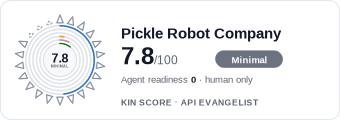 It updates itself when the score changes. Paste this where you link to your API docs:
<a href="https://apis.io/providers/pickle-robot-company/"><img src="https://apis.io/badge/pickle-robot-company/card.svg" alt="Pickle Robot Company on APIs.io — Kin Score by API Evangelist"></a>Other styles, a README pill and a shields.io endpoint are on the badge page.
- Machine-Readable Contract +18 pts — api_specs includes an OpenAPI document Ask about this →
- MCP Server +12 pts — deployment.mode + probe verdict on the mcp/ manifest, not the pointer; an unprobed slug falls back to authorship Ask about this →
- Machine-Readable Auth +10 pts — a served openid-configuration/oauth-authorization-server carrying `issuer` (served), else the securitySchemes class in the provider OpenAPIs — bound (mutualTLS, DPoP, Signature) > negotiable (oauth2 authorizationCode/clientCredentials, openIdConnect) > bearer (http bearer, apiKey) Ask about this →
- Agentic Access Contract +10 pts — agentic_access artifact present (x-agentic-access), graded by author Ask about this →
- Idempotency +9 pts — OpenAPI mutating operations declare an idempotency key — a header, a request-body property, or a named de-duplication token whose own description says so (verified); else common[].type matches /idempoten/i (documented) Ask about this →
- A2A Agent Card +8 pts — a2a/
-a2a.yml manifest, graded on conformance.grade against A2A 1.0.0 Ask about this →
- Contract Quality scores 0.0 — up to +25.0 composite points Ask about this →
- Developer Ergonomics scores 7.1 — up to +18.6 composite points Ask about this →
- Access Clarity scores 12.8 — up to +17.4 composite points Ask about this →
Privacy & Data 1
Its role, the data it processes, retention and transfers, quoted from its own privacy page.
Pickle Robot Company
9 quoted statements, read from Pickle Robot Company's own page on 2026-11-10.
PRIVACYSecurity Posture 1
Authentication, domain security, vulnerability disclosure, and trust-center signals.
Resources
Build 1
SDKs, sample code, and the tooling you integrate with
Access & Security 1
Authentication, authorization, and security posture
Operate 2
Status, limits, changes, and where to get help
Commercial 1
Pricing, plans, and the legal terms of use
Company 2
The organization behind the API
Other 6
Properties that don't map to a standard resource type
Source (apis.yml)
Work with this as data
Every provider here is available over the APIs.io API and to AI agents over MCP.