Zip
Zip is an AI-powered procurement orchestration platform that provides a REST API for managing the full intake-to-pay lifecycle. The API enables developers to build custom integrations that extract, create, and update procurement data including intake requests, vendor onboarding, approval workflows, and contract management. Authentication is handled via API keys passed as Basic Auth credentials, with separate sandbox and production environments available. Zip's platform serves enterprise customers by creating a single front door for all corporate purchase requests and routing them through configurable approval chains before connecting to ERPs and financial systems. The API supports webhook callbacks for async event notifications when procurement workflows complete, enabling deep integration with existing enterprise toolchains.
Zip is listed with 1 API on the APIs.io network: Procurement API. Tagged areas include Procurement, Spend Management, Intake to Pay, Approval Workflows, and Vendor Management.
The Zip catalog on APIs.io includes 1 JSON-LD context.
Zip’s developer surface includes documentation, engineering blog, pricing, and 12 more developer resources.
Kin Score
 Kin Score
How this is scored →
Kin Score
How this is scored →scored 2026-10-23 · rubric v0.25.0
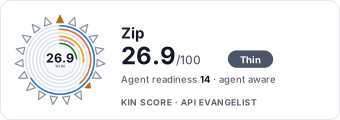 It updates itself when the score changes. Paste this where you link to your API docs:
<a href="https://apis.io/providers/zip/"><img src="https://apis.io/badge/zip/card.svg" alt="Zip on APIs.io — Kin Score by API Evangelist"></a>Other styles, a README pill and a shields.io endpoint are on the badge page.
Markets this provider is in provisional
The Kin Score Market layer reads a provider inside its market: its position, and how deep its integrations go. Depth is only comparable within a position. Provisional and unweighted: not part of the Kin Score or agent readiness.
| Market | Position | Depth | Registered MCP server | Declares compatibility |
|---|---|---|---|---|
| Procurement and B2B Buying (source-to-pay suites, spend management) | undeclared | - | - | - |
Registered MCP server and declares compatibility are report only — not weighted. Undeclared means we found nothing we can read, so there is no number: we never infer integrations.
APIs 1
Individual APIs this provider publishes, each with its own machine-readable definition.
Zip Procurement API
The Zip Procurement API is a REST-based interface for automating and integrating enterprise procurement workflows. It provides endpoints for managing intake requests, vendor onb...
Pricing Plans 1
Published pricing tiers and plan structures.
Zip Plans Pricing
PLANSRate Limits 1
Documented rate limits and quota policies.
Zip Rate Limits
RATE LIMITSFinOps 1
Cost, billing, and metering signals for API financial operations.
Zip Finops
FINOPSSemantic Vocabularies 1
JSON-LD contexts and semantic vocabularies used across these APIs.
Zip Context
JSON-LDSecurity Posture 2
Authentication, domain security, vulnerability disclosure, and trust-center signals.
Resources
Documentation 1
Reference material describing how the API behaves
Design & Contract 1
Pagination, idempotency, versioning, errors, and events
Build 1
SDKs, sample code, and the tooling you integrate with
Access & Security 2
Authentication, authorization, and security posture
Operate 2
Status, limits, changes, and where to get help
Commercial 3
Pricing, plans, and the legal terms of use
Company 4
The organization behind the API
Other 1
Properties that don't map to a standard resource type
Source (apis.yml)
Work with this as data
Every provider here is available over the APIs.io API and to AI agents over MCP.