Udacity
Udacity is an online tech-upskilling platform offering project-based Nanodegree programs, individual courses, and enterprise workforce development across Artificial Intelligence, Generative AI, Agentic AI, Data Science, Cloud Computing, Cybersecurity, Programming, Autonomous Systems, Product Management, and DevOps. Founded by Sebastian Thrun out of the Stanford CS221 free online AI course in 2011, Udacity pioneered the Nanodegree credential and partnered with industry leaders (AWS, Google, Meta, Microsoft, NVIDIA, Mercedes-Benz) to co-develop curriculum. In 2024 Accenture acquired Udacity for approximately $1B and folded the platform into LearnVantage, Accenture's enterprise learning and skilling business. Udacity reports 25M+ learners globally and remains best known for its Self-Driving Car, Deep Learning, and Generative AI Nanodegrees, with hands-on projects reviewed by human mentors and career services. Udacity does not publish a public developer API, SDK, or developer portal — enterprise customers integrate via Accenture LearnVantage sales channels rather than self-service APIs. Its public GitHub organization (github.com/udacity) hosts 1,100+ open-source classroom and course-content repositories (e.g. deep-learning-v2-pytorch, self-driving-car, cd13303-genai-c1-classroom) used as Nanodegree exercises, not as official platform APIs.
Udacity is profiled on the APIs.io network. Tagged areas include E-Learning, Upskilling, Nanodegrees, Tech Education, and Workforce Development.
Udacity’s developer surface includes pricing, engineering blog, privacy policy, GitHub presence, YouTube channel, and 19 more developer resources.
Kin Score
 Kin Score
How this is scored →
scored 2026-11-06 · rubric v0.27.0
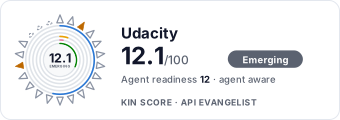 It updates itself when the score changes. Paste this where you link to your API docs:
<a href="https://apis.io/providers/udacity/"><img src="https://apis.io/badge/udacity/card.svg" alt="Udacity on APIs.io — Kin Score by API Evangelist"></a>Other styles, a README pill and a shields.io endpoint are on the badge page.
- Machine-Readable Contract +18 pts — api_specs includes an OpenAPI document
- Agentic Access Contract +10 pts — agentic_access artifact present (x-agentic-access), graded by author
- Machine-Readable Auth +10 pts — a served openid-configuration/oauth-authorization-server carrying `issuer` (served), else the securitySchemes class in the provider OpenAPIs — bound (mutualTLS, DPoP, Signature) > negotiable (oauth2 authorizationCode/clientCredentials, openIdConnect) > bearer (http bearer, apiKey)
- Idempotency +9 pts — OpenAPI mutating operations declare an idempotency key — a header, a request-body property, or a named de-duplication token whose own description says so (verified); else common[].type matches /idempoten/i (documented)
- Stable Error Semantics +8 pts — OpenAPI $refs a shared error schema across 4xx/5xx responses (verified), else common[].type includes ErrorCatalog / ErrorCodes / DeclineCodes
- A2A Agent Card +8 pts — a2a/
-a2a.yml manifest, graded on conformance.grade against A2A 1.0.0
- Contract Quality scores 0.0 — up to +25.0 composite points
- Developer Ergonomics scores 2.4 — up to +19.5 composite points
- Access Clarity scores 31.6 — up to +13.7 composite points
Standards implemented 2
Standards this provider implements or carries. De facto ones are profiled and measured by the API Commons; formal ones come from the standards directory and are linked by the provider's own tags. The evidence column says how each claim was established — not that it was made.
MCP Servers 1
Model Context Protocol servers that expose these APIs to AI agents.
Security Posture 1
Authentication, domain security, vulnerability disclosure, and trust-center signals.
Resources
Build 1
SDKs, sample code, and the tooling you integrate with
Access & Security 1
Authentication, authorization, and security posture
Learn 1
Tutorials, courses, talks, and written guidance
Operate 2
Status, limits, changes, and where to get help
Commercial 3
Pricing, plans, and the legal terms of use
Company 8
The organization behind the API
Scroll for all 8
Other 8
Properties that don't map to a standard resource type
Scroll for all 8
Source (apis.yml)
Udacity API — frequently asked questions
Does Udacity have an MCP server?
Yes. APIs.io lists 1 MCP server for Udacity: Remote MCP server at mcp.udacity.com over HTTP.
Is the Udacity API ready for AI agents?
Udacity has a Kin Score of 12.1 out of 100 (emerging) and an Agent Readiness score of 12.2 (agent-aware), scored by API Evangelist on 2026-11-06.
Work with this as data
Every provider here is available over the APIs.io API and to AI agents over MCP.