turbopuffer
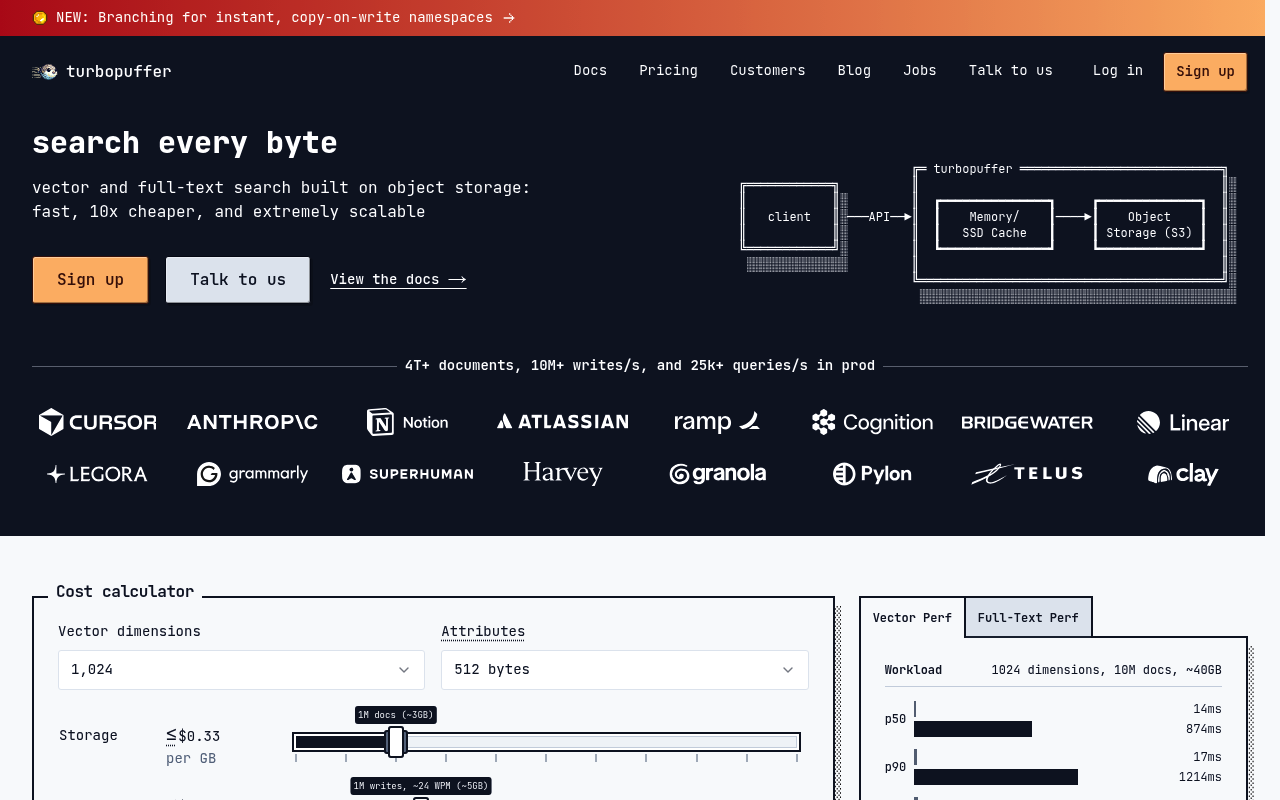
turbopuffer is a serverless search engine that combines vector and full-text (BM25) search built from first principles directly on object storage. It exposes a single REST API organized around namespaces — each namespace stores documents with vector embeddings, attributes, and full-text indexes — and supports approximate nearest neighbor, full-text BM25, and hybrid query patterns with attribute filtering, ranking, and aggregation. The platform is used in production by Anthropic, Cursor, Notion, Linear, Superhuman, Pylon, Readwise, and Telus, and handles 4T+ documents, 10M+ writes/s, and 25k+ queries/s across customer fleets. Official client libraries ship for Python, TypeScript, Go, Java, Ruby, and C#, generated from a public OpenAPI 3.1 specification via Stainless. Pricing is tiered (Launch, Scale, Enterprise) with usage-based metering on storage, writes, and queries on top of monthly minimums.
turbopuffer publishes 11 API contracts indexed on the APIs.io network, including Namespaces API, and 10 more. Tagged areas include Vector Search, Full-Text Search, Hybrid Search, BM25, and Serverless.
The turbopuffer catalog on APIs.io includes 1 Spectral governance ruleset.
turbopuffer’s developer surface includes authentication, documentation, GitHub presence, pricing, engineering blog, and 22 more developer resources.
Kin Score
 Kin Score
How this is scored →
scored 2026-11-13 · rubric v0.28.0
 It updates itself when the score changes. Paste this where you link to your API docs:
<a href="https://apis.io/providers/turbopuffer/"><img src="https://apis.io/badge/turbopuffer/card.svg" alt="turbopuffer on APIs.io — Kin Score by API Evangelist"></a>Other styles, a README pill and a shields.io endpoint are on the badge page.
- MCP Server +12 pts — deployment.mode + probe verdict on the mcp/ manifest, not the pointer; an unprobed slug falls back to authorship Ask about this →
- Idempotency +9 pts — OpenAPI mutating operations declare an idempotency key — a header, a request-body property, or a named de-duplication token whose own description says so (verified); else common[].type matches /idempoten/i (documented) Ask about this →
- Stable Error Semantics +8 pts — OpenAPI $refs a shared error schema across 4xx/5xx responses (verified), else common[].type includes ErrorCatalog / ErrorCodes / DeclineCodes Ask about this →
- A2A Agent Card +8 pts — a2a/
-a2a.yml manifest, graded on conformance.grade against A2A 1.0.0 Ask about this → - Request/Response Examples +7 pts — share of operations carrying request/response examples; else an Examples / Code Samples link Ask about this →
- Registration Without a Human +6 pts — a `registration_endpoint` in the served RFC 8414 / OIDC discovery document Ask about this →
- Developer Ergonomics scores 35.7 — up to +12.9 composite points Ask about this →
- Contract Quality scores 48.4 — up to +12.9 composite points Ask about this →
- Contract Governance scores 13.6 — up to +10.4 composite points Ask about this →
Standards implemented 1
Standards this provider implements or carries. De facto ones are profiled and measured by the API Commons; formal ones come from the standards directory and are linked by the provider's own tags. The evidence column says how each claim was established — not that it was made.
APIs 11
Individual APIs this provider publishes, each with its own machine-readable definition.
turbopuffer Write API
Endpoints for upserting, patching, and deleting documents within a namespace. Writes are batched into a per-namespace write-ahead log and become queryable once committed to obje...
turbopuffer Query API
Unified query endpoint that runs vector ANN, full-text BM25, and hybrid queries against a namespace, with attribute filters, top-k, aggregation groups, and ranking controls. Sup...
turbopuffer Namespaces API
Namespace lifecycle and metadata endpoints — list namespaces, read schema / dimensions / row count, warm the cache, export contents, branch_from (copy-on-write clones in constan...
turbopuffer Python SDK
Official Python client library for the turbopuffer REST API, Stainless-generated from the public OpenAPI spec.
turbopuffer TypeScript SDK
Official TypeScript / JavaScript client library for the turbopuffer REST API, Stainless-generated and published to npm.
turbopuffer Go SDK
Official Go client library for the turbopuffer REST API, Stainless-generated from the public OpenAPI spec.
turbopuffer Java SDK
Official Java / Kotlin client library for the turbopuffer REST API, Stainless-generated from the public OpenAPI spec.
turbopuffer Ruby SDK
Official Ruby client library for the turbopuffer REST API, Stainless-generated from the public OpenAPI spec.
turbopuffer C# SDK
Official C# / .NET client library for the turbopuffer REST API, Stainless-generated from the public OpenAPI spec.
tpuf-benchmark
Open-source general-purpose benchmarking tool for turbopuffer deployments. Useful for validating recall, latency, and throughput on a given workload.
turbopuffer Namespaces API
The Namespaces API from turbopuffer — 12 operation(s) for namespaces.
Scroll for all 11
Open Collections 2
Open, tool-agnostic API collections (OpenAPI-derived and Bruno).
turbopuffer Namespaces API
OPEN COLLECTIONturbopuffer API
OPEN COLLECTIONturbopuffer API pricing
Prices published by turbopuffer, read 2026-10-28 from turbopuffer.com/pricing.
| Plan | Price |
|---|---|
| launch | $16/month minimum usage Includes: Includes all database features; Multi-Tenancy; SOC2 report, GDPR-ready DPA; Community Slack & Email |
| scale | $256/month minimum usage Includes: Includes all database features; Multi-Tenancy; HIPAA-ready BAA; SSO; Audit Logs; IP Allowlisting; Pr |
| enterprise | >= $4,096/month Includes: Single-Tenancy, BYOC, Private Networking, CMEK (Per Namespace), 24/7 support, Uptime SLA 99.95% |
| Storage | ≤ $0.33 per GB |
Plan details, limits and sources →
Rate limits
- Per-Namespace Write Throughput: 10000 writes per second
- Per-Namespace Query Rate: 1000 queries per second
- Per-Namespace Query Concurrency: 16 concurrent queries
Compiled by API Evangelist, not yet checked against turbopuffer's documentation. Rate-limit details →
Billed by: minimum usage · FinOps profile →
Pricing Plans 2
Published pricing tiers and plan structures.
Rate Limits 1
Documented rate limits and quota policies.
turbopuffer Rate Limits
RATE LIMITSTerms of Service 1
What its API terms permit and prohibit, quoted from its own page.
Eligibility 1
Who may sign up and where, quoted from its own terms.
AI Preferences 1
Its stance on AI training, inference and agents, quoted from its own pages.
Data License 1
How its data and outputs may be reused, quoted from its own terms.
FinOps 1
Cost, billing, and metering signals for API financial operations.
turbopuffer Finops
FINOPSSpectral Rules 1
Spectral governance rulesets for linting and validating these APIs. Counts are the severity each rule declares, not results of running them.
turbopuffer API Rules
SPECTRALSecurity Posture 2
Authentication, domain security, vulnerability disclosure, and trust-center signals.
Agentic Access (API Evangelist recommendations) 1
Recommended x-agentic-access execution contracts for AI agents.
Resources
Documentation 4
Reference material describing how the API behaves
Agent Surfaces 2
MCP servers, agent skills, and machine-readable catalogs
Build 1
SDKs, sample code, and the tooling you integrate with
Access & Security 3
Authentication, authorization, and security posture
Operate 3
Status, limits, changes, and where to get help
Commercial 7
Pricing, plans, and the legal terms of use
Scroll for all 7
Company 2
The organization behind the API
Other 5
Properties that don't map to a standard resource type
Source (apis.yml)
turbopuffer API — frequently asked questions
Does turbopuffer have an API?
Yes. APIs.io lists 11 APIs from turbopuffer, including turbopuffer Write API, turbopuffer Query API and turbopuffer Namespaces API, and 8 more.
Is there an OpenAPI specification for the turbopuffer API?
Yes. APIs.io indexes 1 OpenAPI specification for turbopuffer, each linked for download from this page.
How do I authenticate with the turbopuffer API?
turbopuffer uses bearer-token authentication (http · 1 scheme). The details are profiled on APIs.io as turbopuffer Authentication.
How much does the turbopuffer API cost?
turbopuffer publishes its prices; its launch plan is $16/month minimum usage as of 2026-10-28. APIs.io lists 4 pricing plans for turbopuffer, with each plan's price, limits and inclusions under Pricing on this page.
Is the turbopuffer API ready for AI agents?
turbopuffer has a Kin Score of 48.0 out of 100 (developing) and an Agent Readiness score of 19.6 (agent-aware), scored by API Evangelist on 2026-11-13.
Work with this as data
Every provider here is available over the APIs.io API and to AI agents over MCP.