
Taalas
Taalas is a Toronto-based semiconductor company building "Hardcore Models" — AI models etched directly into custom silicon rather than executed as software on general-purpose GPUs, under the tagline "The Model is The Computer." Its first product, the HC1 technology demonstrator, hard-wires Meta's Llama 3.1 8B into an 815mm2 / 53-billion-transistor die on TSMC's 6nm process and is publicly demonstrated through the ChatJimmy chatbot. Taalas exposes that silicon to developers through a hosted inference REST API at api.taalas.com, which publishes two OpenAPI 3.1.0 contracts: a root API with health, model-info and a Taalas-native /generate operation, and an OpenAI-compatible /v1 surface with /v1/completions and /v1/chat/completions. Access is by bearer API key issued through an application form; applications are currently closed due to demand.
Taalas publishes 3 API contracts indexed on the APIs.io network, including Models API, Monitoring API, and 1 more. Tagged areas include Company, Artificial Intelligence, Inference, Semiconductors, and AI Accelerators.
Taalas’ developer surface includes documentation, API reference, signup flow, support, engineering blog, authentication, and 20 more developer resources.
Kin Score
 Kin Score
How this is scored →
Kin Score
How this is scored →scored 2026-10-23 · rubric v0.25.0
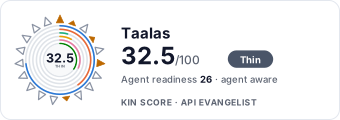 It updates itself when the score changes. Paste this where you link to your API docs:
<a href="https://apis.io/providers/taalas/"><img src="https://apis.io/badge/taalas/card.svg" alt="Taalas on APIs.io — Kin Score by API Evangelist"></a>Other styles, a README pill and a shields.io endpoint are on the badge page.
Markets this provider is in provisional
The Kin Score Market layer reads a provider inside its market: its position, and how deep its integrations go. Depth is only comparable within a position. Provisional and unweighted: not part of the Kin Score or agent readiness.
| Market | Position | Depth | Registered MCP server | Declares compatibility |
|---|---|---|---|---|
| Semiconductor Consortia (RISC-V, OCP hardware, CHIPS awards) | undeclared | - | - | - |
Registered MCP server and declares compatibility are report only — not weighted. Undeclared means we found nothing we can read, so there is no number: we never infer integrations.
Standards implemented 1
Standards this provider implements or carries. De facto ones are profiled and measured by the API Commons; formal ones come from the standards directory and are linked by the provider's own tags. The evidence column says how each claim was established — not that it was made.
APIs 3
Individual APIs this provider publishes, each with its own machine-readable definition.
Taalas API
Taalas-native REST interface for running inference against the HC1 hardcore-model silicon. Three operations: a public /health probe reporting server status, queue depth and the ...
Taalas Models API
The Models API from Taalas — 1 operation(s) for models.
Taalas Monitoring API
The Monitoring API from Taalas — 1 operation(s) for monitoring.
Open Collections 4
Open, tool-agnostic API collections (OpenAPI-derived and Bruno).
Taalas API
OPEN COLLECTIONTaalas API — v1
OPEN COLLECTIONTaalas Models API
OPEN COLLECTIONTaalas Monitoring API
OPEN COLLECTIONOpenAPI Overlays 2
Overlays applied on top of this provider's contracts. Each card says who wrote it: a document the provider publishes, or one API Evangelist derived or generated.
Taalas Inference Api Overlay
DERIVEDTaalas Inference V1 Api Overlay
DERIVEDSecurity Posture 2
Authentication, domain security, vulnerability disclosure, and trust-center signals.
Agentic Access 1
Recommended x-agentic-access execution contracts for AI agents.
Resources
Get Started 3
Portal, sign-up, and the first successful call
Documentation 2
Reference material describing how the API behaves
Agent Surfaces 5
MCP servers, agent skills, and machine-readable catalogs
Design & Contract 5
Pagination, idempotency, versioning, errors, and events
Build 1
SDKs, sample code, and the tooling you integrate with
Access & Security 2
Authentication, authorization, and security posture
Operate 2
Status, limits, changes, and where to get help
Commercial 2
Pricing, plans, and the legal terms of use
Company 3
The organization behind the API
Other 1
Properties that don't map to a standard resource type
Source (apis.yml)
Work with this as data
Every provider here is available over the APIs.io API and to AI agents over MCP.