Steam is Valve's PC gaming platform and digital distribution storefront. Valve exposes the Steamworks Web API at https://api.steampowered.com/ — a constellation of HTTP interfaces for games, players, friends, achievements, items, the economy, leaderboards, remote storage, and the Steam Workshop. A subset of read-only interfaces are public (with a Steam Web API key); the full Steamworks set requires a publisher account and partner-restricted methods. There is no per-call fee for the Steamworks Web API itself; Valve monetizes through a $100 Steam Direct submission fee per product and a revenue share on store sales.
Steam publishes 25 API contracts indexed on the APIs.io network, including IPlayerService API, ISteamNews API, ISteamUser API, and 22 more. Tagged areas include Gaming, Valve, Distribution, Steamworks, and Marketplace.
The Steam catalog on APIs.io includes 1 Spectral governance ruleset.
Steam’s developer surface includes authentication, documentation, API reference, getting-started guide, signup flow, engineering blog, and 25 more developer resources.
Regulatory Posture applies to this provider. Its tags matched the
Horizontal (data, software, accessibility, platform) regime, so
Regulatory Posture carries 15 points of the composite.
If this regime is wrong for your business, say so on your
provider repo — the
applicability map is public and we will correct it.
Create-or-Update Ergonomics does not apply to this provider. The published contracts declare
no write operations, and a read-only API cannot create-or-update. The facet is excluded from this provider's
denominator entirely — not scored zero. A reference or data API is not deficient for being unable to
upsert.
The six quality facets above are damped to 85 points between them,
because the conditional facet above carries the other
15. That is why each facet's contribution is shown against a damped
maximum: raising a quality facet moves the composite by 85% of its nominal
weight, not 100%. The full arithmetic is at apis.io/rating/.
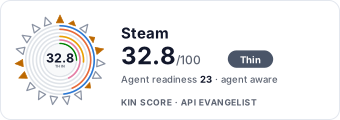
Show this score on your site.
It updates itself when the score changes. Paste this where you link to your API docs:
<a href="https://apis.io/providers/steam/"><img src="https://apis.io/badge/steam/card.svg" alt="Steam on APIs.io — Kin Score by API Evangelist"></a>
Other styles, a README pill and a shields.io endpoint are on the badge page.
Raise your score.
Agent readiness — checks not met, largest first (exact, from this profile):
MCP Server+12 pts — deployment.mode + probe verdict on the mcp/ manifest, not the pointer; an unprobed slug falls back to authorship Ask about this →
Stable Error Semantics+8 pts — OpenAPI $refs a shared error schema across 4xx/5xx responses (verified), else common[].type includes ErrorCatalog / ErrorCodes / DeclineCodes Ask about this →
Delegated User Identity+6 pts — a served discovery document listing authorization_code in grant_types_supported (served), else an oauth2 authorizationCode flow or openIdConnect declared in an OpenAPI (documented) Ask about this →
6 more unmet checks in the Agent Readiness table above.
Kin Score — facets with the most composite points still available (weight × headroom):
Each check links to what satisfies it. Publish the artifact, or tell us where it already lives, and the score moves on the next scoring run.
Not sure how this applies to your stack? Ask about any one item. Kin Lane reads every question, looks at your profile and your situation, and replies with what a fix would take — scoped to that one area, priced up front, yours whether you ship it or not. Ask a question →
The Kin Score Market layer reads a provider inside its market:
its position, and how deep its integrations go. Depth is only comparable within a position. Provisional and unweighted:
not part of the Kin Score or agent readiness.
Registered MCP server and declares compatibility are report only — not weighted.
Undeclared means we found nothing we can read, so there is no number: we never infer integrations.
Standards this provider implements or carries. De facto ones are profiled and measured by the API Commons; formal ones come from the standards directory and are linked by the provider's own tags. The evidence column says how each claim was established — not that it was made.
ISteamUserStats provides global achievement percentages, schema for game stats and achievements, and per-user achievement / stats retrieval (GetGlobalAchievementPercentagesForAp...
ISteamUserAuth issues and validates Steam session tickets (AuthenticateUserTicket, AuthenticateUser) used by partner servers to verify a connecting player's Steam identity.
ISteamApps exposes catalog and server queries (GetAppList, GetServersAtAddress, UpToDateCheck) used to enumerate Steam applications and validate version state.
ISteamEconomy is a secondary economy-system interface (GetAssetClassInfo, GetAssetPrices, FinalizeAssetTransaction) used to look up asset metadata and pricing for in-game items.
IGameInventory is the primary inventory-economy interface used by partner servers to manipulate item ownership (AddItem, ConsumeItem, GetUserInventory, GetItemDefArchive).
IInventoryService is the modern Steam Inventory Service interface used to add/remove/exchange items, manage definitions, and query inventories at scale.
ISteamRemoteStorage exposes Steam Cloud and UGC (user-generated content) storage endpoints — fetching files, retrieving UGC details, and listing published files.
ISteamWebAPIUtil provides helper endpoints — GetServerInfo (Steam server time/version) and GetSupportedAPIList (interfaces and methods callable by the API key).
An unofficial-but-widely-used set of storefront endpoints (https://store.steampowered.com/api/) returns app details, package details, currency conversion, and feature lists. Use...
ISteamMicroTxn / ISteamMicroTxnSandbox handle the full microtransaction lifecycle — InitTxn, FinalizeTxn, GetReport, RefundTxn, QueryTxn — used by F2P and live-service titles.
ISteamDeepLinkService creates and resolves time-limited deep links into the Steam client and store, useful for marketing campaigns and partner referrals.
Not yet checked against Steam's own pricing page. Compiled by API Evangelist on 2026-05-08 from partner.steamgames.com/steamdirect; confirm before you rely on a figure. A free plan or tier is listed.
Plan
Price
Public Steam Web API free
Free
Steam Direct (Game Publisher) paid
$100 per submission Fee Per Product
Steam Distribution Revenue Share revenue-share
% 30 per tier 1 — 0 to $10M Adjusted Gross · % 25 per tier 2 — $10M to $50M Adjusted Gross
Calls without X-API-Key need no key. Calls with it need a paid plan — get a key.
Get an API key
Free tier, no form to fill in. Signing in shares your email address with us — we
store it to create your key and to recognise you if you sign in with another
provider. See our Privacy Policy and
Terms.
 Kin Score
How this is scored →
 It updates itself when the score changes. Paste this where you link to your API docs: