Shieldpay
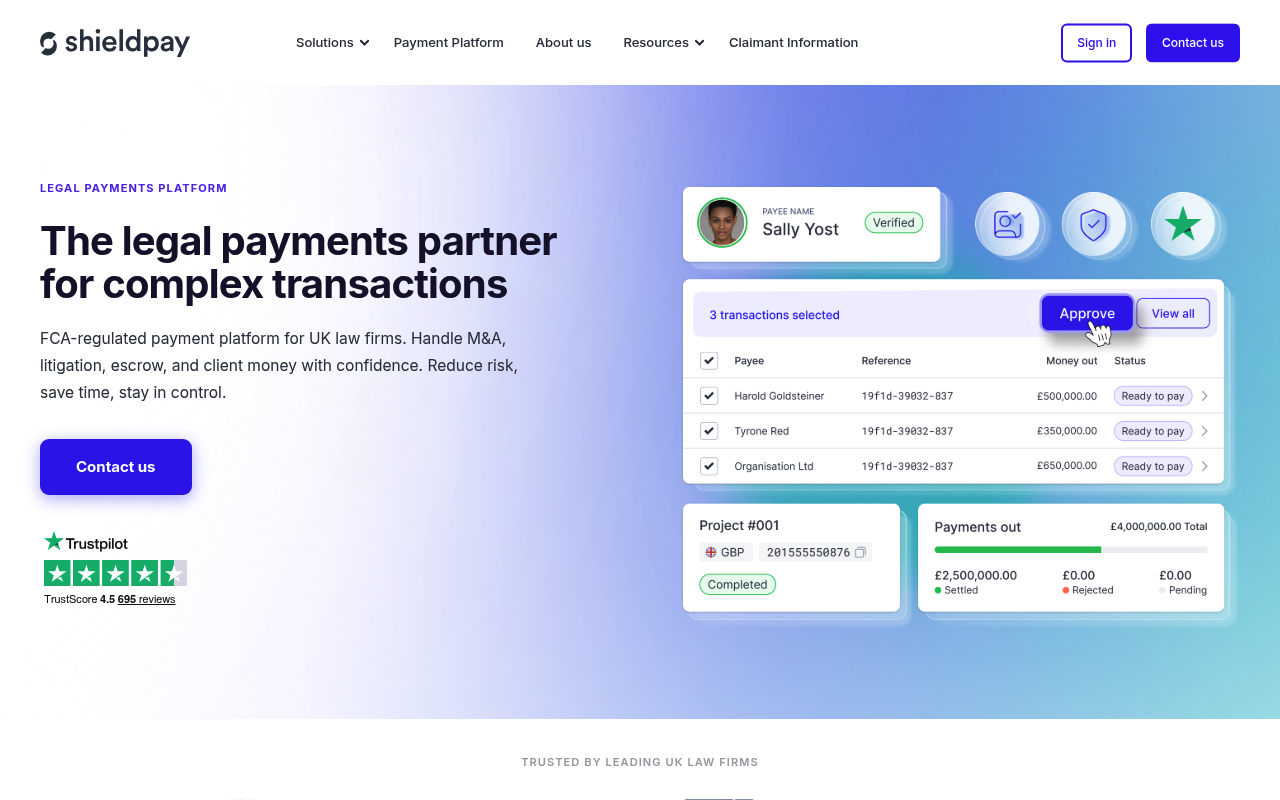
Shieldpay is an FCA-authorised (firm reference 770210) payments platform built for the UK legal and professional-services sector, offering a regulated alternative to holding client money in traditional client accounts. It combines KYC/due-diligence verification of parties, safeguarding of funds with tier-1 banking partners (Citi and ClearBank), and audited disbursement of payments, supporting M&A holdbacks/earnouts and shareholder distributions, multi-claimant litigation settlements, escrow, conveyancing, and ongoing client-money management via its Third-Party Managed Account (TPMA) service. Shieldpay has processed over £18 billion and serves 40+ of the UK top-100 law firms. Its Partner API lets integrators programmatically create projects, manage payers and payees, run KYC, and authorise payments; the API secures every request with mutual TLS, an API key, an RSA-SHA256 request signature, a v4-UUID RequestID for idempotency, and IP whitelisting, and delivers real-time events over webhooks.
Shieldpay is listed with 1 API on the APIs.io network. Tagged areas include Company, Payments, Escrow, Legal Tech, and Fintech.
The Shieldpay catalog on APIs.io includes 1 event-driven AsyncAPI specification.
Shieldpay’s developer surface includes documentation, API reference, getting-started guide, engineering blog, support, authentication, sandbox, and 22 more developer resources.
Kin Score
 Kin Score
How this is scored →
Kin Score
How this is scored →scored 2026-10-17 · rubric v0.24.0
APIs 1
Individual APIs this provider publishes, each with its own machine-readable definition.
Shieldpay Partner API
REST API to manage payment workflows end to end — create projects, manage payers and payees, run KYC verification, and authorise payments to disburse funds securely. Secured wit...
Event Specifications 1
AsyncAPI definitions for this provider's event-driven and streaming APIs.
Shieldpay Webhooks
ASYNCAPISecurity Posture 4
Authentication, domain security, vulnerability disclosure, and trust-center signals.
Resources
Get Started 4
Portal, sign-up, and the first successful call
Documentation 2
Reference material describing how the API behaves
Agent Surfaces 2
MCP servers, agent skills, and machine-readable catalogs
Design & Contract 6
Pagination, idempotency, versioning, errors, and events
Build 1
SDKs, sample code, and the tooling you integrate with
Access & Security 7
Authentication, authorization, and security posture
Scroll for all 7
Operate 2
Status, limits, changes, and where to get help
Commercial 2
Pricing, plans, and the legal terms of use
Company 3
The organization behind the API
Source (apis.yml)
Work with this as data
Every provider here is available over the APIs.io API and to AI agents over MCP.