Samsung
Samsung Electronics is a global technology leader offering developer platforms for building applications and services across mobile devices, IoT, smart home, enterprise security, and entertainment. The Samsung Developer ecosystem spans SmartThings (IoT and smart home platform), Knox (enterprise device security and management), Galaxy mobile SDKs, Smart TV, and Tizen cross-platform development. Samsung provides REST APIs, SDKs, and tools that enable developers to create connected experiences for hundreds of millions of Galaxy devices and Samsung smart home products worldwide.
Samsung publishes 12 API contracts indexed on the APIs.io network, including Apps API, Devices API, Locations API, and 9 more. Tagged areas include Consumer Electronics, Developer Platform, IoT, Mobile, and Smart Home.
The Samsung catalog on APIs.io includes 1 JSON-LD context and 2 Spectral governance rulesets.
Samsung’s developer surface includes authentication, engineering blog, documentation, code examples, and 28 more developer resources.
What this lets a business do 1
Business capabilities this provider's published APIs can perform, derived from its own contracts. Browse all capabilities →
Kin Score
 Kin Score
How this is scored →
scored 2026-11-06 · rubric v0.27.0
 It updates itself when the score changes. Paste this where you link to your API docs:
<a href="https://apis.io/providers/samsung/"><img src="https://apis.io/badge/samsung/card.svg" alt="Samsung on APIs.io — Kin Score by API Evangelist"></a>Other styles, a README pill and a shields.io endpoint are on the badge page.
- Idempotency +9 pts — OpenAPI mutating operations declare an idempotency key — a header, a request-body property, or a named de-duplication token whose own description says so (verified); else common[].type matches /idempoten/i (documented)
- A2A Agent Card +8 pts — a2a/
-a2a.yml manifest, graded on conformance.grade against A2A 1.0.0 - Registration Without a Human +6 pts — a `registration_endpoint` in the served RFC 8414 / OIDC discovery document
- Delegated User Identity +6 pts — a served discovery document listing authorization_code in grant_types_supported (served), else an oauth2 authorizationCode flow or openIdConnect declared in an OpenAPI (documented)
- Typed Event Surface +6 pts — AsyncAPI document, OR webhooks/callbacks objects in the as-published OpenAPI, OR common[].type includes Webhooks
- Documented Reversibility +6 pts — a reversal operation in the contract, graded up when a window is documented too
- Access Clarity scores 5.3 — up to +18.9 composite points
- Developer Ergonomics scores 23.8 — up to +15.2 composite points
- Operational Transparency scores 7.9 — up to +12.0 composite points
Markets this provider is in provisional
The Kin Score Market layer reads a provider inside its market: its position, and how deep its integrations go. Depth is only comparable within a position. Provisional and unweighted: not part of the Kin Score or agent readiness.
| Market | Position | Depth | Registered MCP server | Declares compatibility |
|---|---|---|---|---|
| IoT and Smart Home | standard | 42.5 (thin) | - | - |
| Health and Wellness (consumer health, fitness, wearables) | standard | 42.5 (thin) | - | - |
| Broadcast Television (ATSC 3.0 / NEXTGEN TV, HbbTV, DVB) | standard | 42.5 (thin) | - | - |
| Apple Accessory & Device Ecosystem (MFi, Matter, Apple partners) | standard | 42.5 (thin) | - | - |
| Mobile SDK Publishers (Play SDK Index, CocoaPods, ADA certification) | standard | 42.5 (thin) | - | - |
| ENERGY STAR Certified Products (appliances, electronics, data-center equipment, EV chargers, smart thermostats) | standard | 42.5 (thin) | - | - |
| OpenSSF Best Practices Badge Holders | standard | 42.5 (thin) | - | - |
Registered MCP server and declares compatibility are report only — not weighted. Undeclared means we found nothing we can read, so there is no number: we never infer integrations.
Standards implemented 3
Standards this provider implements or carries. De facto ones are profiled and measured by the API Commons; formal ones come from the standards directory and are linked by the provider's own tags. The evidence column says how each claim was established — not that it was made.
APIs 12
Individual APIs this provider publishes, each with its own machine-readable definition.
Knox Cloud APIs
Samsung Knox provides enterprise-grade device management and security APIs. Knox Cloud APIs enable programmatic access to Knox Deployment Program, Knox Mobile Enrollment, Knox C...
Samsung Health SDK
The Samsung Health SDK enables developers to create health and fitness applications for Galaxy Watch and smartphones, providing access to health data including steps, heart rate...
Galaxy Mobile SDKs
Samsung Galaxy mobile SDKs provide access to device-specific hardware and software features including S Pen Remote, DeX desktop mode, AR Emoji, foldable device optimization, Sam...
Samsung Smart TV SDK
The Samsung Smart TV developer platform enables development of Tizen-based applications for Samsung Smart TVs, including access to TV-specific APIs for media playback, user inte...
Bixby Developer API
The Bixby developer platform allows developers to integrate Samsung's voice assistant into their applications and create custom Bixby capsules (skills) that respond to natural l...
Samsung Wallet API
Samsung Wallet API allows developers to add digital passes, tickets, boarding passes, loyalty cards, coupons, and payment cards to the Samsung Wallet app on Galaxy devices.
Samsung Apps API
SmartApp registration and management.
Samsung Devices API
Connected device management and control.
Samsung Locations API
Location and room management.
Samsung Rules API
Automation rule management.
Samsung Scenes API
Scene activation and management.
Samsung Subscriptions API
Device event subscriptions.
Scroll for all 12
Open Collections 7
Open, tool-agnostic API collections (OpenAPI-derived and Bruno).
Samsung SmartThings Apps API
OPEN COLLECTIONSamsung SmartThings Apps Devices API
OPEN COLLECTIONSamsung SmartThings Apps Locations API
OPEN COLLECTIONSamsung SmartThings Apps Rules API
OPEN COLLECTIONSamsung SmartThings Apps Scenes API
OPEN COLLECTIONSamsung SmartThings API
OPEN COLLECTIONSamsung SmartThings Apps Subscriptions API
OPEN COLLECTIONScroll for all 7
MCP Servers 1
Model Context Protocol servers that expose these APIs to AI agents.
Samsung API pricing
Not yet checked against Samsung's own pricing page. Compiled by API Evangelist on 2026-05-05 from developer.samsung.com/; confirm before you rely on a figure.
| Plan | Price |
|---|---|
| Contact Sales enterprise | — |
Plan details, limits and sources →
Rate limits
- Per-program rate limit: varies per Samsung developer program (SmartThings, Bixby, Knox, Tizen) varies
Compiled by API Evangelist, not yet checked against Samsung's documentation. Rate-limit details →
Pricing Plans 1
Published pricing tiers and plan structures.
Rate Limits 1
Documented rate limits and quota policies.
Samsung Rate Limits
RATE LIMITSService Levels 1
Uptime the provider promises or reports, as SLA4OAI. Read from its own pages; APIs.io runs no monitors.
Samsung
SLAFinOps 1
Cost, billing, and metering signals for API financial operations.
Samsung Finops
FINOPSSemantic Vocabularies 1
JSON-LD contexts and semantic vocabularies used across these APIs.
Samsung Context
JSON-LDSpectral Rules 2
Spectral governance rulesets for linting and validating these APIs.
Samsung — jsonschema rules
SPECTRALSamsung API Rules
SPECTRALJSON Schema 20
Standalone JSON Schema definitions for this provider's data models.
App
JSON SCHEMACreateLocationRequest
JSON SCHEMACreateRuleRequest
JSON SCHEMACreateSubscriptionRequest
JSON SCHEMACreateLocationRequest
JSON SCHEMACreateRuleRequest
JSON SCHEMACreateSubscriptionRequest
JSON SCHEMADeviceCommandRequest
JSON SCHEMADevice
JSON SCHEMADeviceStatus
JSON SCHEMADeviceCommandRequest
JSON SCHEMADeviceComponent
JSON SCHEMADeviceStatus
JSON SCHEMALinks
JSON SCHEMALocation
JSON SCHEMARoom
JSON SCHEMARule
JSON SCHEMAScene
JSON SCHEMASamsung SmartThings Device
JSON SCHEMASubscription
JSON SCHEMAScroll for all 20
JSON Structure 2
JSON Structure definitions describing this provider's data shapes.
Samsung Smartthings Device Structure
JSON STRUCTURESamsung Structure
JSON STRUCTUREExamples 3
Example request and response payloads for these APIs.
Samsung List Devices Example
EXAMPLESecurity Posture 2
Authentication, domain security, vulnerability disclosure, and trust-center signals.
Agentic Access 1
Recommended x-agentic-access execution contracts for AI agents.
Resources
Documentation 4
Reference material describing how the API behaves
Agent Surfaces 3
MCP servers, agent skills, and machine-readable catalogs
Design & Contract 10
Pagination, idempotency, versioning, errors, and events
Scroll for all 10
Build 5
SDKs, sample code, and the tooling you integrate with
Access & Security 2
Authentication, authorization, and security posture
Operate 1
Status, limits, changes, and where to get help
Commercial 2
Pricing, plans, and the legal terms of use
Company 2
The organization behind the API
Other 3
Properties that don't map to a standard resource type
Source (apis.yml)
Samsung API — frequently asked questions
Does Samsung have an API?
Yes. APIs.io lists 12 APIs from Samsung, including Knox Cloud APIs, Samsung Health SDK and Galaxy Mobile SDKs, and 9 more.
Is there an OpenAPI specification for the Samsung API?
Yes. APIs.io indexes 6 OpenAPI specifications for Samsung, each linked for download from this page.
How do I authenticate with the Samsung API?
Samsung documents its authentication (http · 1 scheme). The details are profiled on APIs.io as Samsung Authentication.
How much does the Samsung API cost?
APIs.io lists 1 pricing plan for Samsung, with each plan's price, limits and inclusions under Pricing on this page.
Does Samsung have an MCP server?
Yes. APIs.io lists 1 MCP server for Samsung: Remote MCP server at mcp.smartthings.com over HTTP.
Is the Samsung API ready for AI agents?
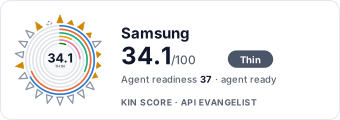
Samsung has a Kin Score of 34.1 out of 100 (thin) and an Agent Readiness score of 37.3 (agent-ready), scored by API Evangelist on 2026-11-06.
Work with this as data
Every provider here is available over the APIs.io API and to AI agents over MCP.