Ring
Ring is an Amazon home-security company (doorbells, cameras, alarm systems, and the Ring Protect subscription) that in 2026 launched the Ring Developer platform and Ring Appstore. Third-party developers can build video-powered apps against the Ring Partner API — a REST API served from api.amazonvision.com (Amazon Vision API / AVA) that follows the JSON:API format and is secured with OAuth 2.0 one-way account linking. The API exposes device discovery, device status/capabilities/location/configurations, event history, WebRTC/WHEP live video, media clip and image downloads, subscription queries, and a webhook event surface (motion, button press, device online/offline, subscription changes). Ring also publishes a remote Model Context Protocol (MCP) server backed by an Amazon Bedrock Knowledge Base so AI coding assistants can query the documentation while building integrations, and publishes a HackerOne bug-bounty via a /.well-known/security.txt.
Ring is listed with 1 API on the APIs.io network. Tagged areas include Company, Home Security, Smart Home, IoT, and Video.
The Ring catalog on APIs.io includes 1 event-driven AsyncAPI specification.
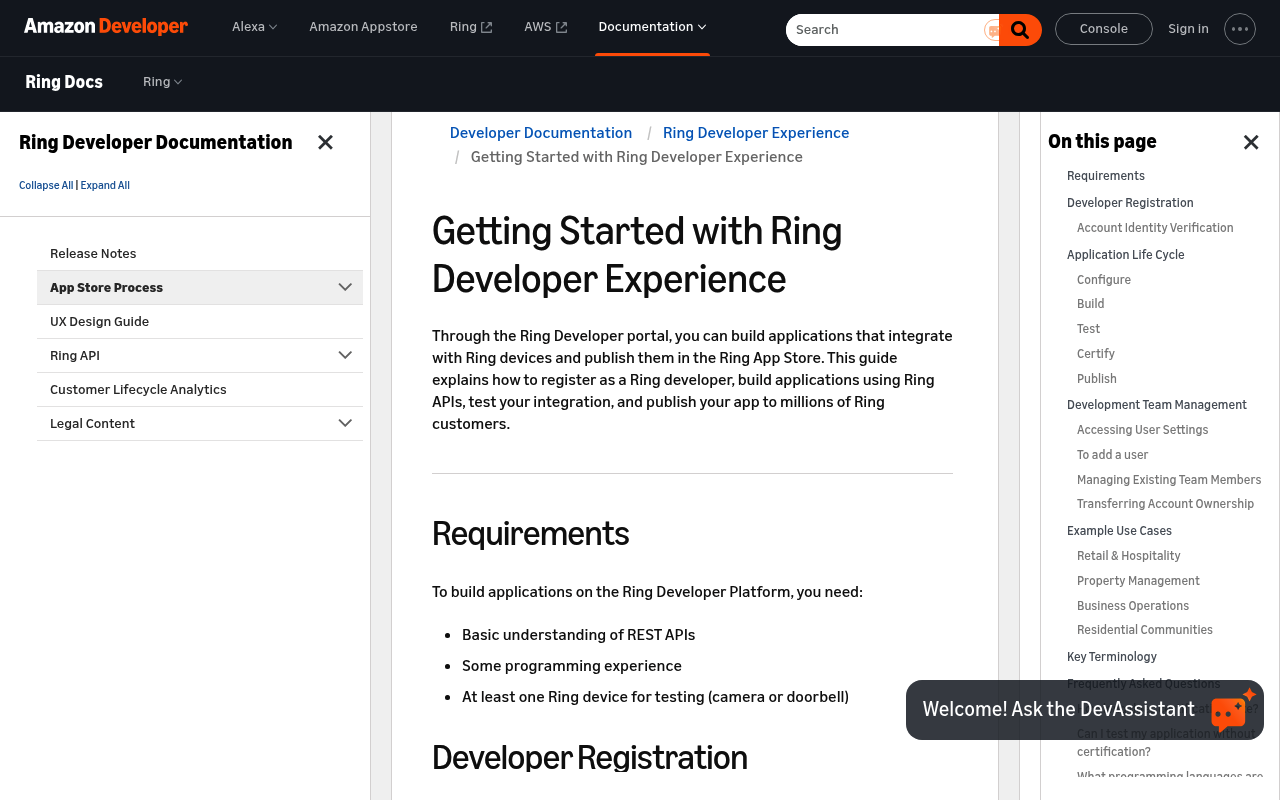
Ring’s developer surface includes documentation, API reference, getting-started guide, authentication, changelog, support, engineering blog, and 23 more developer resources.
Kin Score
 Kin Score
How this is scored →
Kin Score
How this is scored →scored 2026-10-17 · rubric v0.24.0
Markets this provider is in provisional
The Kin Score Market layer reads a provider inside its market: its position, and how deep its integrations go. Depth is only comparable within a position. Provisional and unweighted: not part of the Kin Score or agent readiness.
| Market | Position | Depth | Registered MCP server | Declares compatibility |
|---|---|---|---|---|
| IoT and Smart Home | builds-on | 34.5 (thin) | - | - |
Registered MCP server and declares compatibility are report only — not weighted. Undeclared means we found nothing we can read, so there is no number: we never infer integrations.
APIs 1
Individual APIs this provider publishes, each with its own machine-readable definition.
Ring Partner API
The Ring Partner API (Amazon Vision API / AVA) lets certified Ring Appstore partners access Ring device data and media on behalf of consenting users: list and inspect devices, r...
MCP Servers 1
Model Context Protocol servers that expose these APIs to AI agents.
Ring MCP Server
The Ring Appstore Knowledge MCP Server is a remote Model Context Protocol server backed by an Amazon Bedrock Knowledge Base. It connects an AI coding assistant (Kiro, Cursor, Cl...
MCP SERVEREvent Specifications 1
AsyncAPI definitions for this provider's event-driven and streaming APIs.
Ring Webhooks
ASYNCAPISecurity Posture 3
Authentication, domain security, vulnerability disclosure, and trust-center signals.
Resources
Get Started 2
Portal, sign-up, and the first successful call
Documentation 2
Reference material describing how the API behaves
Agent Surfaces 3
MCP servers, agent skills, and machine-readable catalogs
Design & Contract 7
Pagination, idempotency, versioning, errors, and events
Scroll for all 7
Build 1
SDKs, sample code, and the tooling you integrate with
Access & Security 5
Authentication, authorization, and security posture
Operate 3
Status, limits, changes, and where to get help
Commercial 3
Pricing, plans, and the legal terms of use
Company 3
The organization behind the API
Other 1
Properties that don't map to a standard resource type
Source (apis.yml)
Work with this as data
Every provider here is available over the APIs.io API and to AI agents over MCP.