
R-Zero
R-Zero Systems is a San Francisco based building-intelligence company founded in 2020 that combines privacy-first occupancy sensors, indoor-air-quality monitoring and AI to autonomously optimize HVAC ventilation in commercial real estate, healthcare and higher-education buildings, claiming 20-40% HVAC energy savings without retrofits or capital investment. Its software platform, R-Zero Connect, turns raw sensor telemetry into occupancy analytics, space-utilization insights and portfolio reporting. R-Zero acquired the workplace-sensor company CoWorkr, whose platform still carries the company's developer surface: a REST API for pulling historical workplace utilization data into BI tooling and a Node.js/DDP Stream API that pushes real-time occupancy events into reservation and workplace-experience applications (AgilQuest, Comfy, iOffice Hummingbird, Serraview, Teem, Tactic, Siemens). Both APIs are account-gated - documentation is served inside the authenticated application and access is granted on request - so no public OpenAPI, GraphQL, MCP or A2A surface is published.
R-Zero is listed with 2 APIs on the APIs.io network. Tagged areas include Company, Smart Buildings, Occupancy, Sensors, and IoT.
R-Zero’s developer surface includes documentation, API reference, support, engineering blog, and 20 more developer resources.
Kin Score
 Kin Score
How this is scored →
Kin Score
How this is scored →scored 2026-10-23 · rubric v0.25.0
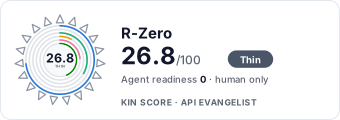 It updates itself when the score changes. Paste this where you link to your API docs:
<a href="https://apis.io/providers/r-zero/"><img src="https://apis.io/badge/r-zero/card.svg" alt="R-Zero on APIs.io — Kin Score by API Evangelist"></a>Other styles, a README pill and a shields.io endpoint are on the badge page.
Markets this provider is in provisional
The Kin Score Market layer reads a provider inside its market: its position, and how deep its integrations go. Depth is only comparable within a position. Provisional and unweighted: not part of the Kin Score or agent readiness.
| Market | Position | Depth | Registered MCP server | Declares compatibility |
|---|---|---|---|---|
| Building Automation (HVAC, BACnet, KNX, smart buildings) | undeclared | - | - | - |
Registered MCP server and declares compatibility are report only — not weighted. Undeclared means we found nothing we can read, so there is no number: we never infer integrations.
APIs 2
Individual APIs this provider publishes, each with its own machine-readable definition.
CoWorkr REST API
CoWorkr's standard REST API for pulling workplace analytical data - historical and current occupancy, utilization and device records for WorkPoints, WorkSpace Counters, WorkHubs...
CoWorkr Stream API
CoWorkr's real-time Stream API. Built on Node.js and DDP (the Meteor Distributed Data Protocol), it pushes utilization sensor updates as they happen - a raw feed used by partner...
Security Posture 2
Authentication, domain security, vulnerability disclosure, and trust-center signals.
Resources
Get Started 1
Portal, sign-up, and the first successful call
Documentation 2
Reference material describing how the API behaves
Agent Surfaces 1
MCP servers, agent skills, and machine-readable catalogs
Design & Contract 5
Pagination, idempotency, versioning, errors, and events
Build 1
SDKs, sample code, and the tooling you integrate with
Access & Security 3
Authentication, authorization, and security posture
Operate 4
Status, limits, changes, and where to get help
Commercial 2
Pricing, plans, and the legal terms of use
Company 4
The organization behind the API
Other 1
Properties that don't map to a standard resource type
Source (apis.yml)
Work with this as data
Every provider here is available over the APIs.io API and to AI agents over MCP.