Quadratic
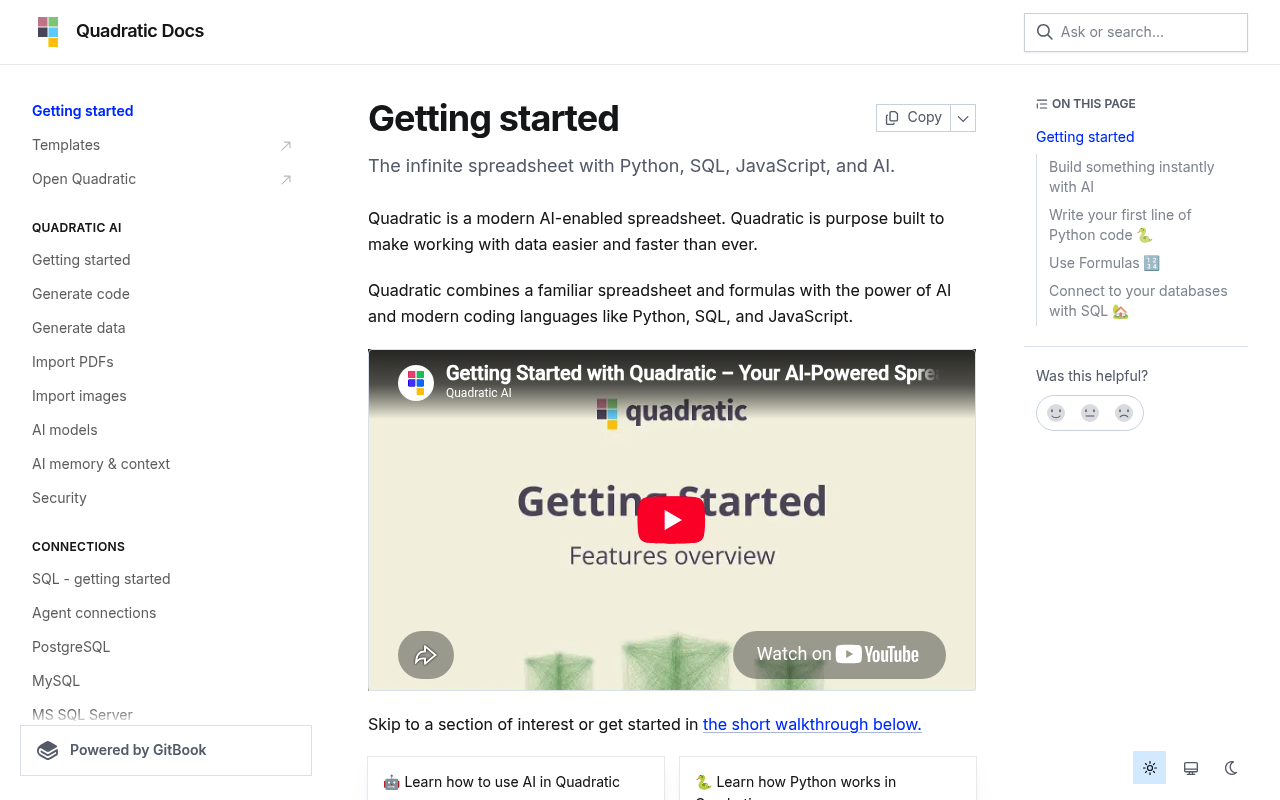
Quadratic is an AI-native infinite spreadsheet that combines Python, SQL, JavaScript, formulas, and AI agents on a single canvas, with live connections to databases like PostgreSQL, MySQL, BigQuery, and Snowflake. Its token-authenticated Developer (Spreadsheet) API and remote MCP server let agents and applications programmatically read and write cells, run code and SQL, build tables, and orchestrate spreadsheets.
Quadratic publishes 14 API contracts indexed on the APIs.io network, including Agent Connections API, Auth API, Cells API, and 11 more. Tagged areas include Company, Artificial Intelligence, Spreadsheets, Analytics, and Data.
Quadratic’s developer surface includes documentation, API reference, getting-started guide, engineering blog, pricing, signup flow, authentication, and 21 more developer resources.
Kin Score
 Kin Score
How this is scored →
Kin Score
How this is scored →scored 2026-10-17 · rubric v0.24.0
APIs 14
Individual APIs this provider publishes, each with its own machine-readable definition.
Quadratic Agent Connections API
List and inspect team agent connections (third-party REST API bindings).
Quadratic Auth API
Identity for the calling token.
Quadratic Cells API
Read and write cell values, code, formulas, formats, borders, and merges.
Quadratic Columns and rows API
Insert, delete, and resize columns and rows.
Quadratic Conditional formats API
Manage conditional-format rules.
Quadratic Connections API
Fetch schemas from registered DB connections.
Quadratic Context, outline, search API
Read-only exploration of file structure and contents.
Quadratic Documentation API
OpenAPI spec and Scalar viewer.
Quadratic Files API
Create, list, fetch, and import files.
Quadratic Health API
Liveness probes.
Quadratic History API
Undo, redo, and atomic batches of actions.
Quadratic Sheets API
Add, rename, delete, reorder, and recolor sheets.
Quadratic Tables API
Create, configure, and manage data tables.
Quadratic Validations API
Manage cell validation rules.
Scroll for all 14
Open Collections 15
Open, tool-agnostic API collections (OpenAPI-derived and Bruno).
API Collection
OPEN COLLECTIONQuadratic Developer Agent Connections API
OPEN COLLECTIONQuadratic Developer Agent Connections Auth API
OPEN COLLECTIONQuadratic Developer Agent Connections Cells API
OPEN COLLECTIONQuadratic Developer Agent Connections Columns and rows API
OPEN COLLECTIONQuadratic Developer Agent Connections API
OPEN COLLECTIONQuadratic Developer Agent Connections Documentation API
OPEN COLLECTIONQuadratic Developer Agent Connections Files API
OPEN COLLECTIONQuadratic Developer Agent Connections Health API
OPEN COLLECTIONQuadratic Developer Agent Connections History API
OPEN COLLECTIONQuadratic Developer Agent Connections Sheets API
OPEN COLLECTIONQuadratic Developer Agent Connections Tables API
OPEN COLLECTIONQuadratic Developer Agent Connections Validations API
OPEN COLLECTIONScroll for all 15
MCP Servers 1
Model Context Protocol servers that expose these APIs to AI agents.
Pricing Plans 1
Published pricing tiers and plan structures.
OpenAPI Overlays 1
Overlays applied on top of this provider's contracts. Each card says who wrote it: a document the provider publishes, or one API Evangelist derived or generated.
Quadratic Openapi Overlay
GENERATEDSecurity Posture 3
Authentication, domain security, vulnerability disclosure, and trust-center signals.
Resources
Get Started 3
Portal, sign-up, and the first successful call
Documentation 2
Reference material describing how the API behaves
Agent Surfaces 4
MCP servers, agent skills, and machine-readable catalogs
Design & Contract 4
Pagination, idempotency, versioning, errors, and events
Build 3
SDKs, sample code, and the tooling you integrate with
Access & Security 4
Authentication, authorization, and security posture
Operate 1
Status, limits, changes, and where to get help
Commercial 4
Pricing, plans, and the legal terms of use
Company 2
The organization behind the API
Other 1
Properties that don't map to a standard resource type
Source (apis.yml)
Work with this as data
Every provider here is available over the APIs.io API and to AI agents over MCP.