
Positron
Positron AI is a US-based generative-AI hardware company founded in 2023 and headquartered in Reno, Nevada, building purpose-built Transformer inference accelerators as an alternative to GPU-based inference infrastructure. Its shipping product, Atlas, is a rack inference appliance built on eight in-house Archer accelerators (256 GB HBM) and dual AMD EPYC Genoa processors, with the next-generation Asimov silicon and Titan system slated for 2027. Positron exposes its inference fleet through "Olivaw", a serving and administration layer that publishes two documented HTTP APIs: an OpenAI-compatible completions API (models, chat completions, text completions, with server-sent-event streaming) so existing OpenAI client code can be repointed at a Positron endpoint, and an administrative API for managing models, service nodes, users, and access tokens on an appliance or hosted cluster. The company raised a $230M Series B in February 2026 at a valuation above $1B from ARENA, Jump Trading, Unless, the Qatar Investment Authority, Arm, Helena, DFJ Growth, Atreides, Valor, Resilience Reserve, Flume Ventures and 1517 Fund.
Positron publishes 5 API contracts indexed on the APIs.io network, including Access Tokens API, Completion API, Models API, and 2 more. Tagged areas include Artificial Intelligence, Inference, inference-hardware, AI Accelerators, and LLM.
Positron’s developer surface includes documentation, API reference, getting-started guide, support, changelog, authentication, and 25 more developer resources.
Kin Score
 Kin Score
How this is scored →
scored 2026-10-23 · rubric v0.25.0
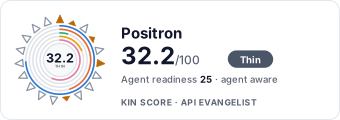 It updates itself when the score changes. Paste this where you link to your API docs:
<a href="https://apis.io/providers/positron/"><img src="https://apis.io/badge/positron/card.svg" alt="Positron on APIs.io — Kin Score by API Evangelist"></a>Other styles, a README pill and a shields.io endpoint are on the badge page.
Markets this provider is in provisional
The Kin Score Market layer reads a provider inside its market: its position, and how deep its integrations go. Depth is only comparable within a position. Provisional and unweighted: not part of the Kin Score or agent readiness.
| Market | Position | Depth | Registered MCP server | Declares compatibility |
|---|---|---|---|---|
| Data Center Tier Certification (facility certification, open hardware, efficiency bodies) | undeclared | - | - | - |
| Semiconductor Consortia (RISC-V, OCP hardware, CHIPS awards) | undeclared | - | - | - |
Registered MCP server and declares compatibility are report only — not weighted. Undeclared means we found nothing we can read, so there is no number: we never infer integrations.
Standards implemented 1
Standards this provider implements or carries. De facto ones are profiled and measured by the API Commons; formal ones come from the standards directory and are linked by the provider's own tags. The evidence column says how each claim was established — not that it was made.
APIs 5
Individual APIs this provider publishes, each with its own machine-readable definition.
Positron Access Tokens API
The access_tokens API from Positron — 3 operation(s) for access_tokens.
Positron Completion API
The completion API from Positron — 2 operation(s) for completion.
Positron Models API
The models API from Positron — 5 operation(s) for models.
Positron Service Nodes API
The service_nodes API from Positron — 2 operation(s) for service_nodes.
Positron Users API
The users API from Positron — 3 operation(s) for users.
Open Collections 7
Open, tool-agnostic API collections (OpenAPI-derived and Bruno).
Olivaw Admin Access Tokens API
OPEN COLLECTIONOlivaw Admin API
OPEN COLLECTIONOlivaw OpenAI Completion API
OPEN COLLECTIONOlivaw OpenAI API
OPEN COLLECTIONPositron Models API
OPEN COLLECTIONOlivaw Admin Service Nodes API
OPEN COLLECTIONOlivaw Admin Users API
OPEN COLLECTIONScroll for all 7
OpenAPI Overlays 2
Overlays applied on top of this provider's contracts. Each card says who wrote it: a document the provider publishes, or one API Evangelist derived or generated.
Positron Admin Overlay
DERIVEDPositron Inference Overlay
DERIVEDSecurity Posture 2
Authentication, domain security, vulnerability disclosure, and trust-center signals.
Agentic Access 1
Recommended x-agentic-access execution contracts for AI agents.
Resources
Get Started 2
Portal, sign-up, and the first successful call
Documentation 4
Reference material describing how the API behaves
Agent Surfaces 5
MCP servers, agent skills, and machine-readable catalogs
Design & Contract 5
Pagination, idempotency, versioning, errors, and events
Build 2
SDKs, sample code, and the tooling you integrate with
Access & Security 2
Authentication, authorization, and security posture
Operate 4
Status, limits, changes, and where to get help
Company 5
The organization behind the API
Other 2
Properties that don't map to a standard resource type
Source (apis.yml)
Work with this as data
Every provider here is available over the APIs.io API and to AI agents over MCP.