Podia is an all-in-one creator platform for selling online courses, digital downloads, coaching, webinars, and memberships, with a website builder, blog, communities, and built-in email marketing. As of this review, Podia does NOT offer a public or partner developer API and does not expose webhooks. The company's own help center states plainly that "Podia does not offer a public API or webhooks," and directs builders to Zapier as the only supported integration path. The logical resources below (products, customers/audience, community, and sales) are therefore documented as endpointsModeled - they reflect the objects and events Podia surfaces through its Zapier app, not a first-party REST API. There is no published base URL, authentication scheme, or OpenAPI description to catalog. What Podia does publish, and what this profile captures, is a real client-side surface: an Advanced JavaScript tracking API exposing Podia.Customer and Podia.Conversion objects plus three DOM CustomEvents on every storefront page, an embeddable email-capture form that POSTs to a per-creator subscriptions endpoint, and a 509-link llms.txt at help.podia.com that renders every help article as markdown. Podia also runs a public Atlassian status page and a Beamer changelog, and allows GPTBot, ClaudeBot and PerplexityBot in robots.txt - the missing agent surface here is a missing API product, not an anti-AI posture.
Podia publishes no API. The 4 entries listed on the APIs.io network are product areas recorded for completeness, each marked as not an API. Tagged areas include Creator Economy, Online Courses, Digital Products, Membership, and Email Marketing.
Podia’s developer surface includes documentation, changelog, support, engineering blog, pricing, signup flow, and 17 more developer resources.
Regulatory Posture applies to this provider. Its tags matched the
Horizontal (data, software, accessibility, platform) regime, so
Regulatory Posture carries 15 points of the composite.
If this regime is wrong for your business, say so on your
provider repo — the
applicability map is public and we will correct it.
Create-or-Update Ergonomics could not be measured. We hold no machine-readable contract for
this provider to read, so there is nothing to measure a write surface against. Excluded rather than scored zero:
never-measured and measured-empty are different facts. Publishing an OpenAPI is what makes this facet — and
several others — scorable at all.
The six quality facets above are damped to 85 points between them,
because the conditional facet above carries the other
15. That is why each facet's contribution is shown against a damped
maximum: raising a quality facet moves the composite by 85% of its nominal
weight, not 100%. The full arithmetic is at apis.io/rating/.
Show this score on your site.
It updates itself when the score changes. Paste this where you link to your API docs:
<a href="https://apis.io/providers/podia/"><img src="https://apis.io/badge/podia/card.svg" alt="Podia on APIs.io — Kin Score by API Evangelist"></a>
Other styles, a README pill and a shields.io endpoint are on the badge page.
Improve this rating by publishing the missing artifacts — every area above can be raised, and the full rubric is at apis.io/rating/. Every facet and dimension name above is a link: it opens that measurement's own page — what it means, the exact checks that feed it, how the whole catalog distributes on it, and the providers at the top of it. This rating is computed from github.com/api-evangelist/podia: open an issue to ask a question, or submit a pull request to add artifacts.
Submit an artifact on GitHub — free →Manage your own listing — the Influence plan, $499/mo →
Markets this provider is in provisional
The Kin Score Market layer reads a provider inside its market:
its position, and how deep its integrations go. Depth is only comparable within a position. Provisional and unweighted:
not part of the Kin Score or agent readiness.
Registered MCP server and declares compatibility are report only — not weighted.
Undeclared means we found nothing we can read, so there is no number: we never infer integrations.
Logical surface for Podia products - online courses, digital downloads, coaching, and webinars. Podia does not expose a public REST API for products; enrollment can only be auto...
Logical surface for Podia customers, email audience, and tags. No public REST API exists. Through Zapier, Podia can add someone to your audience and subscribe them for email, ap...
Logical surface for Podia communities and membership plans. No public REST API is documented. Zapier exposes "Someone Joins Community" and "Someone Leaves Community" triggers, p...
Logical surface for Podia sales and orders. No public REST API or webhook is available to receive order data. Zapier surfaces a "New Sale" trigger that fires when someone purcha...
aid: podia
url: https://raw.githubusercontent.com/api-evangelist/podia/refs/heads/main/apis.yml
x-api-posture: no-product-api
x-api-posture-basis: observed
x-api-posture-note: The company's own help center states plainly that 'Podia does not offer a public API or webhooks,' and
  directs builders to Zapier as the only supported integration path.
name: Podia
kind: company
description: 'Podia is an all-in-one creator platform for selling online courses, digital downloads, coaching, webinars, and
  memberships, with a website builder, blog, communities, and built-in email marketing. As of this review, Podia does NOT
  offer a public or partner developer API and does not expose webhooks. The company''s own help center states plainly that
  "Podia does not offer a public API or webhooks," and directs builders to Zapier as the only supported integration path.
  The logical resources below (products, customers/audience, community, and sales) are therefore documented as endpointsModeled
  - they reflect the objects and events Podia surfaces through its Zapier app, not a first-party REST API. There is no published
  base URL, authentication scheme, or OpenAPI description to catalog. What Podia does publish, and what this profile captures,
  is a real client-side surface: an Advanced JavaScript tracking API exposing Podia.Customer and Podia.Conversion objects
  plus three DOM CustomEvents on every storefront page, an embeddable email-capture form that POSTs to a per-creator subscriptions
  endpoint, and a 509-link llms.txt at help.podia.com that renders every help article as markdown. Podia also runs a public
  Atlassian status page and a Beamer changelog, and allows GPTBot, ClaudeBot and PerplexityBot in robots.txt - the missing
  agent surface here is a missing API product, not an anti-AI posture.'
deliveryModel:
  model: saas
  open_source: false
  commercial: true
  callable_host: false
  label: Hosted service · you call their endpoint
  confidence: medium
  source:
  - pricing
  generated: '2026-08-28'
  method: derived
accessModel:
  pricing: free-trial
  onboarding: unknown
  trial: true
  try_now: false
  public: false
  gated: private
  gated_source:
  - tag:No Public API
  label: Free trial
  confidence: medium
  source:
  - plans
  generated: '2026-07-22'
  method: derived
image: https://kinlane-images.s3.amazonaws.com/shared/apis-json/icons/podia.png
tags:
- Creator Economy
- Online Courses
- Digital Products
- Membership
- Email Marketing
- Zapier Only
- Creator Platform
- Community
- Website Builder
- Client-Side JavaScript
tags_raw:
- Creator Economy
- Online Courses
- Digital Products
- Memberships
- Email Marketing
- Zapier Only
- Creator Platform
- Communities
- Website Builder
- Client-Side JavaScript
created: '2026-07-05'
modified: '2026-08-13'
specificationVersion: '0.23'
apis:
- aid: podia:podia-products-api
  x-published: false
  name: Podia Products API
  tags:
  - Product
  - Courses
  - Digital Downloads
  - Modeled
  tags_raw:
  - Products
  - Courses
  - Digital Downloads
  - Modeled
  image: https://kinlane-images.s3.amazonaws.com/shared/apis-json/apis-json-logo.jpg
  humanURL: https://help.podia.com/en/articles/11371075-does-podia-have-a-public-api-or-webhooks
  endpointsModeled: true
  properties:
  - url: https://help.podia.com/en/articles/11371075-does-podia-have-a-public-api-or-webhooks
    type: Documentation
  - url: https://zapier.com/apps/podia/integrations
    type: Integrations
  description: Logical surface for Podia products - online courses, digital downloads, coaching, and webinars. Podia does
    not expose a public REST API for products; enrollment can only be automated through the Zapier "Sign Someone Up for a
    Product" action and the "Product Signed Up For" trigger (write actions require the Shaker plan). Endpoints are modeled
    from those Zapier capabilities, not fetched from a first-party API reference.
- aid: podia:podia-customers-audience-api
  x-published: false
  name: Podia Customers and Audience API
  tags:
  - Customers
  - Audiences
  - Email Subscribers
  - Modeled
  tags_raw:
  - Customers
  - Audience
  - Email Subscribers
  - Modeled
  image: https://kinlane-images.s3.amazonaws.com/shared/apis-json/apis-json-logo.jpg
  humanURL: https://help.podia.com/en/articles/11371075-does-podia-have-a-public-api-or-webhooks
  endpointsModeled: true
  properties:
  - url: https://help.podia.com/en/articles/11371075-does-podia-have-a-public-api-or-webhooks
    type: Documentation
  - url: https://zapier.com/apps/podia/integrations
    type: Integrations
  description: Logical surface for Podia customers, email audience, and tags. No public REST API exists. Through Zapier, Podia
    can add someone to your audience and subscribe them for email, apply and react to tags ("Someone Gets Tagged"), and add
    people to a product waitlist ("Someone Waitlists"). Endpoints are modeled from these Zapier triggers and actions rather
    than a documented API.
- aid: podia:podia-community-api
  x-published: false
  name: Podia Community API
  tags:
  - Community
  - Membership
  - Spaces
  - Modeled
  - Space
  tags_raw:
  - Community
  - Memberships
  - Spaces
  - Modeled
  - Space
  image: https://kinlane-images.s3.amazonaws.com/shared/apis-json/apis-json-logo.jpg
  humanURL: https://help.podia.com/en/articles/11371075-does-podia-have-a-public-api-or-webhooks
  endpointsModeled: true
  properties:
  - url: https://help.podia.com/en/articles/11371075-does-podia-have-a-public-api-or-webhooks
    type: Documentation
  - url: https://zapier.com/apps/podia/integrations
    type: Integrations
  description: Logical surface for Podia communities and membership plans. No public REST API is documented. Zapier exposes
    "Someone Joins Community" and "Someone Leaves Community" triggers, plus actions to add or remove a community member. Endpoints
    are modeled from those Zapier events, not from a first-party API.
- aid: podia:podia-sales-api
  x-published: false
  name: Podia Sales API
  tags:
  - Sales
  - Order
  - Transaction
  - Modeled
  tags_raw:
  - Sales
  - Orders
  - Transactions
  - Modeled
  image: https://kinlane-images.s3.amazonaws.com/shared/apis-json/apis-json-logo.jpg
  humanURL: https://help.podia.com/en/articles/11371075-does-podia-have-a-public-api-or-webhooks
  endpointsModeled: true
  properties:
  - url: https://help.podia.com/en/articles/11371075-does-podia-have-a-public-api-or-webhooks
    type: Documentation
  - url: https://zapier.com/apps/podia/integrations
    type: Integrations
  description: Logical surface for Podia sales and orders. No public REST API or webhook is available to receive order data.
    Zapier surfaces a "New Sale" trigger that fires when someone purchases a free or paid course or digital download, which
    is the only supported way to react to a transaction programmatically. Endpoints are modeled from that Zapier trigger,
    not a documented API.
common:
- type: DomainSecurity
  url: security/podia-domain-security.yml
- type: LinkedIn
  url: https://www.linkedin.com/company/podiadotcom
- type: Website
  url: https://www.podia.com
- type: Documentation
  url: https://help.podia.com/en/articles/11371075-does-podia-have-a-public-api-or-webhooks
- type: Integrations
  url: https://zapier.com/apps/podia/integrations
- type: Plans
  url: plans/podia-plans-pricing.yml
- type: RateLimits
  url: rate-limits/podia-rate-limits.yml
- type: LLMsTxt
  url: llms/podia-llms.txt
- type: ChangeLog
  url: changelog/podia-changelog.yml
- type: Lifecycle
  url: lifecycle/podia-lifecycle.yml
- type: StatusPage
  url: https://podia.statuspage.io
- type: Components
  url: components/podia-components.yml
- type: DataModel
  url: data-model/podia-data-model.yml
- type: Conformance
  url: conformance/podia-conformance.yml
- type: Compliance
  url: https://www.podia.com/dpa
- type: Integrations
  url: integrations/podia-zapier-surface.yml
- type: HelpCenter
  url: https://help.podia.com
- type: Support
  url: https://help.podia.com
- type: Blog
  url: https://www.podia.com/articles
- type: GitHubOrganization
  url: https://github.com/podia
- type: Pricing
  url: https://www.podia.com/pricing
- type: SignUp
  url: https://www.podia.com/signup
- type: Login
  url: https://app.podia.com/login
- type: TermsOfService
  url: https://www.podia.com/terms
- type: PrivacyPolicy
  url: https://www.podia.com/privacy
maintainers:
- FN: Kin Lane
  email: kin@apievangelist.com
x-enrichment:
  date: '2026-08-13'
  status: enriched
  artifacts_added: 9
  pass: local-v1
x-coverage:
  state: none
  reason: no-developer-program
  detail: 'Podia''s own help center article "Does Podia have a public API or webhooks?" answers itself in one line - "Podia
    does not offer a public API or webhooks" - and every contract probe agreed: api.podia.com resolves but serves an HTML
    404 at /openapi.json, /swagger.json, /api-docs and /graphql, and developers.podia.com, developer.podia.com and docs.podia.com
    do not exist.'
  evidence:
  - url: https://help.podia.com/en/articles/11371075-does-podia-have-a-public-api-or-webhooks.md
    status: 200
  - url: https://api.podia.com/openapi.json
    status: 404
  - url: https://developers.podia.com/
    status: 404
  - url: https://www.podia.com/.well-known/agent-card.json
    status: 404
  - url: https://help.podia.com/llms.txt
    status: 200
  checked: '2026-08-13'
x-tags-removed:
- No Public API
Discovery needs no key. Ratings and market analysis are Pro.
Get an API key
Free tier, no form to fill in. Signing in shares your email address with us — we
store it to create your key and to recognise you if you sign in with another
provider. See our Privacy Policy and
Terms.

 Kin Score
How this is scored →
Kin Score
How this is scored →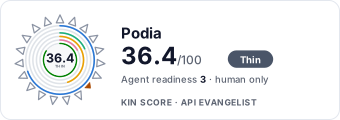 It updates itself when the score changes. Paste this where you link to your API docs: