Home Providers Plerion
Plerion
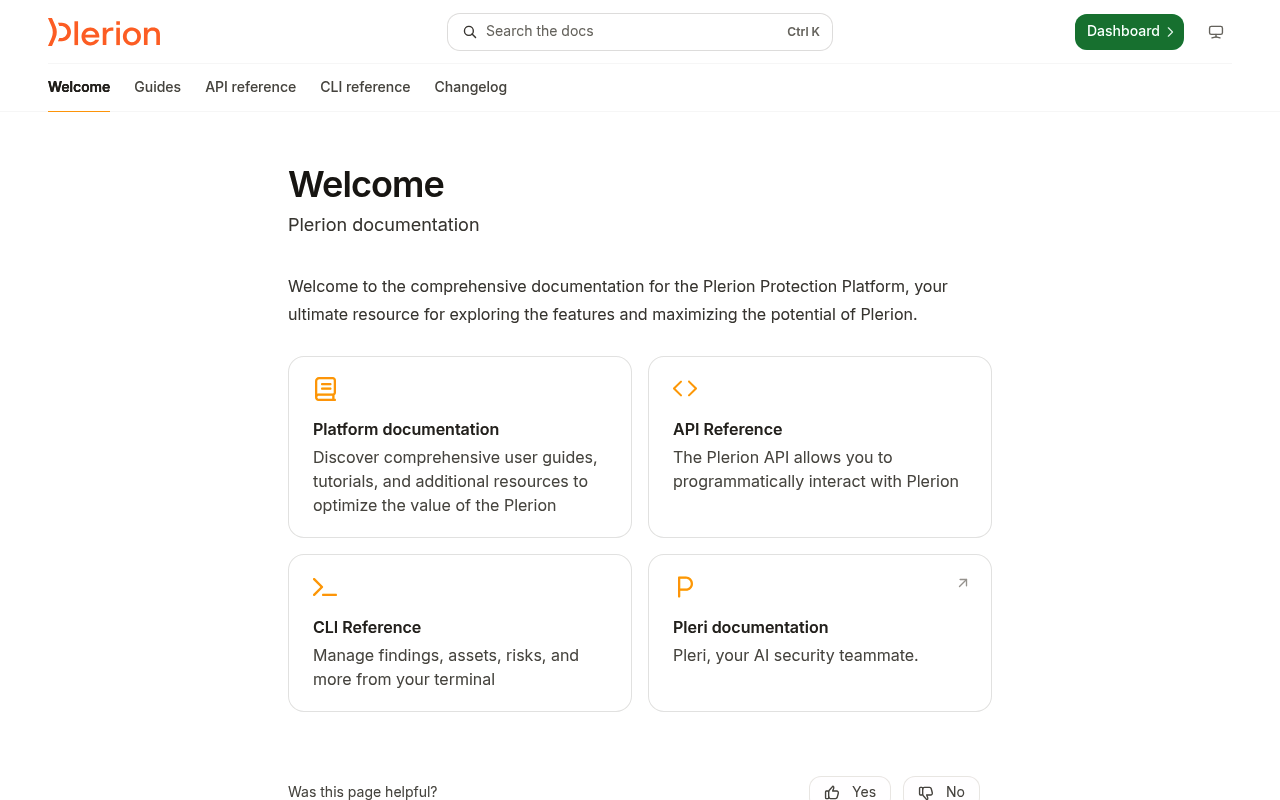
Plerion is an AI-powered cloud security platform that gives teams unified visibility and automated remediation across cloud, code, and AI. It covers Cloud Security Posture Management (CSPM) for AWS, Azure, GCP, and Kubernetes; Cloud Workload Protection (CWPP) with vulnerability and SBOM scanning; Code Security (IaC and SCA scanning for GitHub, GitLab, and Bitbucket); AI Security Posture Management (AI-SPM) for Bedrock, OpenAI, and Anthropic deployments; attack-path analysis, entitlements analysis, resource access grants, and compliance tracking against frameworks like ISO 27001, SOC 2, CIS, and ISMS-P. Plerion exposes a tenant-scoped REST API (Bearer API key, regional hosts) plus a cross-platform CLI so teams can query findings, assets, risks, vulnerabilities, and compliance posture programmatically.
Plerion publishes 13 API contracts indexed on the APIs.io network, including Alerts API, Asset groups API, Assets API, and 10 more. Tagged areas include Company, Security, Cloud Security, CSPM, and Cloud Workload Protection.
Plerion’s developer surface includes documentation, API reference, getting-started guide, authentication, CLI, changelog, engineering blog, and 25 more developer resources.
1 published contract
On this page
Kin Score Standards 1
APIs 13
Open Collections 14
Overlays 1
Security Posture 4
Resources 32
apis.yml
Business capabilities this provider's published APIs can perform, derived from its own
contracts. Browse all capabilities →
29 Operational Transparency
0 Create-or-Update Ergonomics
Composite quality — 47.0/100 · developing
Agent readiness — 27/100 · agent aware
Standards this provider implements or carries. De facto ones are profiled and measured by the API Commons ; formal ones come from the standards directory and are linked by the provider's own tags. The evidence column says how each claim was established — not that it was made.
tagged — the provider's own APIs.json carries the standard as a tag; implementation not verified
Individual APIs this provider publishes, each with its own machine-readable definition.
Scroll for all 13
Open, tool-agnostic API collections (OpenAPI-derived and Bruno).
Scroll for all 14
Overlays applied on top of this provider's contracts. Each card says who wrote it: a document the provider publishes, or one API Evangelist derived or generated.
Authentication, domain security, vulnerability disclosure, and trust-center signals.
Get Started 3
Portal, sign-up, and the first successful call
Documentation 2
Reference material describing how the API behaves
Agent Surfaces 4
MCP servers, agent skills, and machine-readable catalogs
Design & Contract 5
Pagination, idempotency, versioning, errors, and events
Build 3
SDKs, sample code, and the tooling you integrate with
Access & Security 5
Authentication, authorization, and security posture
Operate 2
Status, limits, changes, and where to get help
Commercial 3
Pricing, plans, and the legal terms of use
Company 3
The organization behind the API
Other 2
Properties that don't map to a standard resource type
Source (apis.yml)
aid: plerion
name: Plerion
description: Plerion is an AI-powered cloud security platform that gives teams unified visibility and automated remediation
  across cloud, code, and AI. It covers Cloud Security Posture Management (CSPM) for AWS, Azure, GCP, and Kubernetes; Cloud
  Workload Protection (CWPP) with vulnerability and SBOM scanning; Code Security (IaC and SCA scanning for GitHub, GitLab,
  and Bitbucket); AI Security Posture Management (AI-SPM) for Bedrock, OpenAI, and Anthropic deployments; attack-path analysis,
  entitlements analysis, resource access grants, and compliance tracking against frameworks like ISO 27001, SOC 2, CIS, and
  ISMS-P. Plerion exposes a tenant-scoped REST API (Bearer API key, regional hosts) plus a cross-platform CLI so teams can
  query findings, assets, risks, vulnerabilities, and compliance posture programmatically.
url: https://raw.githubusercontent.com/api-evangelist/plerion/refs/heads/main/apis.yml
deliveryModel:
  model: saas
  open_source: false
  commercial: true
  callable_host: true
  label: Hosted service · you call their endpoint
  confidence: high
  source:
  - openapi
  - pricing
  generated: '2026-08-28'
  method: derived
accessModel:
  pricing: unknown
  onboarding: unknown
  trial: false
  try_now: false
  public: false
  label: Unknown
  confidence: low
  source:
  - authentication
  - security
  generated: '2026-09-03'
  method: derived
image: https://www.plerion.com/favicon.ico
x-type: company
x-source: vc-portfolio
x-backed-by:
- prosus-ventures
x-tier: stub
x-tier-reason: portfolio-lead
specificationVersion: '0.23'
created: '2026-07-17'
modified: '2026-10-06'
x-docs-platform: mintlify
x-docs-platform-confidence: medium
x-docs-platform-checked: 2026-10-04
x-docs-hosting: vercel
tags:
- Company
- Security
- Cloud Security
- CSPM
- Cloud Workload Protection
- Vulnerability Management
- Compliance
- AI Security
- DevSecOps
tags_raw:
- Company
- Security
- Cloud Security
- CSPM
- Cloud Workload Protection
- Vulnerability Management
- Compliance
- AI Security
- DevSecOps
- API
apis:
- aid: plerion:plerion-alerts-api
  name: Plerion Alerts API
  description: "The Plerion Risk Score (PRS) Engine has calculated Alerts that are the highest priority items based on the\
    \ available information across Identity, Configuration, and Vulnerability Management. \nAlerts offer the highest value\
    \ CONTEXT from across the Plerion Platform. Alerts are accompanied by a narrative to guide customers on the overall risk\
    \ and the recommended remediation steps to take to improve, reduce, or eradicate the identified risk."
  humanURL: https://docs.plerion.com/api-reference
  baseURL: https://au.api.plerion.com
  tags:
  - Alerts
  properties:
  - type: OpenAPI
    url: openapi/plerion-alerts-api-openapi.yml
  - type: Authentication
    url: authentication/plerion-authentication.yml
  - type: Conventions
    url: conventions/plerion-conventions.yml
  - type: ErrorCatalog
    url: errors/plerion-problem-types.yml
  - type: DataModel
    url: data-model/plerion-data-model.yml
  - type: Conformance
    url: conformance/plerion-conformance.yml
- aid: plerion:plerion-asset-groups-api
  name: Plerion Asset groups API
  description: Asset Group is classifying assets into specific group based on the different criteria such as integration,
    asset tag, resource type and resource name.  This helps users to manage, organize, and analyze their assets more efficiently.  User
    can group assets based on the teams, projects, business units, environments, tech stack etc.
  humanURL: https://docs.plerion.com/api-reference
  baseURL: https://au.api.plerion.com
  tags:
  - Asset groups
  properties:
  - type: OpenAPI
    url: openapi/plerion-asset-groups-api-openapi.yml
  - type: Authentication
    url: authentication/plerion-authentication.yml
  - type: Conventions
    url: conventions/plerion-conventions.yml
  - type: ErrorCatalog
    url: errors/plerion-problem-types.yml
  - type: DataModel
    url: data-model/plerion-data-model.yml
  - type: Conformance
    url: conformance/plerion-conformance.yml
- aid: plerion:plerion-assets-api
  name: Plerion Assets API
  description: 'Plerion Assets form the basis upon which all Plerion contextual security is reported.


    Every unique cloud resource on which Plerion collects information is classified as a single asset on the Plerion platform.


    A detailed asset view combines various sources of security, compliance, and risk-related metrics to empower customers
    to make high-impact decisions when evaluating a single asset in relation to their overall cloud environments.'
  humanURL: https://docs.plerion.com/api-reference
  baseURL: https://au.api.plerion.com
  tags:
  - Assets
  properties:
  - type: OpenAPI
    url: openapi/plerion-assets-api-openapi.yml
  - type: Authentication
    url: authentication/plerion-authentication.yml
  - type: Conventions
    url: conventions/plerion-conventions.yml
  - type: ErrorCatalog
    url: errors/plerion-problem-types.yml
  - type: DataModel
    url: data-model/plerion-data-model.yml
  - type: Conformance
    url: conformance/plerion-conformance.yml
- aid: plerion:plerion-audit-logs-api
  name: Plerion Audit logs API
  description: 'Audit logs provide a comprehensive trail of user activities and system operations within a tenant.

    These logs capture important events such as user logins, API calls, configuration changes, and other security-relevant
    activities. Audit logs help with compliance, security monitoring, and troubleshooting.'
  humanURL: https://docs.plerion.com/api-reference
  baseURL: https://au.api.plerion.com
  tags:
  - Audit Logs
  tags_raw:
  - Audit logs
  properties:
  - type: OpenAPI
    url: openapi/plerion-audit-logs-api-openapi.yml
  - type: Authentication
    url: authentication/plerion-authentication.yml
  - type: Conventions
    url: conventions/plerion-conventions.yml
  - type: ErrorCatalog
    url: errors/plerion-problem-types.yml
  - type: DataModel
    url: data-model/plerion-data-model.yml
  - type: Conformance
    url: conformance/plerion-conformance.yml
- aid: plerion:plerion-aws-integration-api
  name: Plerion AWS integration API
  description: "In order to connect your AWS account to Plerion or update existing account, you will need, <ol>\n  <li> <b>CloudFormation\
    \ Template URL</b>. Retrieve the template from <a href=\"#tag/AWS-Integration/operation/getCloudformationTemplate\">Get\n\
    CloudFormation template</a></li>\n  <li> <b>External Id</b> of the tenant. Retrieve the External Id from <a href=\"#tag/AWS-Integration/operation/getExternalId\"\
    >Get\nthe external id of the tenant</a></li>\n  <li> <b>Plerion AWS Account Id</b>. The value will always be <code>588158338731</code></li>\n\
    \  <li> <b>Temporary Auth Token</b>. Token to be passed to CloudFormation template that auto registers\nthe AWS integration.\
    \ Retrieve the temporary auth token from <a href=\"#tag/AWS-Integration/operation/createTemporaryToken\">Generate temporary\
    \ token for creating AWS integration</a></li>\n  <li> <b>Plerion API URL</b>. The value will always be <code>au.api.plerion.com</code></li>\n\
    \  <li> Select <b>Capabilities</b>. Select CSPM for CSPM only capability or ALL for both CSPM and CWPP\ncapability.</li>\n\
    \  <li> Select <b>KMSKeyAccessMode</b>. When CWPP is enabled, you can choose the KMS Key access mode\nto facilitate Plerion's\
    \ access to keys for decrypting volumes, images, and lambda code. In the <b>ALL_KEYS</b> mode, Plerion is granted access\
    \ to all KMS keys in the account. However, you have the option to restrict access to certain keys by applying the \"PlerionAccess:\
    \ Denied\" tag. Alternatively, the <b>SELECTED_KEYS</b> mode allows Plerion access solely to the KMS keys that have been\
    \ tagged with \"PlerionAccess: Granted\".</li> </ol> Passing the parameters to the CloudFormation template will create\
    \ a new AWS integration or update existing integration. <br/><br/>\n<h3><b>Quick Start</b></h3>\nFollow the guide to create\
    \ a new AWS integration or update existing integration using <code>curl</code> command.  <br/> <b>Note:</b> Replace {$PLERION_API_KEY}\
    \ with your API key. <br/><br/>\n<h4> <b>Create a new AWS Integration</b></h4>\n<pre>\n  export PLERION_API_URL=au.api.plerion.com\n\
    \  export PLERION_API_KEY={$PLERION_API_KEY}\n  export PLERION_AWS_ACCOUNT_ID=588158338731\n  # Fetch the template URL\n\
    \  export TEMPLATE_URL=$(curl -s GET  \"https://$PLERION_API_URL/v1/tenant/cloudformation-templates?type=AWSAccount\"\n\
    -H \"Authorization: Bearer $PLERION_API_KEY\" | jq -r '.data.templateURL')\n  # Generate the temporary auth token\n  export\
    \ TEMP_AUTH_TOKEN=$(curl -s -X POST  \"https://$PLERION_API_URL/v1/tenant/integrations/token\"\n-H \"Authorization: Bearer\
    \ $PLERION_API_KEY\" | jq -r '.data.token')\n  # Fetch the external ID\n  export EXTERNAL_ID=$(curl -s -X GET  \"https://$PLERION_API_URL/v1/tenant/external-id\"\
    \ -H \"Authorization:\nBearer $PLERION_API_KEY\" | jq -r '.data.externalId')\n  # Create the stack\n  export PLERION_STACK_NAME=plerion-aws-integration\n\
    \  aws cloudformation create-stack --stack-name $PLERION_STACK_NAME --template-url $TEMPLATE_URL --capabilities\nCAPABILITY_NAMED_IAM\
    \ \\\n    --parameters ParameterKey=ExternalId,ParameterValue=$EXTERNAL_ID \\\n      ParameterKey=PlerionAccountId,ParameterValue=$PLERION_AWS_ACCOUNT_ID\
    \  \\\n      ParameterKey=AuthToken,ParameterValue=$TEMP_AUTH_TOKEN \\\n      ParameterKey=Capabilities,ParameterValue=ALL\
    \ \\\n      ParameterKey=KMSKeyAccessMode,ParameterValue=\"ALL_KEYS\" \\\n      ParameterKey=PlerionURL,ParameterValue=$PLERION_API_URL\n\
    \  # Wait for the stack to complete\n  aws cloudformation wait stack-create-complete --stack-name $PLERION_STACK_NAME\n\
    </pre> <br/><br/> <h4> <b>Update an existing AWS Integration</b></h4>\n<pre>\n  export PLERION_API_URL=au.api.plerion.com\n\
    \  export PLERION_API_KEY={$PLERION_API_KEY}\n  export PLERION_AWS_ACCOUNT_ID=588158338731\n  # Fetch the template URL\n\
    \  export TEMPLATE_URL=$(curl -s GET  \"https://$PLERION_API_URL/v1/tenant/cloudformation-templates?type=AWSAccount\"\n\
    -H \"Authorization: Bearer $PLERION_API_KEY\" | jq -r '.data.templateURL')\n  # Generate the temporary auth token\n  export\
    \ TEMP_AUTH_TOKEN=$(curl -s -X POST  \"https://$PLERION_API_URL/v1/tenant/integrations/token\"\n-H \"Authorization: Bearer\
    \ $PLERION_API_KEY\" | jq -r '.data.token')\n  # Fetch the external ID\n  export EXTERNAL_ID=$(curl -s -X GET  \"https://$PLERION_API_URL/v1/tenant/external-id\"\
    \ -H \"Authorization:\nBearer $PLERION_API_KEY\" | jq -r '.data.externalId')\n  # Update an existing stack\n  export PLERION_STACK_NAME=plerion-aws-integration\n\
    \  aws cloudformation update-stack --stack-name $PLERION_STACK_NAME --template-url $TEMPLATE_URL --capabilities\nCAPABILITY_NAMED_IAM\
    \ \\\n    --parameters ParameterKey=ExternalId,ParameterValue=$EXTERNAL_ID \\\n      ParameterKey=PlerionAccountId,ParameterValue=$PLERION_AWS_ACCOUNT_ID\
    \  \\\n      ParameterKey=AuthToken,ParameterValue=$TEMP_AUTH_TOKEN \\\n      ParameterKey=Capabilities,ParameterValue=ALL\
    \ \\\n      ParameterKey=KMSKeyAccessMode,ParameterValue=\"ALL_KEYS\" \\\n      ParameterKey=PlerionURL,ParameterValue=$PLERION_API_URL\n\
    \  # Wait for the stack to complete\n  aws cloudformation wait stack-update-complete --stack-name $PLERION_STACK_NAME\n\
    </pre>"
  humanURL: https://docs.plerion.com/api-reference
  baseURL: https://au.api.plerion.com
  tags:
  - AWS integration
  properties:
  - type: OpenAPI
    url: openapi/plerion-aws-integration-api-openapi.yml
  - type: Authentication
    url: authentication/plerion-authentication.yml
  - type: Conventions
    url: conventions/plerion-conventions.yml
  - type: ErrorCatalog
    url: errors/plerion-problem-types.yml
  - type: DataModel
    url: data-model/plerion-data-model.yml
  - type: Conformance
    url: conformance/plerion-conformance.yml
- aid: plerion:plerion-code-security-api
  name: Plerion Code security API
  description: The Code security API from Plerion — 4 operation(s) for code security.
  humanURL: https://docs.plerion.com/api-reference
  baseURL: https://au.api.plerion.com
  tags:
  - Code Security
  tags_raw:
  - Code security
  properties:
  - type: OpenAPI
    url: openapi/plerion-code-security-api-openapi.yml
  - type: Authentication
    url: authentication/plerion-authentication.yml
  - type: Conventions
    url: conventions/plerion-conventions.yml
  - type: ErrorCatalog
    url: errors/plerion-problem-types.yml
  - type: DataModel
    url: data-model/plerion-data-model.yml
  - type: Conformance
    url: conformance/plerion-conformance.yml
- aid: plerion:plerion-compliance-frameworks-api
  name: Plerion Compliance frameworks API
  description: 'Compliance Frameworks help our customers meet their regulatory and compliance obligations, and reduce compliance
    risk, enabling them to achieve their strategic objectives.

    Plerion offers customers hundreds of prebuilt detections delivering continuous assurance against industry standards and
    best practices.'
  humanURL: https://docs.plerion.com/api-reference
  baseURL: https://au.api.plerion.com
  tags:
  - Compliance Frameworks
  tags_raw:
  - Compliance frameworks
  properties:
  - type: OpenAPI
    url: openapi/plerion-compliance-frameworks-api-openapi.yml
  - type: Authentication
    url: authentication/plerion-authentication.yml
  - type: Conventions
    url: conventions/plerion-conventions.yml
  - type: ErrorCatalog
    url: errors/plerion-problem-types.yml
  - type: DataModel
    url: data-model/plerion-data-model.yml
  - type: Conformance
    url: conformance/plerion-conformance.yml
- aid: plerion:plerion-findings-api
  name: Plerion Findings API
  description: 'Findings are the results of the Plerion Detection Engine (PDE) Detection reporting a finding and rating the
    severity of the finding as it relates to best practices or a relevant compliance standard.

    Plerion Findings enable customers to reduce the risk to their environments by continuously highlighting areas for improvement.'
  humanURL: https://docs.plerion.com/api-reference
  baseURL: https://au.api.plerion.com
  tags:
  - Findings
  properties:
  - type: OpenAPI
    url: openapi/plerion-findings-api-openapi.yml
  - type: Authentication
    url: authentication/plerion-authentication.yml
  - type: Conventions
    url: conventions/plerion-conventions.yml
  - type: ErrorCatalog
    url: errors/plerion-problem-types.yml
  - type: DataModel
    url: data-model/plerion-data-model.yml
  - type: Conformance
    url: conformance/plerion-conformance.yml
- aid: plerion:plerion-integrations-api
  name: Plerion Integrations API
  description: 'Integrations enable customers to connect their own cloud environments to the Plerion platform.

    Integrations allow for the collection of data from the integrated environment, e.g. Connecting Plerion to your cloud service
    provider will facilitate Plerion to collect, analyze, and prioritize the most significant risks across your cloud operating
    environments.'
  humanURL: https://docs.plerion.com/api-reference
  baseURL: https://au.api.plerion.com
  tags:
  - Integration
  tags_raw:
  - Integrations
  properties:
  - type: OpenAPI
    url: openapi/plerion-integrations-api-openapi.yml
  - type: Authentication
    url: authentication/plerion-authentication.yml
  - type: Conventions
    url: conventions/plerion-conventions.yml
  - type: ErrorCatalog
    url: errors/plerion-problem-types.yml
  - type: DataModel
    url: data-model/plerion-data-model.yml
  - type: Conformance
    url: conformance/plerion-conformance.yml
- aid: plerion:plerion-risks-api
  name: Plerion Risks API
  description: In a cloud environment there are usually many hundreds or thousands of misconfigurations, but which of those
    pose a clear and present danger of a breach? That’s what the Plerion risk is about.
  humanURL: https://docs.plerion.com/api-reference
  baseURL: https://au.api.plerion.com
  tags:
  - Risks
  properties:
  - type: OpenAPI
    url: openapi/plerion-risks-api-openapi.yml
  - type: Authentication
    url: authentication/plerion-authentication.yml
  - type: Conventions
    url: conventions/plerion-conventions.yml
  - type: ErrorCatalog
    url: errors/plerion-problem-types.yml
  - type: DataModel
    url: data-model/plerion-data-model.yml
  - type: Conformance
    url: conformance/plerion-conformance.yml
- aid: plerion:plerion-tenant-api
  name: Plerion Tenant API
  description: 'The Plerion platform caters for multi-tenancy.

    Multi-tenancy within the Plerion platform delivers isolation for the integrations supported by Plerion. Each Tenancy (Tenant)
    allows for multiple inbound or outbound integrations, like integrating with Cloud Service Providers (AWS, Azure, GCP),
    and their corresponding Audit log service (AWS: CloudTrail, Azure: AuditLog, GCP: Cloud Audit Log).'
  humanURL: https://docs.plerion.com/api-reference
  baseURL: https://au.api.plerion.com
  tags:
  - Tenants
  tags_raw:
  - Tenant
  properties:
  - type: OpenAPI
    url: openapi/plerion-tenant-api-openapi.yml
  - type: Authentication
    url: authentication/plerion-authentication.yml
  - type: Conventions
    url: conventions/plerion-conventions.yml
  - type: ErrorCatalog
    url: errors/plerion-problem-types.yml
  - type: DataModel
    url: data-model/plerion-data-model.yml
  - type: Conformance
    url: conformance/plerion-conformance.yml
- aid: plerion:plerion-vulnerabilities-api
  name: Plerion Vulnerabilities API
  description: The Vulnerabilities API from Plerion — 3 operation(s) for vulnerabilities.
  humanURL: https://docs.plerion.com/api-reference
  baseURL: https://au.api.plerion.com
  tags:
  - Vulnerabilities
  properties:
  - type: OpenAPI
    url: openapi/plerion-vulnerabilities-api-openapi.yml
  - type: Authentication
    url: authentication/plerion-authentication.yml
  - type: Conventions
    url: conventions/plerion-conventions.yml
  - type: ErrorCatalog
    url: errors/plerion-problem-types.yml
  - type: DataModel
    url: data-model/plerion-data-model.yml
  - type: Conformance
    url: conformance/plerion-conformance.yml
- aid: plerion:plerion-well-architected-frameworks-api
  name: Plerion Well-Architected frameworks API
  description: The AWS Well-Architected Framework helps customers design secure, high-performing, resilient, and efficient  cloud
    infrastructure.  Plerion continuously assesses your environment against the AWS Well-Architected pillars,  aligning your
    architecture with AWS best practices and accelerating improvement.
  humanURL: https://docs.plerion.com/api-reference
  baseURL: https://au.api.plerion.com
  tags:
  - Well-Architected frameworks
  properties:
  - type: OpenAPI
    url: openapi/plerion-well-architected-frameworks-api-openapi.yml
  - type: Authentication
    url: authentication/plerion-authentication.yml
  - type: Conventions
    url: conventions/plerion-conventions.yml
  - type: ErrorCatalog
    url: errors/plerion-problem-types.yml
  - type: DataModel
    url: data-model/plerion-data-model.yml
  - type: Conformance
    url: conformance/plerion-conformance.yml
maintainers:
- FN: Kin Lane
  email: kin@apievangelist.com
- FN: APIs.json
  email: info@apis.io
common:
- url: https://www.plerion.com/blog/rss.xml
  type: BlogRSS
- type: CapabilityMap
  url: capabilities/plerion-capability-edges.yml
  name: Plerion Business Capability Map
- type: Overlay
  url: overlays/plerion-openapi-overlay.yaml
- type: Website
  url: https://plerion.com
- type: DeveloperPortal
  url: https://docs.plerion.com
- type: Documentation
  url: https://docs.plerion.com
- type: APIReference
  url: https://docs.plerion.com/api-reference
- type: GettingStarted
  url: https://docs.plerion.com/api-reference/index
- type: Authentication
  url: authentication/plerion-authentication.yml
- type: CLI
  url: cli/plerion-cli.yml
- type: Packages
  url: packages/plerion-packages.yml
- type: X-MCPServerCandidate
  url: mcp/plerion-mcp.yml
  note: 'Renamed from MCPServer 2026-09-03 (roadmap#247): the manifest self-describes as status: candidate — a tool list derived
    from the published API contracts, not an existing server. The scorer already read the manifest and reported mcp_server
    correctly; the MCPServer type was crediting the artifact-type surfaces with a server that does not exist.'
- type: AgentSkill
  url: skills/_index.yml
- type: LLMsTxt
  url: llms/plerion-llms.txt
- type: Conventions
  url: conventions/plerion-conventions.yml
- type: ErrorCatalog
  url: errors/plerion-problem-types.yml
- type: Lifecycle
  url: lifecycle/plerion-lifecycle.yml
- type: Conformance
  url: conformance/plerion-conformance.yml
- type: DataModel
  url: data-model/plerion-data-model.yml
- type: WellKnown
  url: well-known/plerion-well-known.yml
- type: DomainSecurity
  url: security/plerion-domain-security.yml
- type: VulnerabilityDisclosure
  url: security/plerion-vulnerability-disclosure.yml
- type: Security
  url: https://www.plerion.com/company/vulnerability-disclosure-policy
- type: TrustCenter
  url: https://trust.plerion.com/
- type: ChangeLog
  url: changelog/plerion-changelog.yml
- type: GitHubOrganization
  url: https://github.com/plerionhq
- type: Blog
  url: https://www.plerion.com/blog
- type: Pricing
  url: https://www.plerion.com/pricing
- type: Login
  url: https://app.plerion.com/sign-in
- type: Support
  url: https://www.plerion.com/contact-us
- type: TermsOfService
  url: https://www.plerion.com/terms-and-conditions
- type: PrivacyPolicy
  url: https://www.plerion.com/company/privacy-policy
x-enrichment:
  date: '2026-07-20'
  status: enriched
  artifacts_added: 18
  pass: local-v1
Every provider here is available over the APIs.io API and to AI agents over MCP.
MCP server
One button, every client — Claude, Cursor, VS Code and the rest.
https://apis.io/mcp
Tools for providers
9 MCP tools reach this
find_providersBrowse and filter every provider in the catalog. get_provider_artifactsEvery artifact this provider publishes, grouped by type. get_provider_operationsEvery operation across all of their OpenAPIs — one call instead of parsing every spec. get_provider_toolsEvery MCP tool they ship, with the operation each wraps. get_provider_evidenceHow each part of their score was established. Free — the basis for a claim should not sit behind it. get_provider_ratingPRO — composite, band, trend and facet scores. apis_io_searchSTART HERE — APIs, providers and tags for one query, each with its total. resolveTurn a domain, URL or GitHub org into the provider it belongs to. find_cohortsEvery scored population of providers in the catalog.
All 92 tools →
Call it yourself
curl for this page
This provider
curl "https://apis.io/api/v1/providers/plerion"
All providers
curl "https://apis.io/api/v1/providers?limit=25"
Every operation they expose
curl "https://apis.io/api/v1/providers/plerion/operations?limit=25"
How their score was established
curl "https://apis.io/api/v1/providers/plerion/evidence"
Discovery needs no key. Ratings and market analysis are Pro.
Get an API key
Free tier, no form to fill in. Signing in shares your email address with us — we
store it to create your key and to recognise you if you sign in with another
provider. See our Privacy Policy and
Terms .
A second provider on the same verified email joins the account you already have.
 Kin Score
How this is scored →
Kin Score
How this is scored →