ParadeDB
ParadeDB is an open-source Postgres extension stack (pg_search for BM25 full-text search and pg_analytics for columnar OLAP) that turns PostgreSQL into a real-time search and analytics engine, positioned as an Elasticsearch alternative. Its interface is SQL over the PostgreSQL wire protocol - custom operators (@@@) and paradedb.* functions - not a REST API.
ParadeDB publishes 3 API contracts indexed on the APIs.io network: pg_search (Full-Text Search), Analytics (pg_analytics), and Postgres SQL Interface. Tagged areas include Search, Full-Text Search, Analytics, PostgreSQL, and Database.
ParadeDB’s developer surface includes engineering blog, documentation, and 8 more developer resources.
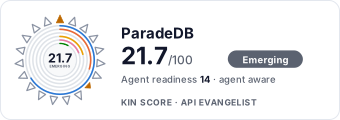
Kin Score
 Kin Score
How this is scored →
Kin Score
How this is scored →scored 2026-10-23 · rubric v0.25.0
 It updates itself when the score changes. Paste this where you link to your API docs:
<a href="https://apis.io/providers/paradedb/"><img src="https://apis.io/badge/paradedb/card.svg" alt="ParadeDB on APIs.io — Kin Score by API Evangelist"></a>Other styles, a README pill and a shields.io endpoint are on the badge page.
Markets this provider is in provisional
The Kin Score Market layer reads a provider inside its market: its position, and how deep its integrations go. Depth is only comparable within a position. Provisional and unweighted: not part of the Kin Score or agent readiness.
| Market | Position | Depth | Registered MCP server | Declares compatibility |
|---|---|---|---|---|
| Search API (Elasticsearch / OpenSearch shape) | undeclared | - | - | 1 |
| Databases (PostgreSQL wire) | undeclared | - | - | 1 |
| Artifact Hub Cloud-Native Packages | undeclared | - | - | 1 |
Registered MCP server and declares compatibility are report only — not weighted. Undeclared means we found nothing we can read, so there is no number: we never infer integrations.
APIs 3
Individual APIs this provider publishes, each with its own machine-readable definition.
ParadeDB pg_search (Full-Text Search)
BM25 full-text search inside Postgres via the pg_search extension, built on Tantivy. Consumed as SQL over the PostgreSQL wire protocol - BM25 indexes are created with CREATE IND...
ParadeDB Analytics (pg_analytics)
Columnar storage, fast aggregates, and OLAP-style analytics over Postgres data, powered by Apache DataFusion and Postgres parallel workers. Accessed entirely through standard SQ...
ParadeDB Postgres SQL Interface
The primary integration surface for ParadeDB - the PostgreSQL wire protocol itself. Any standard Postgres client, driver, or ORM (psql, libpq, Drizzle, Django, SQLAlchemy, Rails...
Open Collections 1
Open, tool-agnostic API collections (OpenAPI-derived and Bruno).
ParadeDB SQL Interface (No REST API)
OPEN COLLECTIONPricing Plans 1
Published pricing tiers and plan structures.
Rate Limits 1
Documented rate limits and quota policies.
Paradedb Rate Limits
RATE LIMITSFinOps 1
Cost, billing, and metering signals for API financial operations.
Paradedb Finops
FINOPSSecurity Posture 2
Authentication, domain security, vulnerability disclosure, and trust-center signals.
Resources
Documentation 1
Reference material describing how the API behaves
Build 1
SDKs, sample code, and the tooling you integrate with
Access & Security 2
Authentication, authorization, and security posture
Operate 1
Status, limits, changes, and where to get help
Commercial 2
Pricing, plans, and the legal terms of use
Company 3
The organization behind the API
Source (apis.yml)
Work with this as data
Every provider here is available over the APIs.io API and to AI agents over MCP.