NVIDIA NIM (NVIDIA Inference Microservices) is a catalog of GPU-accelerated, containerized AI inference microservices that package optimized model engines (TensorRT-LLM, vLLM, SGLang, Triton) behind industry-standard OpenAI-compatible REST APIs. NIM covers large language models, embeddings and reranking, vision-language models, speech (Riva), visual generative AI, and biology (BioNeMo) — exposed identically whether consumed from the hosted endpoint at integrate.api.nvidia.com or self-hosted via Docker containers and the Kubernetes-native NIM Operator. NIM ships with NVIDIA AI Enterprise for commercial deployment and is the inference layer underneath NVIDIA AI Blueprints, NeMo Retriever, NeMo Guardrails, and the broader NVIDIA developer stack.
NVIDIA NIM publishes 10 API contracts indexed on the APIs.io network, including Completions API, Embeddings API, Reranking API, and 7 more. Tagged areas include Artificial Intelligence, Inference, Microservices, LLM, and Foundation Models.
The NVIDIA NIM catalog on APIs.io includes 1 JSON-LD context and 1 Spectral governance ruleset.
NVIDIA NIM’s developer surface includes authentication, developer portal, documentation, getting-started guide, signup flow, sandbox, pricing, and 70 more developer resources.
The questions people put to an LLM, and the jobs they hand an agent, that NVIDIA NIM's APIs answer — each one linked to the operation that does it.
Generated by API Evangelist
Regulatory Posture applies to this provider. Its tags matched the
AI & Biometrics regime, so
Regulatory Posture carries 15 points of the composite.
If this regime is wrong for your business, say so on your
provider repo — the
applicability map is public and we will correct it.
Create-or-Update Ergonomics applies to this provider. This API accepts writes, so it
carries 10 points of the composite. It is scored from the published contracts
themselves: whether a caller can create-or-update in one call, whether the write accepts a key the caller already
holds, and whether the response says which branch ran. Without that, every write needs a search-and-branch in
front of it, and the first time that check is skipped a duplicate record is created.
Scored against the observed mean rather than raw — a provider at the catalog average is unchanged by this facet,
not penalised by it.
The six quality facets above are damped to 75 points between them,
because the conditional facet above carries the other
25. That is why each facet's contribution is shown against a damped
maximum: raising a quality facet moves the composite by 75% of its nominal
weight, not 100%. The full arithmetic is at apis.io/rating/.
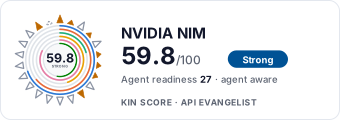
Show this score on your site.
It updates itself when the score changes. Paste this where you link to your API docs:
<a href="https://apis.io/providers/nvidia-nim/"><img src="https://apis.io/badge/nvidia-nim/card.svg" alt="NVIDIA NIM on APIs.io — Kin Score by API Evangelist"></a>
Other styles, a README pill and a shields.io endpoint are on the badge page.
Raise your score.
Agent readiness — checks not met, largest first (exact, from this profile):
MCP Server+12 pts — deployment.mode + probe verdict on the mcp/ manifest, not the pointer; an unprobed slug falls back to authorship
Idempotency+9 pts — OpenAPI mutating operations declare an idempotency key — a header, a request-body property, or a named de-duplication token whose own description says so (verified); else common[].type matches /idempoten/i (documented)
A2A Agent Card+8 pts — a2a/-a2a.yml manifest, graded on conformance.grade against A2A 1.0.0
Delegated User Identity+6 pts — a served discovery document listing authorization_code in grant_types_supported (served), else an oauth2 authorizationCode flow or openIdConnect declared in an OpenAPI (documented)
Typed Event Surface+6 pts — AsyncAPI document, OR webhooks/callbacks objects in the as-published OpenAPI, OR common[].type includes Webhooks
7 more unmet checks in the Agent Readiness table above.
Kin Score — facets with the most composite points still available (weight × headroom):
The Kin Score Market layer reads a provider inside its market:
its position, and how deep its integrations go. Depth is only comparable within a position. Provisional and unweighted:
not part of the Kin Score or agent readiness.
Registered MCP server and declares compatibility are report only — not weighted.
Undeclared means we found nothing we can read, so there is no number: we never infer integrations.
Standards this provider implements or carries. De facto ones are profiled and measured by the API Commons; formal ones come from the standards directory and are linked by the provider's own tags. The evidence column says how each claim was established — not that it was made.
Legacy OpenAI-compatible text completion endpoint (/v1/completions) for non-chat foundation models served by NIM. Accepts a raw prompt and returns generated text with the same s...
OpenAI-compatible embeddings endpoint (/v1/embeddings) backed by NVIDIA NeMo Retriever text embedding models including NV-Embed, NV-EmbedQA-E5, llama-3.2-nv-embedqa-1b, and BAAI...
NeMo Retriever cross-encoder reranking endpoint (/v1/ranking) for scoring candidate passages against a query. Improves retrieval relevance on RAG pipelines and supports the llam...
OpenAI-compatible model catalog endpoint (/v1/models) returning the list of models served by the NIM endpoint or container. Each entry includes id, owned_by, and created timesta...
Liveness, readiness, and startup probes exposed by self-hosted NIM containers (/v1/health/live, /v1/health/ready) and a Prometheus /v1/metrics scrape endpoint for GPU utilizatio...
BioNeMo NIMs for protein structure prediction (AlphaFold2, ESMFold, OpenFold), protein generation (ProtGPT2, RFDiffusion), molecular property prediction (MolMIM), small molecule...
100+ foundation models exposed through a single API contract — Llama 3.1/3.2/3.3, Mistral, Mixtral, NVIDIA Nemotron, DeepSeek-R1, Qwen 2.5, Microsoft Phi, Google Gemma, IBM Granite, and Falcon
Free hosted inference at build.nvidia.com on DGX Cloud — 1,000 credits on signup, 40 RPM rate limit
Self-hosted deployment via Docker containers shipping TensorRT-LLM, vLLM, or SGLang inference engines
Kubernetes-native deployment via the NIM Operator with NIMService, NIMCache, NIMPipeline CRDs
GPU-aware autoscaling, persistent model caches, and rolling upgrades managed by the operator
Multi-tenant licensing through NVIDIA AI Enterprise (commercial production use)
NeMo Retriever NIMs for embeddings, reranking, OCR, and PDF-to-Markdown extraction in RAG pipelines
Vision Language Model NIMs reusing the chat-completions surface for multimodal inputs
NVIDIA Riva speech NIMs (Parakeet ASR, Canary translation, Magpie TTS) with HTTP and gRPC adapters
BioNeMo NIMs for AlphaFold2, ESMFold, ProtGPT2, MolMIM, DiffDock, RFDiffusion
Visual generative AI NIMs — FLUX.1, SDXL, Shutterstock Edify Image, Edify 3D
NeMo Guardrails for input/output safety and topic policy enforcement
Function calling, JSON mode, tool use, and structured outputs across compatible LLMs
Streaming via Server-Sent Events on chat/completions
Prometheus /v1/metrics scrape endpoint and /v1/health/{live,ready} probes for Kubernetes
LangChain, LlamaIndex, Haystack, OpenAI SDK, and direct REST client compatibility
NVIDIA AI Blueprints — full reference RAG, multimodal search, drug discovery, and digital human stacks
Available on DGX Cloud, AWS, Azure, Google Cloud, Oracle Cloud, GKE, EKS, AKS, OpenShift, and on-prem
Overlays applied on top of this provider's contracts. Each card says who wrote it: a document the provider publishes, or one API Evangelist derived or generated.
Calls without X-API-Key need no key. Calls with it need a paid plan — get a key.
Get an API key
Free tier, no form to fill in. Signing in shares your email address with us — we
store it to create your key and to recognise you if you sign in with another
provider. See our Privacy Policy and
Terms.
 Kin Score
How this is scored →
 It updates itself when the score changes. Paste this where you link to your API docs: