Nansen
Nansen is an onchain analytics platform with wallet labeling, smart-money tracking, token screener, portfolio, prediction markets, and AI Agent endpoints across 30+ chains. The Nansen API exposes REST endpoints under api.nansen.ai with Smart Money, Profiler, Token Screener, Portfolio, Points, Hyperliquid, Agent, and Prediction Markets categories.
Nansen publishes 2 API contracts indexed on the APIs.io network, including Smart Money API, and 1 more. Tagged areas include Web3, Cryptocurrency, Onchain, Wallet Labels, and Smart Money.
Nansen’s developer surface includes authentication, developer portal, documentation, pricing, engineering blog, and 9 more developer resources.
Kin Score
 Kin Score
How this is scored →
Kin Score
How this is scored →scored 2026-10-23 · rubric v0.25.0
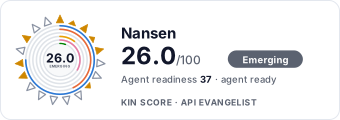 It updates itself when the score changes. Paste this where you link to your API docs:
<a href="https://apis.io/providers/nansen/"><img src="https://apis.io/badge/nansen/card.svg" alt="Nansen on APIs.io — Kin Score by API Evangelist"></a>Other styles, a README pill and a shields.io endpoint are on the badge page.
Markets this provider is in provisional
The Kin Score Market layer reads a provider inside its market: its position, and how deep its integrations go. Depth is only comparable within a position. Provisional and unweighted: not part of the Kin Score or agent readiness.
| Market | Position | Depth | Registered MCP server | Declares compatibility |
|---|---|---|---|---|
| Agent Skills (SKILL.md packages) | undeclared | - | 1 | 1 |
| x402 Micropayments & Agentic Pay-per-Call | undeclared | - | 1 | 1 |
Registered MCP server and declares compatibility are report only — not weighted. Undeclared means we found nothing we can read, so there is no number: we never infer integrations.
APIs 2
Individual APIs this provider publishes, each with its own machine-readable definition.
Nansen REST API
REST API surfacing Nansen's on-chain intelligence: smart-money flows, profiler (wallet labels and balances), token screener, portfolio, points, Hyperliquid analytics, prediction...
Nansen Smart Money API
Smart-money wallet flows and behavior.
Open Collections 2
Open, tool-agnostic API collections (OpenAPI-derived and Bruno).
Nansen REST Smart Money API
OPEN COLLECTIONNansen REST API
OPEN COLLECTIONMCP Servers 2
Model Context Protocol servers that expose these APIs to AI agents.
Pricing Plans 1
Published pricing tiers and plan structures.
Nansen Plans Pricing
PLANSRate Limits 1
Documented rate limits and quota policies.
Nansen Rate Limits
RATE LIMITSFinOps 1
Cost, billing, and metering signals for API financial operations.
Nansen Finops
FINOPSSecurity Posture 2
Authentication, domain security, vulnerability disclosure, and trust-center signals.
Agentic Access 1
Recommended x-agentic-access execution contracts for AI agents.
Resources
Get Started 1
Portal, sign-up, and the first successful call
Documentation 1
Reference material describing how the API behaves
Agent Surfaces 2
MCP servers, agent skills, and machine-readable catalogs
Build 1
SDKs, sample code, and the tooling you integrate with
Access & Security 2
Authentication, authorization, and security posture
Operate 1
Status, limits, changes, and where to get help
Commercial 3
Pricing, plans, and the legal terms of use
Company 3
The organization behind the API
Source (apis.yml)
Work with this as data
Every provider here is available over the APIs.io API and to AI agents over MCP.