
Magento
Overview of the Adobe Commerce and Magento Open Source REST API documentation.
Magento publishes 16 API contracts indexed on the APIs.io network, including Adobe Commerce Webhooks, Adobe Commerce Eventing, Authentication API, and 13 more. Tagged areas include E-Commerce, Catalog, Headless Commerce, and Magento.
The Magento catalog on APIs.io includes 2 event-driven AsyncAPI specifications, 1 JSON-LD context, and 2 Spectral governance rulesets.
Magento’s developer surface includes authentication and 13 more developer resources.
What this lets a business do 4
Business capabilities this provider's published APIs can perform, derived from its own contracts. Browse all capabilities →
What people ask Magento 11
The questions people put to an LLM, and the jobs they hand an agent, that Magento's APIs answer — each one linked to the operation that does it. Generated by API Evangelist
Kin Score
 Kin Score
How this is scored →
scored 2026-11-21 · rubric v0.28.1
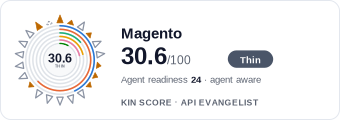 It updates itself when the score changes. Paste this where you link to your API docs:
<a href="https://apis.io/providers/magento/"><img src="https://apis.io/badge/magento/card.svg" alt="Magento on APIs.io — Kin Score by API Evangelist"></a>Other styles, a README pill and a shields.io endpoint are on the badge page.
- MCP Server +12 pts — deployment.mode + probe verdict on the mcp/ manifest, not the pointer; an unprobed slug falls back to authorship Ask about this →
- Idempotency +9 pts — OpenAPI mutating operations declare an idempotency key — a header, a request-body property, or a named de-duplication token whose own description says so (verified); else common[].type matches /idempoten/i (documented) Ask about this →
- A2A Agent Card +8 pts — a2a/
-a2a.yml manifest, graded on conformance.grade against A2A 1.0.0 Ask about this → - Registration Without a Human +6 pts — a `registration_endpoint` in the served RFC 8414 / OIDC discovery document Ask about this →
- Delegated User Identity +6 pts — a served discovery document listing authorization_code in grant_types_supported (served), else an oauth2 authorizationCode flow or openIdConnect declared in an OpenAPI (documented) Ask about this →
- Agent Skills +5 pts — skills artifact present, graded by who authored it Ask about this →
- Access Clarity scores 6.4 — up to +18.7 composite points Ask about this →
- Developer Ergonomics scores 21.4 — up to +15.7 composite points Ask about this →
- Contract Governance scores 13.6 — up to +10.4 composite points Ask about this →
Markets this provider is in provisional
The Kin Score Market layer reads a provider inside its market: its position, and how deep its integrations go. Depth is only comparable within a position. Provisional and unweighted: not part of the Kin Score or agent readiness.
| Market | Position | Depth | Registered MCP server | Declares compatibility |
|---|---|---|---|---|
| E-commerce Extension Marketplaces (Adobe Commerce / Magento, Shopware) | regulated | 45.0 | - | - |
Registered MCP server and declares compatibility are report only — not weighted. Undeclared means we found nothing we can read, so there is no number: we never infer integrations.
Used by apps
5 of the reference apps in Applications, across 3 categories, integrate with this provider, read from each app's own code, build or integrations page.
- inFlow Inventory Inventory & Warehouse Management
- Loyverse POS Point of Sale & In-Person Payments
- Square Point of Sale Point of Sale & In-Person Payments
- Sendcloud Shipping, Fulfillment & Returns
- Shippo Shipping, Fulfillment & Returns
Standards implemented 2
Standards this provider implements or carries. De facto ones are profiled and measured by the API Commons; formal ones come from the standards directory and are linked by the provider's own tags. The evidence column says how each claim was established — not that it was made.
APIs 16
Individual APIs this provider publishes, each with its own machine-readable definition.
Magento GraphQL API
The Adobe Commerce GraphQL API offers a flexible, query-driven interface designed primarily for building headless storefronts and progressive web applications. It exposes a sing...
Magento SOAP API
The Adobe Commerce SOAP API exposes the same service contracts as the REST API through a WSDL 1.2 interface compliant with WS-I 2.0 Basic Profile. It allows enterprise systems a...
Adobe Commerce Webhooks
Adobe Commerce Webhooks enable developers to configure synchronous HTTP callbacks that fire when specific events occur within a Commerce instance, allowing external systems to r...
Adobe Commerce Admin UI SDK
The Adobe Commerce Admin UI SDK enables App Builder developers to extend the Commerce Admin panel with custom menus, pages, and UI components built as out-of-process application...
Adobe Commerce Eventing
Adobe Commerce Eventing provides an asynchronous event-driven integration framework that publishes Commerce business events to Adobe I/O Events, enabling App Builder application...
magento Authentication API
Endpoints for obtaining integration tokens for admin and customer users. Token-based authentication issues a Bearer token that must be included in the Authorization header of su...
magento Carts API
Shopping cart and quote management for admin, customer, and guest users, including item management, coupon codes, shipping estimation, and payment information collection.
magento Categories API
Category tree management including creation, retrieval, update, and deletion of catalog categories and their product assignments.
magento Customers API
Customer account management including registration, profile updates, address management, authentication, and customer group assignment.
magento Inventory API
Multi-source inventory management including sources, stocks, stock-source links, and source item quantity management.
magento Invoices API
Invoice management for orders including invoice creation, retrieval, and payment capture operations.
magento Orders API
Sales order management including order retrieval, status updates, comment posting, cancellation, and order item management.
magento Products API
Catalog product management including creation, retrieval, update, and deletion of simple, configurable, virtual, bundled, and grouped products. Supports product attributes, medi...
magento Shipments API
Shipment management for orders including shipment creation, retrieval, tracking number management, and shipment comments.
magento Stores API
Store configuration retrieval including store groups, store views, websites, and configuration settings.
magento Tax API
Tax configuration management including tax rates, tax rules, and tax classes used for order tax calculation.
Scroll for all 16
Open Collections 12
Open, tool-agnostic API collections (OpenAPI-derived and Bruno).
Magento REST Authentication API
OPEN COLLECTIONMagento REST Authentication Carts API
OPEN COLLECTIONMagento REST Authentication Categories API
OPEN COLLECTIONMagento REST Authentication Customers API
OPEN COLLECTIONMagento REST Authentication Inventory API
OPEN COLLECTIONMagento REST Authentication Invoices API
OPEN COLLECTIONMagento REST Authentication Orders API
OPEN COLLECTIONMagento REST Authentication Products API
OPEN COLLECTIONMagento REST API
OPEN COLLECTIONMagento REST Authentication Shipments API
OPEN COLLECTIONMagento REST Authentication Stores API
OPEN COLLECTIONMagento REST Authentication Tax API
OPEN COLLECTIONScroll for all 12
GraphQL 1
GraphQL schemas published by this provider.
magento GraphQL API
The Adobe Commerce GraphQL API offers a flexible, query-driven interface designed primarily for building headless storefronts and progressive web applications. It exposes a sing...
GRAPHQLMagento API pricing
Not yet checked against Magento's own pricing page. Compiled by API Evangelist on 2026-05-04 from business.adobe.com/products/magento/magento-commerce.html; confirm before you rely on a figure. A free plan or tier is listed.
| Plan | Price |
|---|---|
| Magento Open Source freemium | Free |
| Adobe Commerce enterprise | — |
| Adobe Commerce Cloud enterprise | — |
Plan details, limits and sources →
Rate limits
- REST/GraphQL (default): user-controlled configurable
- OAuth /token endpoint: configurable requests per minute
- Search Engine API: depends on backend (Elasticsearch/OpenSearch) requests per second
Compiled by API Evangelist, not yet checked against Magento's documentation. Rate-limit details →
Pricing Plans 1
Published pricing tiers and plan structures.
Rate Limits 1
Documented rate limits and quota policies.
Magento Rate Limits
RATE LIMITSFinOps 1
Cost, billing, and metering signals for API financial operations.
Magento Finops
FINOPSFeatures 16
Notable capabilities this provider offers.
Scroll for all 16
Event Specifications 2
AsyncAPI definitions for this provider's event-driven and streaming APIs.
Adobe Commerce Eventing
Adobe Commerce Eventing provides an asynchronous event-driven integration framework that publishes Commerce business events to Adobe I/O Events, enabling App Builder application...
ASYNCAPIAdobe Commerce Webhooks
Adobe Commerce Webhooks enable developers to configure synchronous HTTP callbacks that fire when specific events occur within a Commerce instance, allowing external systems to r...
ASYNCAPISemantic Vocabularies 1
JSON-LD contexts and semantic vocabularies used across these APIs.
Magento Context
JSON-LDSpectral Rules 2
Spectral governance rulesets for linting and validating these APIs. Counts are the severity each rule declares, not results of running them.
Magento — asyncapi rules
SPECTRALMagento — jsonschema rules
SPECTRALOpenAPI Overlays 11
Overlays applied on top of this provider's contracts. Each card says who wrote it: a document the provider publishes, or one API Evangelist derived or generated.
Magento Carts Api Phrasing Overlay
GENERATEDMagento Categories Api Phrasing Overlay
GENERATEDMagento Customers Api Phrasing Overlay
GENERATEDMagento Inventory Api Phrasing Overlay
GENERATEDMagento Invoices Api Phrasing Overlay
GENERATEDMagento Orders Api Phrasing Overlay
GENERATEDMagento Products Api Phrasing Overlay
GENERATEDMagento Shipments Api Phrasing Overlay
GENERATEDMagento Stores Api Phrasing Overlay
GENERATEDMagento Tax Api Phrasing Overlay
GENERATEDScroll for all 11
JSON Schema 35
Standalone JSON Schema definitions for this provider's data models.
Address
JSON SCHEMAAdminTokenRequest
JSON SCHEMACartItem
JSON SCHEMACartItemRequest
JSON SCHEMACategory
JSON SCHEMACategoryRequest
JSON SCHEMACategoryTree
JSON SCHEMACustomAttribute
JSON SCHEMACustomer
JSON SCHEMACustomerRequest
JSON SCHEMACustomerSearchResults
JSON SCHEMACustomerTokenRequest
JSON SCHEMAError
JSON SCHEMAInventorySource
JSON SCHEMAInventorySourceRequest
JSON SCHEMAInventorySourceSearchResults
JSON SCHEMAInvoice
JSON SCHEMAInvoiceRequest
JSON SCHEMAInvoiceSearchResults
JSON SCHEMAMagento Order
JSON SCHEMAOrderCommentRequest
JSON SCHEMAOrderItem
JSON SCHEMAOrderRequest
JSON SCHEMAOrderSearchResults
JSON SCHEMAMagento Product
JSON SCHEMAProductRequest
JSON SCHEMAProductSearchResults
JSON SCHEMAShipment
JSON SCHEMAShipmentRequest
JSON SCHEMASourceItem
JSON SCHEMASourceItemSearchResults
JSON SCHEMASourceItemUpdateRequest
JSON SCHEMAStoreConfig
JSON SCHEMATaxRate
JSON SCHEMATaxRateSearchResults
JSON SCHEMAScroll for all 35
JSON Structure 1
JSON Structure definitions describing this provider's data shapes.
Magento Structure
JSON STRUCTURESecurity Posture 3
Authentication, domain security, vulnerability disclosure, and trust-center signals.
Agentic Access (API Evangelist recommendations) 1
Recommended x-agentic-access execution contracts for AI agents.
Resources
Documentation 2
Reference material describing how the API behaves
Agent Surfaces 1
MCP servers, agent skills, and machine-readable catalogs
Design & Contract 1
Pagination, idempotency, versioning, errors, and events
Build 1
SDKs, sample code, and the tooling you integrate with
Access & Security 3
Authentication, authorization, and security posture
Operate 1
Status, limits, changes, and where to get help
Commercial 2
Pricing, plans, and the legal terms of use
Company 2
The organization behind the API
Other 1
Properties that don't map to a standard resource type
Source (apis.yml)
Magento API — frequently asked questions
Does Magento have an API?
Yes. APIs.io lists 16 APIs from Magento, including Magento GraphQL API, Magento SOAP API and Adobe Commerce Webhooks, and 13 more.
Is there an OpenAPI specification for the Magento API?
Yes. APIs.io indexes 11 OpenAPI specifications for Magento, each linked for download from this page.
How do I authenticate with the Magento API?
Magento uses bearer-token authentication (http · 1 scheme). The details are profiled on APIs.io as Magento Authentication.
How much does the Magento API cost?
APIs.io lists 3 pricing plans for Magento, with each plan's price, limits and inclusions under Pricing on this page.
Is the Magento API ready for AI agents?
Magento has a Kin Score of 30.3 out of 100 (thin) and an Agent Readiness score of 28.9 (agent-ready), scored by API Evangelist on 2026-11-21.
Work with this as data
Every provider here is available over the APIs.io API and to AI agents over MCP.