Kamal is an open-source deployment tool from 37signals (DHH / Basecamp) for deploying containerized web applications to any infrastructure — bare metal, cloud VMs, or a mix — with zero-downtime rolling restarts. Originally built for Rails apps, Kamal works with any web application that can be packaged as a Docker container. It uses SSHKit to drive remote commands over SSH and pairs with kamal-proxy, a lightweight HTTP proxy written in Go that seamlessly switches request traffic between old and new containers during a deploy. Kamal is imperative and Capistrano-like in feel, with a single `config/deploy.yml` describing servers, image, registry, accessories, env, secrets, and proxy/SSL settings. Capabilities include auto-provisioning Docker on new servers, remote builds, asset bridging, accessory services (databases, Redis, cron sidecars), automatic TLS via Let's Encrypt, host- and path-based routing, and hooks for custom pre/post-deploy logic. Kamal is the operational backbone of 37signals' on-premises exit from major cloud providers and powers their ONCE product line. Kamal itself is a CLI tool, not a hosted service — there is no public REST API, no SDK, and no paid tier. The project is released under the MIT License and developed openly on GitHub under the `basecamp` organization.
Kamal is listed with 2 APIs on the APIs.io network. Tagged areas include Deployment, DevOps, Docker, Containers, and Zero Downtime.
Kamal’s developer surface includes documentation, getting-started guide, release notes, changelog, CLI, and 12 more developer resources.
Regulatory Posture applies to this provider. Its tags matched the
Horizontal (data, software, accessibility, platform) regime, so
Regulatory Posture carries 15 points of the composite.
If this regime is wrong for your business, say so on your
provider repo — the
applicability map is public and we will correct it.
Open Source Surface applies to this provider. This product is open source and we
read its repository directly, so Open Source Surface carries
10 points of the composite. It is scored from what the repository actually
publishes — a security policy, a contribution guide, a release history, a code of conduct — read live from the
provider rather than inferred from our own catalog pointers.
This facet adds; nothing was taken away to make room for it. An open-source project is not excused from
the commercial facets, because exemption would strip it of the points it does earn.
If we have the wrong repository, or this product is not open source, say so on your
provider repo and we
will drop the facet rather than have you publish against it.
Create-or-Update Ergonomics could not be measured. We hold no machine-readable contract for
this provider to read, so there is nothing to measure a write surface against. Excluded rather than scored zero:
never-measured and measured-empty are different facts. Publishing an OpenAPI is what makes this facet — and
several others — scorable at all.
The six quality facets above are damped to 75 points between them,
because both conditional facets apply and carry
25 points together. That is why each facet's contribution is shown against a damped
maximum: raising a quality facet moves the composite by 75% of its nominal
weight, not 100%. The full arithmetic is at apis.io/rating/.
Show this score on your site.
It updates itself when the score changes. Paste this where you link to your API docs:
<a href="https://apis.io/providers/kamal-deploy/"><img src="https://apis.io/badge/kamal-deploy/card.svg" alt="Kamal on APIs.io — Kin Score by API Evangelist"></a>
Other styles, a README pill and a shields.io endpoint are on the badge page.
Improve this rating by publishing the missing artifacts — every area above can be raised, and the full rubric is at apis.io/rating/. Every facet and dimension name above is a link: it opens that measurement's own page — what it means, the exact checks that feed it, how the whole catalog distributes on it, and the providers at the top of it. This rating is computed from github.com/api-evangelist/kamal-deploy: open an issue to ask a question, or submit a pull request to add artifacts.
Submit an artifact on GitHub — free →Manage your own listing — the Influence plan, $499/mo →
Standards this provider implements or carries. De facto ones are profiled and measured by the API Commons; formal ones come from the standards directory and are linked by the provider's own tags. The evidence column says how each claim was established — not that it was made.
The Kamal CLI (`kamal`) is the primary command-line interface for packaging, shipping, and operating containerized web apps across one or more SSH-reachable servers. It reads `c...
Kamal Proxy is a minimal HTTP reverse proxy written in Go that powers the zero-downtime deploy switchover behind Kamal. It exposes a small `kamal-proxy` CLI with `run`, `deploy`...
aid: kamal-deploy
name: Kamal
description: Kamal is an open-source deployment tool from 37signals (DHH / Basecamp) for deploying containerized web applications
  to any infrastructure — bare metal, cloud VMs, or a mix — with zero-downtime rolling restarts. Originally built for Rails
  apps, Kamal works with any web application that can be packaged as a Docker container. It uses SSHKit to drive remote commands
  over SSH and pairs with kamal-proxy, a lightweight HTTP proxy written in Go that seamlessly switches request traffic between
  old and new containers during a deploy. Kamal is imperative and Capistrano-like in feel, with a single `config/deploy.yml`
  describing servers, image, registry, accessories, env, secrets, and proxy/SSL settings. Capabilities include auto-provisioning
  Docker on new servers, remote builds, asset bridging, accessory services (databases, Redis, cron sidecars), automatic TLS
  via Let's Encrypt, host- and path-based routing, and hooks for custom pre/post-deploy logic. Kamal is the operational backbone
  of 37signals' on-premises exit from major cloud providers and powers their ONCE product line. Kamal itself is a CLI tool,
  not a hosted service — there is no public REST API, no SDK, and no paid tier. The project is released under the MIT License
  and developed openly on GitHub under the `basecamp` organization.
type: Index
deliveryModel:
  model: self-hosted
  license: MIT
  license_evidence:
    repo: basecamp/kamal
    spdx: MIT
    stars: 14604
  open_source: true
  commercial: false
  callable_host: false
  label: Self-hosted open source · you run it yourself
  confidence: medium
  source:
  - repository-license
  generated: '2026-09-25'
  method: derived
accessModel:
  pricing: unknown
  onboarding: unknown
  trial: false
  try_now: false
  public: false
  label: Unknown
  confidence: low
  source: []
  generated: '2026-07-22'
  method: derived
position: Producing
access: 3rd-Party
image: https://kinlane-images.s3.amazonaws.com/shared/apis-json/icons/kamal-deploy.png
tags:
- Deployment
- DevOps
- Docker
- Containers
- Zero Downtime
- Rolling Deploys
- Ruby on Rails
- Ruby
- Open Source
- 37signals
- Basecamp
- On-Premises
- Infrastructure
- CLI
- SSH
tags_raw:
- Deployment
- DevOps
- Docker
- Containers
- Zero Downtime
- Rolling Deploys
- Rails
- Ruby
- Open Source
- 37signals
- Basecamp
- On Premises
- Infrastructure
- CLI
- SSH
- Open-Source
url: https://raw.githubusercontent.com/api-evangelist/kamal-deploy/refs/heads/main/apis.yml
created: '2026-05-25'
modified: '2026-05-25'
specificationVersion: '0.23'
apis:
- aid: kamal-deploy:kamal
  name: Kamal CLI
  description: 'The Kamal CLI (`kamal`) is the primary command-line interface for packaging, shipping, and operating containerized
    web apps across one or more SSH-reachable servers. It reads `config/deploy.yml` (plus environment-specific overlays and
    encrypted secrets) and orchestrates the full lifecycle: building images, pushing to a registry, provisioning Docker on
    target hosts, starting accessory services, deploying the app via kamal-proxy with health-check gated traffic switching,
    and tailing logs or rolling back to a prior version. Command groups include `app`, `accessory`, `build`, `proxy`, `registry`,
    `secrets`, `server`, and `prune`, plus top-level shortcuts like `deploy`, `redeploy`, `rollback`, `setup`, `audit`, `details`,
    `env`, `lock`, `version`, and `init`.'
  humanURL: https://kamal-deploy.org/docs/
  tags:
  - CLI
  - Deployment
  - Docker
  - Ruby on Rails
  - Ruby
  - SSH
  tags_raw:
  - CLI
  - Deployment
  - Docker
  - Rails
  - Ruby
  - SSH
  properties:
  - type: Documentation
    url: https://kamal-deploy.org/docs/
  - type: GettingStarted
    url: https://kamal-deploy.org/docs/installation/
  - type: Source
    url: https://github.com/basecamp/kamal
  - type: GitHubRepository
    url: https://github.com/basecamp/kamal
  - type: License
    url: https://github.com/basecamp/kamal/blob/main/MIT-LICENSE
  - type: ReleaseNotes
    url: https://github.com/basecamp/kamal/releases
  - type: Configuration
    url: https://kamal-deploy.org/docs/configuration/
    title: deploy.yml Configuration Reference
  - type: Hooks
    url: https://kamal-deploy.org/docs/hooks/
  - type: Upgrade
    url: https://kamal-deploy.org/docs/upgrading/
  - type: SDKs
    url: https://rubygems.org/gems/kamal
    title: kamal (RubyGem)
- aid: kamal-deploy:kamal-proxy
  name: Kamal Proxy
  description: Kamal Proxy is a minimal HTTP reverse proxy written in Go that powers the zero-downtime deploy switchover behind
    Kamal. It exposes a small `kamal-proxy` CLI with `run`, `deploy`, and `remove` commands; the Kamal CLI talks to it over
    SSH to register new container instances (`hostname:port`), runs health checks (default `GET /up` once per second returning
    `200`), drains traffic from old instances, and atomically switches new traffic to the healthy instance. The proxy supports
    host-based routing (multiple apps on one server), path-based routing with optional prefix stripping, custom health-check
    paths/ports/timeouts, automatic TLS via Let's Encrypt, and custom TLS certificate/key files (useful for Cloudflare origin
    certs or private CAs). It can also be run standalone outside of Kamal.
  humanURL: https://github.com/basecamp/kamal-proxy
  tags:
  - Proxy
  - HTTP
  - Load Balancing
  - Zero Downtime
  - TLS
  - Go
  properties:
  - type: Documentation
    url: https://github.com/basecamp/kamal-proxy/blob/main/README.md
  - type: Source
    url: https://github.com/basecamp/kamal-proxy
  - type: GitHubRepository
    url: https://github.com/basecamp/kamal-proxy
  - type: License
    url: https://github.com/basecamp/kamal-proxy/blob/main/MIT-LICENSE
  - type: Dockerfile
    url: https://github.com/basecamp/kamal-proxy/blob/main/Dockerfile
common:
- type: IssueTracker
  url: https://github.com/basecamp/kamal/issues
- type: DomainSecurity
  url: security/kamal-deploy-domain-security.yml
- type: Website
  url: https://kamal-deploy.org
- type: Documentation
  url: https://kamal-deploy.org/docs/
- type: GettingStarted
  url: https://kamal-deploy.org/docs/installation/
- type: Source
  url: https://github.com/basecamp/kamal
- type: GitHubRepository
  url: https://github.com/basecamp/kamal
- type: GitHubOrganization
  url: https://github.com/basecamp
- type: License
  url: https://github.com/basecamp/kamal/blob/main/MIT-LICENSE
  title: MIT License
- type: ReleaseNotes
  url: https://github.com/basecamp/kamal/releases
- type: ChangeLog
  url: https://github.com/basecamp/kamal/releases
- type: Community
  url: https://github.com/basecamp/kamal/discussions
  title: GitHub Discussions
- type: Community
  url: https://discord.gg/YgHVT7GCXS
  title: Discord
- type: Contributing
  url: https://github.com/basecamp/kamal/blob/main/CONTRIBUTING.md
- type: CodeOfConduct
  url: https://github.com/basecamp/kamal/blob/main/CODE_OF_CONDUCT.md
- type: SDKs
  url: https://rubygems.org/gems/kamal
  title: kamal (RubyGem)
- type: CLI
  url: https://kamal-deploy.org/docs/commands/
  title: kamal CLI
- type: Integrations
  url: https://github.com/basecamp/kamal-proxy
  title: kamal-proxy (Go)
- type: Integrations
  url: https://github.com/basecamp/kamal-skiff
  title: kamal-skiff — static sites on nginx + SSI via Kamal
- type: Integrations
  url: https://github.com/basecamp/kamal-site
  title: kamal-site — source for kamal-deploy.org
- type: UseCases
  url: https://once.com
  title: 37signals ONCE — single-tenant self-hosted apps deployed via Kamal
maintainers:
- FN: Kin Lane
  email: kin@apievangelist.com
Discovery needs no key. Ratings and market analysis are Pro.
Get an API key
Free tier, no form to fill in. Signing in shares your email address with us — we
store it to create your key and to recognise you if you sign in with another
provider. See our Privacy Policy and
Terms.
 Kin Score
How this is scored →
Kin Score
How this is scored →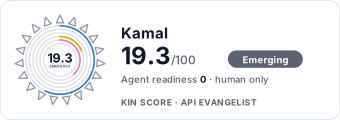 It updates itself when the score changes. Paste this where you link to your API docs: