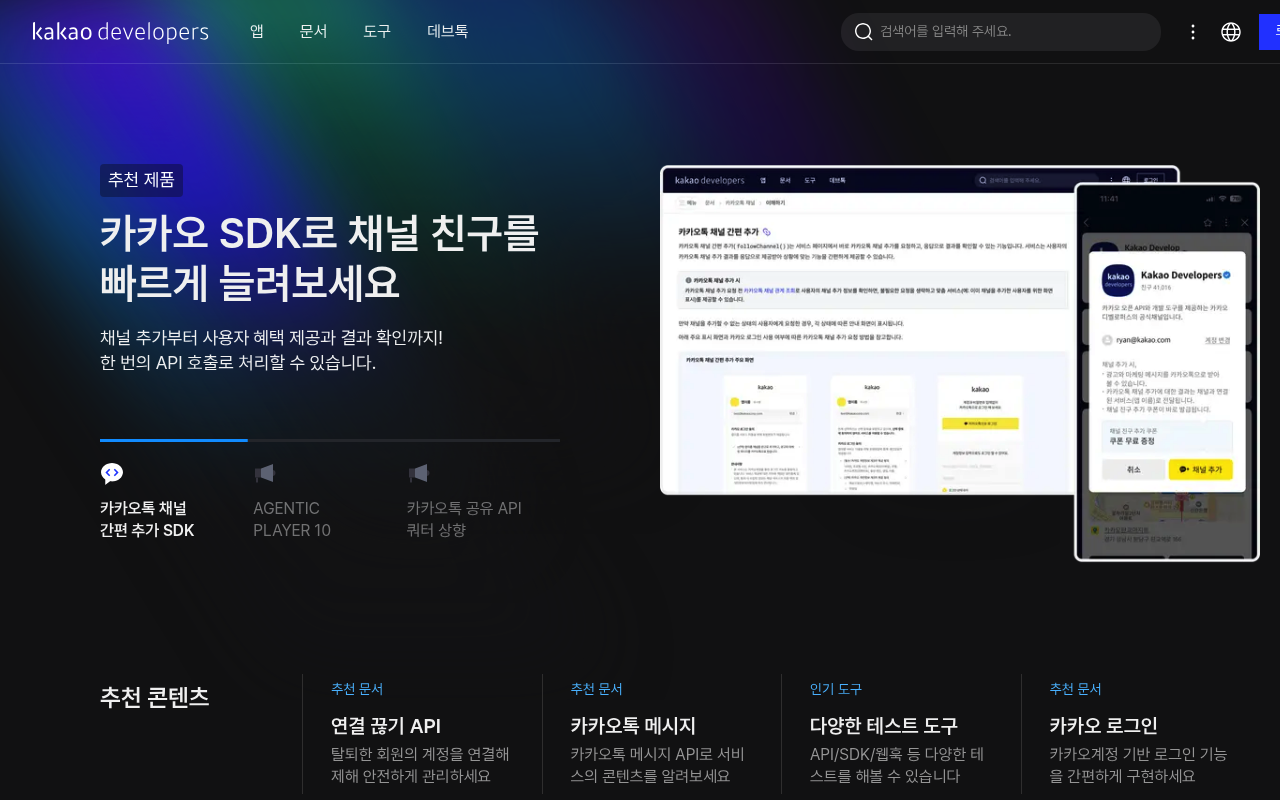
Kakao Corp. is the South Korean technology group behind KakaoTalk — the dominant mobile messenger in Korea — along with KakaoPay (payments), Kakao Bank (digital bank), KakaoMobility (taxi, navigation, parking), KakaoMap, Kakao Games, Kakao Entertainment (Melon, Kakao Webtoon, Daum), and KakaoCloud. Kakao runs its public developer platform at developers.kakao.com, exposing REST APIs for Kakao Login (OAuth 2.0), Kakao Sync, KakaoTalk Share / Message / Friend Picker / Channel, KakaoStory, KakaoNavi, KakaoMap, Local search, Daum Search, KakaoPay (PG / online easy-pay), and KoGPT generative AI. KakaoMobility and Kakao Enterprise / KakaoCloud each operate additional partner- facing developer surfaces.
Kakao publishes 21 API contracts indexed on the APIs.io network, including OIDC API, Service Terms API, User API, and 18 more. Tagged areas include Messaging, Maps, Navigation, Payments, and Search.
The Kakao catalog on APIs.io includes 1 Spectral governance ruleset.
Kakao’s developer surface includes authentication, documentation, GitHub presence, engineering blog, and 19 more developer resources.
Regulatory Posture applies to this provider. Its tags matched the
Payments regime, so
Regulatory Posture carries 15 points of the composite.
If this regime is wrong for your business, say so on your
provider repo — the
applicability map is public and we will correct it.
Create-or-Update Ergonomics applies to this provider. This API accepts writes, so it
carries 10 points of the composite. It is scored from the published contracts
themselves: whether a caller can create-or-update in one call, whether the write accepts a key the caller already
holds, and whether the response says which branch ran. Without that, every write needs a search-and-branch in
front of it, and the first time that check is skipped a duplicate record is created.
Scored against the observed mean rather than raw — a provider at the catalog average is unchanged by this facet,
not penalised by it.
The six quality facets above are damped to 75 points between them,
because the conditional facet above carries the other
25. That is why each facet's contribution is shown against a damped
maximum: raising a quality facet moves the composite by 75% of its nominal
weight, not 100%. The full arithmetic is at apis.io/rating/.
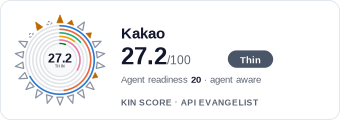
Show this score on your site.
It updates itself when the score changes. Paste this where you link to your API docs:
<a href="https://apis.io/providers/kakao/"><img src="https://apis.io/badge/kakao/card.svg" alt="Kakao on APIs.io — Kin Score by API Evangelist"></a>
Other styles, a README pill and a shields.io endpoint are on the badge page.
Raise your score.
Agent readiness — checks not met, largest first (exact, from this profile):
MCP Server+12 pts — deployment.mode + probe verdict on the mcp/ manifest, not the pointer; an unprobed slug falls back to authorship Ask about this →
Idempotency+9 pts — OpenAPI mutating operations declare an idempotency key — a header, a request-body property, or a named de-duplication token whose own description says so (verified); else common[].type matches /idempoten/i (documented) Ask about this →
Stable Error Semantics+8 pts — OpenAPI $refs a shared error schema across 4xx/5xx responses (verified), else common[].type includes ErrorCatalog / ErrorCodes / DeclineCodes Ask about this →
Each check links to what satisfies it. Publish the artifact, or tell us where it already lives, and the score moves on the next scoring run.
Not sure how this applies to your stack? Ask about any one item. Kin Lane reads every question, looks at your profile and your situation, and replies with what a fix would take — scoped to that one area, priced up front, yours whether you ship it or not. Ask a question →
The Kin Score Market layer reads a provider inside its market:
its position, and how deep its integrations go. Depth is only comparable within a position. Provisional and unweighted:
not part of the Kin Score or agent readiness.
Registered MCP server and declares compatibility are report only — not weighted.
Undeclared means we found nothing we can read, so there is no number: we never infer integrations.
Standards this provider implements or carries. De facto ones are profiled and measured by the API Commons; formal ones come from the standards directory and are linked by the provider's own tags. The evidence column says how each claim was established — not that it was made.
Kakao Login is Korea's most widely used social-identity provider, built on OAuth 2.0 / OpenID Connect. The API issues access and refresh tokens, returns user profile attributes ...
Kakao Sync extends Kakao Login with a one-click signup experience that simultaneously creates an in-app account and (optionally) adds a KakaoTalk Channel friendship for Korean s...
Returns the list of KakaoTalk friends who have also signed into a Kakao-Linked app, for friend-picker, invite, and social-feature experiences subject to user consent.
Kakao Local API offers address-to-coordinate (and reverse) geocoding, keyword and category place search, and administrative-region lookup for Korean addresses and POIs.
KakaoNavi exposes driving directions, multi-waypoint route planning, ETA, and Future Driving directions (predictive ETA), and a native "Send to Kakao Navi" handoff for Korean mo...
Daum Search API returns search results from Daum's web, vClip video, image, blog, book, café, and Q&A indexes, complementing Kakao Local for content discovery.
KakaoPay Online (also known as KakaoPay Easy-Pay) lets online merchants accept KakaoPay wallet payments for one-time and subscription purchases, with order create, approve, canc...
Subscription Payments API enables recurring KakaoPay billing for SaaS, content, and membership models — using a one-time SID (subscription ID) handshake followed by server-side ...
KoGPT is Kakao Brain's Korean-language large language model. The KoGPT API provides text generation, summarization, paraphrasing, and classification for Korean text.
KakaoMobility's Business API powers KakaoT corporate mobility — letting enterprise platforms book Kakao T taxi rides, manage corporate accounts, and reconcile employee trips for...
Not yet checked against Kakao's own pricing page. Compiled by API Evangelist on 2026-05-22; confirm before you rely on a figure. A free plan or tier is listed.
Calls without X-API-Key need no key. Calls with it need a paid plan — get a key.
Get an API key
Free tier, no form to fill in. Signing in shares your email address with us — we
store it to create your key and to recognise you if you sign in with another
provider. See our Privacy Policy and
Terms.
 Kin Score
How this is scored →
 It updates itself when the score changes. Paste this where you link to your API docs: