IOTA is an open-source distributed ledger technology built to bring real-world applications on-chain. It is the first internet-scale programmable blockchain platform powered by the Move programming language with horizontal scaling, feeless transactions, and a unique parallel transaction processing model. IOTA exposes a JSON-RPC 2.0 API over HTTP and a GraphQL RPC for querying objects, checkpoints, transactions, coins, events, and on-chain state on Mainnet, Testnet, and Devnet networks. The platform targets trade and supply chains, decentralized finance, digital identity, real-world asset tokenization, and product lifecycle management.
IOTA publishes 17 API contracts indexed on the APIs.io network, including Auth API, Chains API, Coin Query API, and 14 more. Tagged areas include Blockchain, Distributed Ledger, Web3, DeFi, and Cryptocurrency.
The IOTA catalog on APIs.io includes 1 JSON-LD context and 1 Spectral governance ruleset.
IOTA’s developer surface includes authentication, developer portal, documentation, getting-started guide, API reference, CLI, engineering blog, and 28 more developer resources.
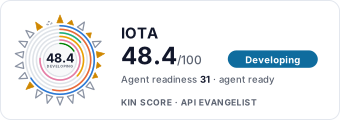
48.4/100developing▬ flatAgent31/100agent readyFront door AI1/6
silent
Heartbeat79/100
alive
open core · Apache-2.0
Full breakdown ↓
scored 2026-11-06 · rubric v0.27.0 · Show this score on your site →
Regulatory Posture applies to this provider. Its tags matched the
Horizontal (data, software, accessibility, platform) regime, so
Regulatory Posture carries 15 points of the composite.
If this regime is wrong for your business, say so on your
provider repo — the
applicability map is public and we will correct it.
Open Source Surface applies to this provider. This product is open source and we
read its repository directly, so Open Source Surface carries
10 points of the composite. It is scored from what the repository actually
publishes — a security policy, a contribution guide, a release history, a code of conduct — read live from the
provider rather than inferred from our own catalog pointers.
This facet adds; nothing was taken away to make room for it. An open-source project is not excused from
the commercial facets, because exemption would strip it of the points it does earn.
If we have the wrong repository, or this product is not open source, say so on your
provider repo and we
will drop the facet rather than have you publish against it.
Create-or-Update Ergonomics applies to this provider. This API accepts writes, so it
carries 10 points of the composite. It is scored from the published contracts
themselves: whether a caller can create-or-update in one call, whether the write accepts a key the caller already
holds, and whether the response says which branch ran. Without that, every write needs a search-and-branch in
front of it, and the first time that check is skipped a duplicate record is created.
Scored against the observed mean rather than raw — a provider at the catalog average is unchanged by this facet,
not penalised by it.
The six quality facets above are damped to 65 points between them,
because both conditional facets apply and carry
35 points together. That is why each facet's contribution is shown against a damped
maximum: raising a quality facet moves the composite by 65% of its nominal
weight, not 100%. The full arithmetic is at apis.io/rating/.
Show this score on your site.
It updates itself when the score changes. Paste this where you link to your API docs:
<a href="https://apis.io/providers/iota/"><img src="https://apis.io/badge/iota/card.svg" alt="IOTA on APIs.io — Kin Score by API Evangelist"></a>
Other styles, a README pill and a shields.io endpoint are on the badge page.
Raise your score.
Agent readiness — checks not met, largest first (exact, from this profile):
MCP Server+12 pts — deployment.mode + probe verdict on the mcp/ manifest, not the pointer; an unprobed slug falls back to authorship
Idempotency+9 pts — OpenAPI mutating operations declare an idempotency key — a header, a request-body property, or a named de-duplication token whose own description says so (verified); else common[].type matches /idempoten/i (documented)
A2A Agent Card+8 pts — a2a/-a2a.yml manifest, graded on conformance.grade against A2A 1.0.0
Delegated User Identity+6 pts — a served discovery document listing authorization_code in grant_types_supported (served), else an oauth2 authorizationCode flow or openIdConnect declared in an OpenAPI (documented)
Typed Event Surface+6 pts — AsyncAPI document, OR webhooks/callbacks objects in the as-published OpenAPI, OR common[].type includes Webhooks
7 more unmet checks in the Agent Readiness table above.
Kin Score — facets with the most composite points still available (weight × headroom):
Access Clarityscores 15.8 — up to +16.8 composite points
The Kin Score Market layer reads a provider inside its market:
its position, and how deep its integrations go. Depth is only comparable within a position. Provisional and unweighted:
not part of the Kin Score or agent readiness.
Registered MCP server and declares compatibility are report only — not weighted.
Undeclared means we found nothing we can read, so there is no number: we never infer integrations.
Standards this provider implements or carries. De facto ones are profiled and measured by the API Commons; formal ones come from the standards directory and are linked by the provider's own tags. The evidence column says how each claim was established — not that it was made.
GraphQL RPC interface for the IOTA blockchain, providing an alternative to the JSON-RPC API. Supports querying transaction blocks, objects, checkpoints, events, and on-chain sta...
The IOTA GraphQL RPC provides a flexible, typed interface for querying on-chain state on the IOTA blockchain. It serves as an alternative to the JSON-RPC 2.0 API and is served b...
GRAPHQL
IOTA API pricing
Not yet checked against IOTA's own pricing page. Compiled by API Evangelist on 2026-06-14 from docs.iota.org/developer/network-overview; confirm before you rely on a figure. A free plan or tier is listed.
Calls without X-API-Key need no key. Calls with it need a paid plan — get a key.
Get an API key
Free tier, no form to fill in. Signing in shares your email address with us — we
store it to create your key and to recognise you if you sign in with another
provider. See our Privacy Policy and
Terms.
 Kin Score
How this is scored →
 It updates itself when the score changes. Paste this where you link to your API docs: