Immuta website screenshot

Immuta

Immuta is a data security and access-governance platform that lets organizations register their cloud data platforms — Snowflake, Databricks (Unity Catalog, Lakebase, Spark), Amazon Redshift and Redshift Spectrum, Amazon S3, AWS Lake Formation, Google BigQuery, Azure Synapse Analytics, Starburst (Trino) and Teradata — and then author, enforce and audit subscription, data and write policies against that data from a single control plane. The platform is split into the Govern, Provision (Request) and Comply apps, with attribute-based access control, sensitive data discovery and tagging, dynamic masking and row-level filtering, purpose-based restrictions, data products and an access-request workflow, plus agentic data access controls for governing how AI agents and LLMs query sensitive data. Immuta exposes this surface through several REST APIs: the Data Marketplace / Request app API (published as OpenAPI 3.0), the Govern V1 and V2 APIs, the integrations API and the connections API, alongside the Immuta CLI, a webhook event surface and a Terraform provider.

Immuta publishes 11 APIs on the APIs.io network, including Access Request API, Asset API, Auth API, and 8 more. Tagged areas include Company, Data Governance, Data Access Control, Data Security, and Data Privacy.

The Immuta catalog on APIs.io includes 1 event-driven AsyncAPI specification.

Immuta’s developer surface includes documentation, API reference, getting-started guide, support, engineering blog, changelog, authentication, and 32 more developer resources.

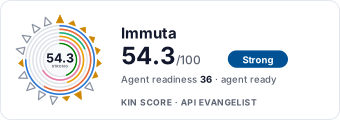
56.7/100 strong ▬ flat Agent 35/100 agent ready saas Full breakdown ↓
scored 2026-09-14 · rubric v0.22.0
1 APIs 1 MCP Servers
CompanyData GovernanceData Access ControlData SecurityData PrivacyPolicy ManagementData MarketplaceComplianceSnowflakeDatabricksAnalyticsAgentic Data Access

Kin Score

Kin Score Kin Score How this is scored →
scored 2026-09-14 · rubric v0.22.0
Regulatory Posture applies to this provider. Its tags matched the Insurance regime, so Regulatory Posture carries 15 points of the composite. If this regime is wrong for your business, say so on your provider repo — the applicability map is public and we will correct it.
Create-or-Update Ergonomics applies to this provider. This API accepts writes, so it carries 10 points of the composite. It is scored from the published contracts themselves: whether a caller can create-or-update in one call, whether the write accepts a key the caller already holds, and whether the response says which branch ran. Without that, every write needs a search-and-branch in front of it, and the first time that check is skipped a duplicate record is created. Scored against the observed mean rather than raw — a provider at the catalog average is unchanged by this facet, not penalised by it.
The six quality facets above are damped to 75 points between them, because the conditional facet above carries the other 25. That is why each facet's contribution is shown against a damped maximum: raising a quality facet moves the composite by 75% of its nominal weight, not 100%. The full arithmetic is at apis.io/rating/.
Improve this rating by publishing the missing artifacts — every area above can be raised, and the full rubric is at apis.io/rating/. Every facet and dimension name above is a link: it opens that measurement's own page — what it means, the exact checks that feed it, how the whole catalog distributes on it, and the providers at the top of it. This rating is computed from github.com/api-evangelist/immuta: open an issue to ask a question, or submit a pull request to add artifacts. Submit an artifact on GitHub — free → Manage your own listing — the Influence plan, $499/mo →

APIs 12

Individual APIs this provider publishes, each with its own machine-readable definition.

Immuta Govern API

The Immuta Govern app API — the tenant-hosted REST surface for registering data sources and connections, authoring data, subscription and write policies, managing domains, proje...

Immuta Access Request API

APIs for managing data access

Immuta Asset API

APIs for managing assets

Immuta Auth API

The Auth API from Immuta — 3 operation(s) for auth.

Immuta Data Product API

APIs for managing data products

Immuta Data Source API

APIs for managing data sources

Immuta Data Use Agreement API

APIs for managing data use agreements

Immuta Health API

APIs for checking the health of the service

Immuta Metadata API

APIs used to retrieve metadata from Immuta to enrich the marketplace

Immuta Notification API

APIs for managing notifications

Immuta Request Form API

APIs for managing request forms

Immuta Settings API

APIs used to retrieve metadata settings

Scroll for all 12

Open Collections 1

Open, tool-agnostic API collections (OpenAPI-derived and Bruno).

Immuta Data Marketplace

OPEN COLLECTION

MCP Servers 1

Model Context Protocol servers that expose these APIs to AI agents.

Immuta MCP Server

MCP SERVER

Event Specifications 1

AsyncAPI definitions for this provider's event-driven and streaming APIs.

Immuta Webhooks

ASYNCAPI

Security Posture 4

Authentication, domain security, vulnerability disclosure, and trust-center signals.

Immuta Authentication

http/apiKey · 3 schemes

SECURITY

Immuta Domain Security

TLSv1.3 · HSTS · DMARC

SECURITY

Immuta Trust Center

SOC 2, ISO 27001, PCI DSS, GDPR

SECURITY

Agentic Access 1

Recommended x-agentic-access execution contracts for AI agents.

Immuta Agentic Access

83 operations · 32 acting · 2 human-in-the-loop

83 operations · 32 acting

AGENTIC

Resources

Get Started 3

Portal, sign-up, and the first successful call

Documentation 2

Reference material describing how the API behaves

Agent Surfaces 4

MCP servers, agent skills, and machine-readable catalogs

Design & Contract 5

Pagination, idempotency, versioning, errors, and events

Build 4

SDKs, sample code, and the tooling you integrate with

Access & Security 7

Authentication, authorization, and security posture

Scroll for all 7

Learn 1

Tutorials, courses, talks, and written guidance

Operate 6

Status, limits, changes, and where to get help

Commercial 2

Pricing, plans, and the legal terms of use

Company 4

The organization behind the API

Other 1

Properties that don't map to a standard resource type

Source (apis.yml)

apis.yml Raw ↑
aid: immuta
name: Immuta
description: 'Immuta is a data security and access-governance platform that lets organizations register their cloud data platforms
  — Snowflake, Databricks (Unity Catalog, Lakebase, Spark), Amazon Redshift and Redshift Spectrum, Amazon S3, AWS Lake Formation,
  Google BigQuery, Azure Synapse Analytics, Starburst (Trino) and Teradata — and then author, enforce and audit subscription,
  data and write policies against that data from a single control plane. The platform is split into the Govern, Provision
  (Request) and Comply apps, with attribute-based access control, sensitive data discovery and tagging, dynamic masking and
  row-level filtering, purpose-based restrictions, data products and an access-request workflow, plus agentic data access
  controls for governing how AI agents and LLMs query sensitive data. Immuta exposes this surface through several REST APIs:
  the Data Marketplace / Request app API (published as OpenAPI 3.0), the Govern V1 and V2 APIs, the integrations API and the
  connections API, alongside the Immuta CLI, a webhook event surface and a Terraform provider.'
deliveryModel:
  model: saas
  open_source: false
  commercial: true
  callable_host: true
  label: Hosted service · you call their endpoint
  confidence: high
  source:
  - openapi
  - pricing
  generated: '2026-08-28'
  method: derived
accessModel:
  pricing: unknown
  onboarding: unknown
  trial: false
  try_now: false
  public: false
  label: Unknown
  confidence: low
  source:
  - authentication
  - security
  generated: '2026-09-03'
  method: derived
image: https://www.immuta.com/wp-content/uploads/2024/10/favicon.png
url: https://raw.githubusercontent.com/api-evangelist/immuta/refs/heads/main/apis.yml
x-type: company
x-source: harvest:secondary-market
x-tier: profiled
x-tier-reason: enrichment
specificationVersion: '0.23'
created: '2026-08-01'
modified: '2026-08-01'
tags:
- Company
- Data Governance
- Data Access Control
- Data Security
- Data Privacy
- Policy Management
- Data Marketplace
- Compliance
- Snowflake
- Databricks
- Analytics
- Agentic Data Access
apis:
- aid: immuta:govern-api
  name: Immuta Govern API
  description: 'The Immuta Govern app API — the tenant-hosted REST surface for registering data sources and connections, authoring
    data, subscription and write policies, managing domains, projects, purposes, tags, frameworks, identities (bim), licenses,
    jobs, search filters and webhooks, and generating governance reports. It is documented in three layers: the V2 API (declarative
    policy-as-code, JSON or YAML, same endpoint for create and update), the V1 API (full endpoint reference), and the integrations
    and connections APIs for wiring remote data platforms into Immuta. Authenticated with an Immuta API key or a bearer token
    exchanged at /bim/apikey/authenticate. The base URL is the customer''s own Immuta SaaS tenant host.'
  humanURL: https://documentation.immuta.com/saas/developer-guides/api-intro
  baseURL: https://your-immuta-url.immuta.com
  x-tenant-scoped: true
  x-base-url-note: Immuta SaaS is multi-tenant; the Govern API base URL is the customer's own tenant host (https://<your-tenant>.immuta.com).
    The value here is the host Immuta uses verbatim in its own documented curl examples.
  tags:
  - Data Governance
  - Policy Management
  - Data Access Control
  - Webhook
  tags_raw:
  - Data Governance
  - Policy Management
  - Data Access Control
  - Webhooks
  properties:
  - type: Documentation
    url: https://documentation.immuta.com/saas/developer-guides/api-intro
  - type: APIReference
    url: https://documentation.immuta.com/saas/developer-guides/api-intro/immuta-v1-api
  - type: Authentication
    url: https://documentation.immuta.com/saas/developer-guides/api-intro/authentication
  - type: Webhooks
    url: asyncapi/immuta-webhooks.yml
  - type: ErrorCatalog
    url: errors/immuta-problem-types.yml
- aid: immuta:immuta-access-request-api
  name: Immuta Access Request API
  description: APIs for managing data access
  humanURL: https://documentation.immuta.com/saas/developer-guides/api-intro/marketplace-api
  baseURL: https://na.api.immutacloud.com/marketplace
  tags:
  - Access Request
  properties:
  - type: OpenAPI
    url: openapi/immuta-access-request-api-openapi.yml
  - type: Documentation
    url: https://documentation.immuta.com/saas/developer-guides/api-intro/marketplace-api
  - type: Authentication
    url: https://documentation.immuta.com/saas/developer-guides/api-intro/authentication
  - type: DataModel
    url: data-model/immuta-data-model.yml
  - type: ErrorCatalog
    url: errors/immuta-problem-types.yml
- aid: immuta:immuta-asset-api
  name: Immuta Asset API
  description: APIs for managing assets
  humanURL: https://documentation.immuta.com/saas/developer-guides/api-intro/marketplace-api
  baseURL: https://na.api.immutacloud.com/marketplace
  tags:
  - Asset
  properties:
  - type: OpenAPI
    url: openapi/immuta-asset-api-openapi.yml
  - type: Documentation
    url: https://documentation.immuta.com/saas/developer-guides/api-intro/marketplace-api
  - type: Authentication
    url: https://documentation.immuta.com/saas/developer-guides/api-intro/authentication
  - type: DataModel
    url: data-model/immuta-data-model.yml
  - type: ErrorCatalog
    url: errors/immuta-problem-types.yml
- aid: immuta:immuta-auth-api
  name: Immuta Auth API
  description: The Auth API from Immuta — 3 operation(s) for auth.
  humanURL: https://documentation.immuta.com/saas/developer-guides/api-intro/marketplace-api
  baseURL: https://na.api.immutacloud.com/marketplace
  tags:
  - Authentication
  tags_raw:
  - Auth
  properties:
  - type: OpenAPI
    url: openapi/immuta-auth-api-openapi.yml
  - type: Documentation
    url: https://documentation.immuta.com/saas/developer-guides/api-intro/marketplace-api
  - type: Authentication
    url: https://documentation.immuta.com/saas/developer-guides/api-intro/authentication
  - type: DataModel
    url: data-model/immuta-data-model.yml
  - type: ErrorCatalog
    url: errors/immuta-problem-types.yml
- aid: immuta:immuta-data-product-api
  name: Immuta Data Product API
  description: APIs for managing data products
  humanURL: https://documentation.immuta.com/saas/developer-guides/api-intro/marketplace-api
  baseURL: https://na.api.immutacloud.com/marketplace
  tags:
  - Data Product
  properties:
  - type: OpenAPI
    url: openapi/immuta-data-product-api-openapi.yml
  - type: Documentation
    url: https://documentation.immuta.com/saas/developer-guides/api-intro/marketplace-api
  - type: Authentication
    url: https://documentation.immuta.com/saas/developer-guides/api-intro/authentication
  - type: DataModel
    url: data-model/immuta-data-model.yml
  - type: ErrorCatalog
    url: errors/immuta-problem-types.yml
- aid: immuta:immuta-data-source-api
  name: Immuta Data Source API
  description: APIs for managing data sources
  humanURL: https://documentation.immuta.com/saas/developer-guides/api-intro/marketplace-api
  baseURL: https://na.api.immutacloud.com/marketplace
  tags:
  - DataSource
  tags_raw:
  - Data Source
  properties:
  - type: OpenAPI
    url: openapi/immuta-data-source-api-openapi.yml
  - type: Documentation
    url: https://documentation.immuta.com/saas/developer-guides/api-intro/marketplace-api
  - type: Authentication
    url: https://documentation.immuta.com/saas/developer-guides/api-intro/authentication
  - type: DataModel
    url: data-model/immuta-data-model.yml
  - type: ErrorCatalog
    url: errors/immuta-problem-types.yml
- aid: immuta:immuta-data-use-agreement-api
  name: Immuta Data Use Agreement API
  description: APIs for managing data use agreements
  humanURL: https://documentation.immuta.com/saas/developer-guides/api-intro/marketplace-api
  baseURL: https://na.api.immutacloud.com/marketplace
  tags:
  - Data Use Agreement
  properties:
  - type: OpenAPI
    url: openapi/immuta-data-use-agreement-api-openapi.yml
  - type: Documentation
    url: https://documentation.immuta.com/saas/developer-guides/api-intro/marketplace-api
  - type: Authentication
    url: https://documentation.immuta.com/saas/developer-guides/api-intro/authentication
  - type: DataModel
    url: data-model/immuta-data-model.yml
  - type: ErrorCatalog
    url: errors/immuta-problem-types.yml
- aid: immuta:immuta-health-api
  name: Immuta Health API
  description: APIs for checking the health of the service
  humanURL: https://documentation.immuta.com/saas/developer-guides/api-intro/marketplace-api
  baseURL: https://na.api.immutacloud.com/marketplace
  tags:
  - Health
  properties:
  - type: OpenAPI
    url: openapi/immuta-health-api-openapi.yml
  - type: Documentation
    url: https://documentation.immuta.com/saas/developer-guides/api-intro/marketplace-api
  - type: Authentication
    url: https://documentation.immuta.com/saas/developer-guides/api-intro/authentication
  - type: DataModel
    url: data-model/immuta-data-model.yml
  - type: ErrorCatalog
    url: errors/immuta-problem-types.yml
- aid: immuta:immuta-metadata-api
  name: Immuta Metadata API
  description: APIs used to retrieve metadata from Immuta to enrich the marketplace
  humanURL: https://documentation.immuta.com/saas/developer-guides/api-intro/marketplace-api
  baseURL: https://na.api.immutacloud.com/marketplace
  tags:
  - Metadata
  properties:
  - type: OpenAPI
    url: openapi/immuta-metadata-api-openapi.yml
  - type: Documentation
    url: https://documentation.immuta.com/saas/developer-guides/api-intro/marketplace-api
  - type: Authentication
    url: https://documentation.immuta.com/saas/developer-guides/api-intro/authentication
  - type: DataModel
    url: data-model/immuta-data-model.yml
  - type: ErrorCatalog
    url: errors/immuta-problem-types.yml
- aid: immuta:immuta-notification-api
  name: Immuta Notification API
  description: APIs for managing notifications
  humanURL: https://documentation.immuta.com/saas/developer-guides/api-intro/marketplace-api
  baseURL: https://na.api.immutacloud.com/marketplace
  tags:
  - Notification
  properties:
  - type: OpenAPI
    url: openapi/immuta-notification-api-openapi.yml
  - type: Documentation
    url: https://documentation.immuta.com/saas/developer-guides/api-intro/marketplace-api
  - type: Authentication
    url: https://documentation.immuta.com/saas/developer-guides/api-intro/authentication
  - type: DataModel
    url: data-model/immuta-data-model.yml
  - type: ErrorCatalog
    url: errors/immuta-problem-types.yml
- aid: immuta:immuta-request-form-api
  name: Immuta Request Form API
  description: APIs for managing request forms
  humanURL: https://documentation.immuta.com/saas/developer-guides/api-intro/marketplace-api
  baseURL: https://na.api.immutacloud.com/marketplace
  tags:
  - Request Form
  properties:
  - type: OpenAPI
    url: openapi/immuta-request-form-api-openapi.yml
  - type: Documentation
    url: https://documentation.immuta.com/saas/developer-guides/api-intro/marketplace-api
  - type: Authentication
    url: https://documentation.immuta.com/saas/developer-guides/api-intro/authentication
  - type: DataModel
    url: data-model/immuta-data-model.yml
  - type: ErrorCatalog
    url: errors/immuta-problem-types.yml
- aid: immuta:immuta-settings-api
  name: Immuta Settings API
  description: APIs used to retrieve metadata settings
  humanURL: https://documentation.immuta.com/saas/developer-guides/api-intro/marketplace-api
  baseURL: https://na.api.immutacloud.com/marketplace
  tags:
  - Settings
  properties:
  - type: OpenAPI
    url: openapi/immuta-settings-api-openapi.yml
  - type: Documentation
    url: https://documentation.immuta.com/saas/developer-guides/api-intro/marketplace-api
  - type: Authentication
    url: https://documentation.immuta.com/saas/developer-guides/api-intro/authentication
  - type: DataModel
    url: data-model/immuta-data-model.yml
  - type: ErrorCatalog
    url: errors/immuta-problem-types.yml
x-enrichment:
  date: '2026-08-01'
  status: enriched
  artifacts_added: 22
  pass: local-v1
maintainers:
- FN: Kin Lane
  email: kin@apievangelist.com
- FN: APIs.json
  email: info@apis.io
common:
- type: Overlay
  url: overlays/immuta-marketplace-api-overlay.yaml
- type: AgenticAccess
  url: agentic-access/immuta-agentic-access.yml
- type: Website
  url: https://www.immuta.com/
- type: DeveloperPortal
  url: https://documentation.immuta.com/saas/developer-guides/api-intro
- type: Documentation
  url: https://documentation.immuta.com/saas
- type: APIReference
  url: https://documentation.immuta.com/saas/developer-guides/api-intro
- type: GettingStarted
  url: https://documentation.immuta.com/saas/developer-guides/api-intro/integrations-api/getting-started
- type: Support
  url: https://support.immuta.com/en/customer-portal
- type: Blog
  url: https://www.immuta.com/blog/
- type: GitHubOrganization
  url: https://github.com/immuta
- type: ChangeLog
  url: https://changelog.immuta.com/en
- type: ChangeLog
  url: changelog/immuta-changelog.yml
- type: StatusPage
  url: https://status.immuta.com/
- type: Deprecation
  url: https://documentation.immuta.com/saas/releases/deprecations
- type: Lifecycle
  url: lifecycle/immuta-lifecycle.yml
- type: TermsOfService
  url: https://www.immuta.com/terms-of-service/
- type: PrivacyPolicy
  url: https://www.immuta.com/legal/privacy-policy/
- type: Login
  url: https://app.immutacloud.com/
- type: TrustCenter
  url: security/immuta-trust-center.yml
- type: Trust
  url: https://www.immuta.com/trust/
- type: Compliance
  url: https://www.immuta.com/trust/
- type: Security
  url: https://bugcrowd.com/61d7ba4d-be53-4704-9a73-761d6f108df9/external/report
- type: VulnerabilityDisclosure
  url: security/immuta-vulnerability-disclosure.yml
- type: DomainSecurity
  url: security/immuta-domain-security.yml
- type: Conformance
  url: conformance/immuta-conformance.yml
- type: Authentication
  url: authentication/immuta-authentication.yml
- type: Conventions
  url: conventions/immuta-conventions.yml
- type: Idempotency
  url: conventions/immuta-conventions.yml
- type: Packages
  url: packages/immuta-packages.yml
- type: CLI
  url: cli/immuta-cli.yml
- type: MCPServer
  url: mcp/immuta-mcp.yml
- type: ToolCrosswalk
  url: mcp/immuta-tool-crosswalk.yml
- type: AgentSkill
  url: skills/_index.yml
- type: Webhooks
  url: asyncapi/immuta-webhooks.yml
- type: LLMsTxt
  url: llms/immuta-llms.txt
- type: SLA
  url: https://www.immuta.com/wp-content/uploads/2025/01/Immuta-Support-Policy-SLA-February-2025.pdf
- type: LinkedIn
  url: https://www.linkedin.com/company/immuta/
- type: Twitter
  url: https://x.com/immuta
- type: YouTube
  url: https://www.youtube.com/c/Immuta

Work with this as data

Every provider here is available over the APIs.io API and to AI agents over MCP.

MCP server

One button, every client — Claude, Cursor, VS Code and the rest.

https://apis.io/mcp

Tools for providers

9 MCP tools reach this
  • find_providersBrowse and filter every provider in the catalog.
  • get_provider_artifactsEvery artifact this provider publishes, grouped by type.
  • get_provider_operationsEvery operation across all of their OpenAPIs — one call instead of parsing every spec.
  • get_provider_toolsEvery MCP tool they ship, with the operation each wraps.
  • get_provider_evidenceHow each part of their score was established. Free — the basis for a claim should not sit behind it.
  • get_provider_ratingPRO — composite, band, trend and facet scores.
  • apis_io_searchSTART HERE — APIs, providers and tags for one query, each with its total.
  • resolveTurn a domain, URL or GitHub org into the provider it belongs to.
  • find_cohortsEvery scored population of providers in the catalog.
All 92 tools →

Call it yourself

curl for this page
This provider
curl "https://apis.io/api/v1/providers/immuta"
All providers
curl "https://apis.io/api/v1/providers?limit=25"
Every operation they expose
curl "https://apis.io/api/v1/providers/immuta/operations?limit=25"
How their score was established
curl "https://apis.io/api/v1/providers/immuta/evidence"

Discovery needs no key. Ratings and market analysis are Pro.

Get an API key

Free tier, no form to fill in. Signing in shares your email address with us — we store it to create your key and to recognise you if you sign in with another provider. See our Privacy Policy and Terms.

A second provider on the same verified email joins the account you already have.