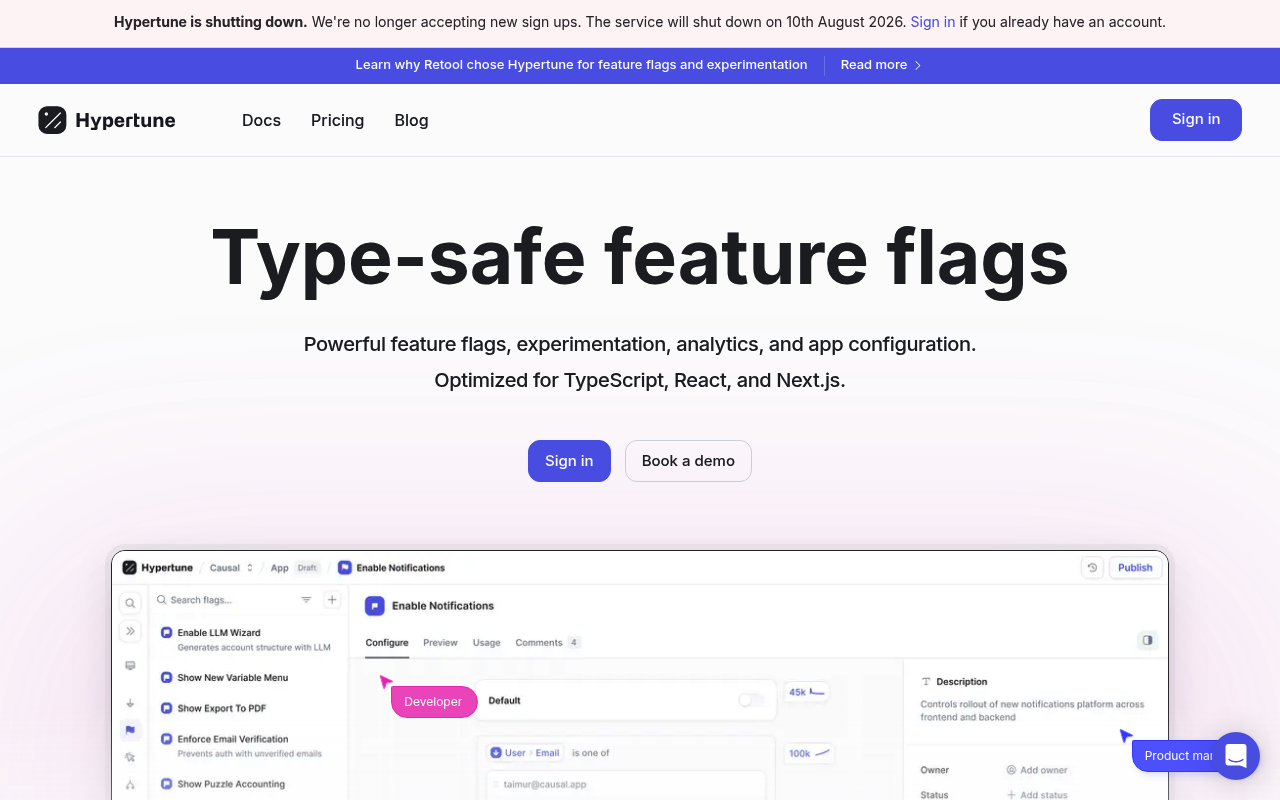
Hypertune
Hypertune is a type-safe, Git-based platform for feature flags, A/B testing, experimentation, analytics, and app configuration. Flag logic is authored in Hyperlang and modeled as a GraphQL schema; SDKs use a CLI to generate fully typed clients, fetch flag logic once from Hypertune Edge (Cloudflare CDN) at initialization, then evaluate flags locally and synchronously in memory. A GraphQL Edge API offers a no-SDK path, and analytics events are flushed back to Hypertune Edge in the background.
Hypertune publishes 2 API contracts indexed on the APIs.io network, including Graph QL API, and 1 more. Tagged areas include Feature Flags, Experimentation, A/B Testing, Analytics, and App Configuration.
Hypertune’s developer surface includes authentication, documentation, engineering blog, and 9 more developer resources.
What this lets a business do 1
Business capabilities this provider's published APIs can perform, derived from its own contracts. Browse all capabilities →
Kin Score
 Kin Score
How this is scored →
Kin Score
How this is scored →scored 2026-10-23 · rubric v0.25.0
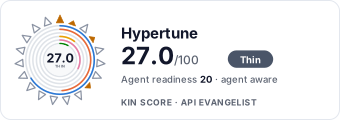 It updates itself when the score changes. Paste this where you link to your API docs:
<a href="https://apis.io/providers/hypertune/"><img src="https://apis.io/badge/hypertune/card.svg" alt="Hypertune on APIs.io — Kin Score by API Evangelist"></a>Other styles, a README pill and a shields.io endpoint are on the badge page.
Standards implemented 1
Standards this provider implements or carries. De facto ones are profiled and measured by the API Commons; formal ones come from the standards directory and are linked by the provider's own tags. The evidence column says how each claim was established — not that it was made.
APIs 2
Individual APIs this provider publishes, each with its own machine-readable definition.
Hypertune Management API
Programmatic and Git-based management of flags, experiments, and configuration. Hypertune versions all flags, experiments, analytics events, and app configuration together in a ...
Hypertune Graph QL API
The Graph QL API from Hypertune — 1 operation(s) for graph ql.
Open Collections 2
Open, tool-agnostic API collections (OpenAPI-derived and Bruno).
Hypertune Edge GraphQL API
OPEN COLLECTIONHypertune Edge API
OPEN COLLECTIONGraphQL 1
GraphQL schemas published by this provider.
Hypertune GraphQL Schema
Conceptual, representative GraphQL schema for the [Hypertune](https://www.hypertune.com/)
GRAPHQLPricing Plans 1
Published pricing tiers and plan structures.
Rate Limits 1
Documented rate limits and quota policies.
Hypertune Rate Limits
RATE LIMITSFinOps 1
Cost, billing, and metering signals for API financial operations.
Hypertune Finops
FINOPSSecurity Posture 2
Authentication, domain security, vulnerability disclosure, and trust-center signals.
Agentic Access 1
Recommended x-agentic-access execution contracts for AI agents.
Resources
Documentation 1
Reference material describing how the API behaves
Agent Surfaces 1
MCP servers, agent skills, and machine-readable catalogs
Build 1
SDKs, sample code, and the tooling you integrate with
Access & Security 2
Authentication, authorization, and security posture
Operate 1
Status, limits, changes, and where to get help
Commercial 2
Pricing, plans, and the legal terms of use
Company 3
The organization behind the API
Other 1
Properties that don't map to a standard resource type
Source (apis.yml)
Work with this as data
Every provider here is available over the APIs.io API and to AI agents over MCP.