Guild.ai
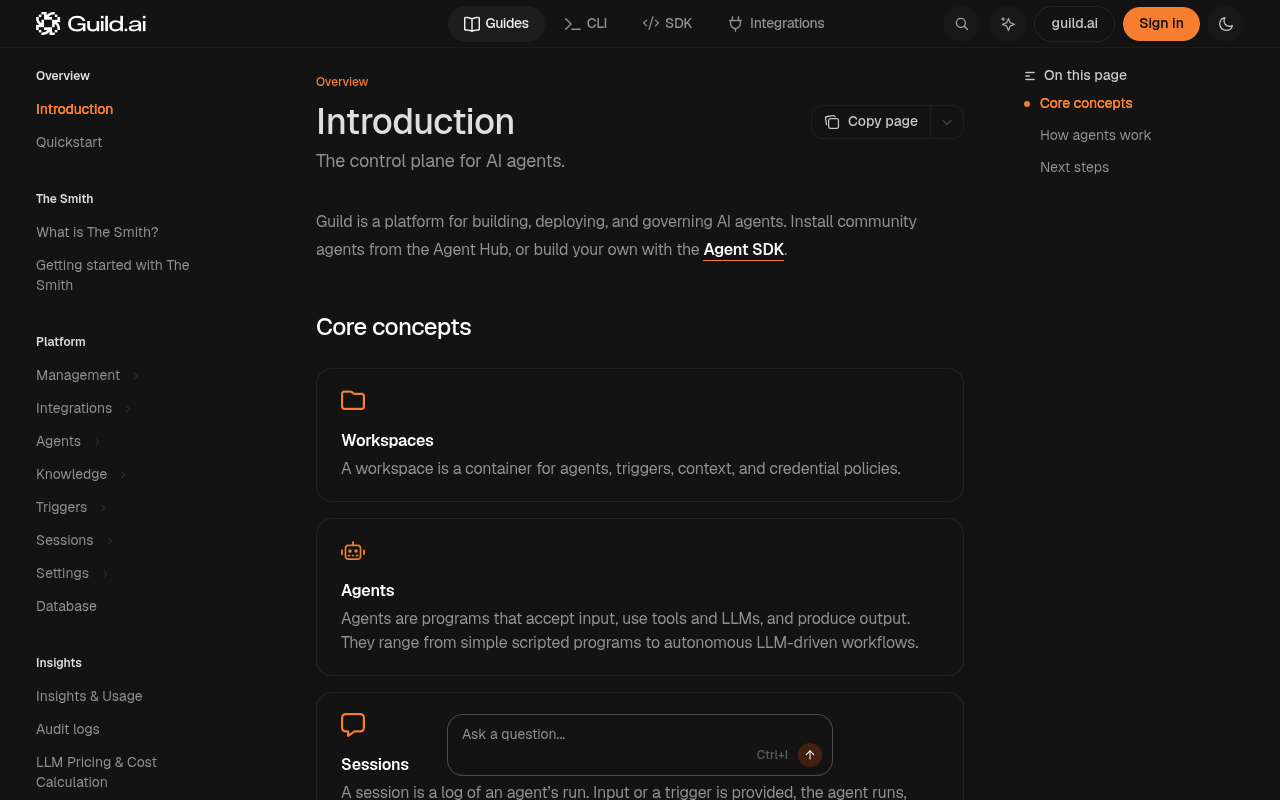
Guild.ai is a control plane for AI agents that lets engineering teams build, deploy, govern, and share agents in production. Agents are authored in TypeScript with the @guildai/agents-sdk (alongside Guild Native and Goose recipe agent types) and run in a governed, sandboxed runtime that mediates all external tool access and enforces least-privilege scoped credentials, with workspaces, versioning, audit logs, and real-time usage and cost tracking. Guild is model-agnostic across OpenAI, Anthropic, and Google, ships a first-party CLI that also runs an MCP server, exposes a Guildcode REST API plus per-trigger API keys for programmatic invocation, offers 40+ integrations (GitHub, Slack, Jira, Linear, Notion, Google Cloud, and more), and provides an Agent Hub for discovering, forking, and publishing agents. Backed by GV, NFX, and Khosla Ventures.
Guild.ai is listed with 1 API on the APIs.io network. Tagged areas include Company, Artificial Intelligence, AI Agents, Agent Control Plane, and Agent Runtime.
Guild.ai’s developer surface includes documentation, API reference, getting-started guide, engineering blog, support, pricing, signup flow, and 13 more developer resources.
Kin Score
 Kin Score
How this is scored →
Kin Score
How this is scored →scored 2026-10-09 · rubric v0.23.0
APIs 1
Individual APIs this provider publishes, each with its own machine-readable definition.
Guild REST API
The Guildcode REST API for creating workspace-scoped agent sessions, posting events, and reading session events and tasks. HTTP Basic authentication; no public OpenAPI spec.
MCP Servers 1
Model Context Protocol servers that expose these APIs to AI agents.
Guild.ai MCP Server
The Guild CLI ships an MCP server that exposes Guild control-plane operations as tools for MCP clients, so client agents can list and inspect workspaces, agents, sessions, trigg...
MCP SERVERPricing Plans 1
Published pricing tiers and plan structures.
Security Posture 2
Authentication, domain security, vulnerability disclosure, and trust-center signals.
Resources
Get Started 3
Portal, sign-up, and the first successful call
Documentation 2
Reference material describing how the API behaves
Agent Surfaces 2
MCP servers, agent skills, and machine-readable catalogs
Design & Contract 1
Pagination, idempotency, versioning, errors, and events
Build 3
SDKs, sample code, and the tooling you integrate with
Access & Security 2
Authentication, authorization, and security posture
Operate 1
Status, limits, changes, and where to get help
Commercial 4
Pricing, plans, and the legal terms of use
Company 2
The organization behind the API
Source (apis.yml)
Work with this as data
Every provider here is available over the APIs.io API and to AI agents over MCP.