Grab is Southeast Asia's leading on-demand superapp, offering ride-hailing (GrabCar / GrabBike / GrabTaxi), food delivery (GrabFood), package delivery (GrabExpress), grocery and retail (GrabMart), digital payments (GrabPay), financial services (GrabFin), and a B2B / enterprise business unit (Grab for Business). Grab exposes a partner-grade developer platform at developer.grab.com covering ride pricing (Farefeed), delivery (Express, GrabFood, GrabMart), payments (GrabPay QR, One-Time Charge, Tokenisation, Grab POS), identity (Login with Grab), loyalty (GrabRewards / Points / GrabGifts), corporate accounts (Grab for Business), and digital products / bill payments via Grab Kios. The platform is OAuth 2.0 based with partner-issued client credentials.
Grab publishes 19 API contracts indexed on the APIs.io network, including GrabExpress API, GrabID API, GrabPay API, and 16 more. Tagged areas include Ride Hailing, Food Delivery, Last Mile Delivery, Digital Payments, and Super App.
The Grab catalog on APIs.io includes 1 Spectral governance ruleset.
Grab’s developer surface includes authentication, documentation, GitHub presence, engineering blog, and 17 more developer resources.
Regulatory Posture applies to this provider. Its tags matched the
Payments regime, so
Regulatory Posture carries 15 points of the composite.
If this regime is wrong for your business, say so on your
provider repo — the
applicability map is public and we will correct it.
Create-or-Update Ergonomics applies to this provider. This API accepts writes, so it
carries 10 points of the composite. It is scored from the published contracts
themselves: whether a caller can create-or-update in one call, whether the write accepts a key the caller already
holds, and whether the response says which branch ran. Without that, every write needs a search-and-branch in
front of it, and the first time that check is skipped a duplicate record is created.
Scored against the observed mean rather than raw — a provider at the catalog average is unchanged by this facet,
not penalised by it.
The six quality facets above are damped to 75 points between them,
because the conditional facet above carries the other
25. That is why each facet's contribution is shown against a damped
maximum: raising a quality facet moves the composite by 75% of its nominal
weight, not 100%. The full arithmetic is at apis.io/rating/.
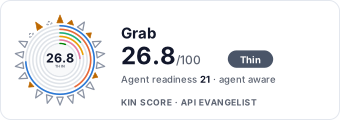
Show this score on your site.
It updates itself when the score changes. Paste this where you link to your API docs:
<a href="https://apis.io/providers/grab/"><img src="https://apis.io/badge/grab/card.svg" alt="Grab on APIs.io — Kin Score by API Evangelist"></a>
Other styles, a README pill and a shields.io endpoint are on the badge page.
Raise your score.
Agent readiness — checks not met, largest first (exact, from this profile):
MCP Server+12 pts — deployment.mode + probe verdict on the mcp/ manifest, not the pointer; an unprobed slug falls back to authorship
Idempotency+9 pts — OpenAPI mutating operations declare an idempotency key — a header, a request-body property, or a named de-duplication token whose own description says so (verified); else common[].type matches /idempoten/i (documented)
Stable Error Semantics+8 pts — OpenAPI $refs a shared error schema across 4xx/5xx responses (verified), else common[].type includes ErrorCatalog / ErrorCodes / DeclineCodes
A2A Agent Card+8 pts — a2a/-a2a.yml manifest, graded on conformance.grade against A2A 1.0.0
Request/Response Examples+7 pts — share of operations carrying request/response examples; else an Examples / Code Samples link
The Kin Score Market layer reads a provider inside its market:
its position, and how deep its integrations go. Depth is only comparable within a position. Provisional and unweighted:
not part of the Kin Score or agent readiness.
Registered MCP server and declares compatibility are report only — not weighted.
Undeclared means we found nothing we can read, so there is no number: we never infer integrations.
Standards this provider implements or carries. De facto ones are profiled and measured by the API Commons; formal ones come from the standards directory and are linked by the provider's own tags. The evidence column says how each claim was established — not that it was made.
Grab ID is Grab's OAuth 2.0 / OpenID Connect identity provider. Partner applications use the Login With Grab flow to authenticate Grab consumers and obtain ID and access tokens ...
The GrabFood API lets merchant POS / SaaS partners receive, acknowledge, and fulfill GrabFood orders, manage menus and store status, and surface delivery status to the merchant.
The GrabMart API supports grocery, convenience, and retail merchants integrating with Grab's on-demand marketplace — including catalog ingestion, store-level inventory, order ac...
GrabExpress is Grab's on-demand same-city courier API for ecommerce, retail, and SaaS partners. Partners create delivery requests, fetch quotes, track couriers in real time, and...
The Farefeed API exposes ride pricing and supply information to ecosystem partners (e.g. mapping, navigation, planning apps) so they can render Grab fare estimates inline.
Partner Apps Integration lets third-party applications surface services inside the Grab consumer app via a partner-app framework — covering deep links, in-app activation, and ev...
The Grab For Business Partner API supports corporate travel, expense, and HR platforms that need to provision corporate Grab accounts, set ride policies, and pull employee trip ...
GrabGifts Integration enables partner platforms to issue and redeem Grab e-gift vouchers — used for employee rewards, customer incentives, and loyalty programs across SEA.
GrabDefence exposes Grab's internal fraud, abuse, and risk evaluation platform as an API for partners — covering device risk scoring, account integrity checks, and transaction r...
The One-Time Charge API supports online merchants charging GrabPay wallets via a redirect or app-to-app handoff checkout flow, with payment success and failure webhook notificat...
Tokenisation lets partner merchants store a customer's GrabPay payment instrument as a reusable token for recurring and one-click checkouts, with PCI-scope reduction.
The Grab POS API integrates physical point-of-sale terminals with GrabPay for in-store payment acceptance, including transaction lifecycle, refund, and reconciliation flows.
The Points Earning and GrabRewards Tier APIs let ecosystem partners award GrabRewards points for qualifying activity and check a user's loyalty tier for tier-based offers.
Grab Kios Digital Products API powers digital-goods commerce for Grab Kios agents in Indonesia — covering top-ups for mobile credit, data packages, gaming credits, and digital v...
The Biller Gateway API lets Grab Kios agents accept bill payments for electricity, water, multifinance, and other Indonesian billers, with inquiry, payment, and reversal operati...
Not yet checked against Grab's own pricing page. Compiled by API Evangelist on 2026-05-22; confirm before you rely on a figure. A free plan or tier is listed.
Calls without X-API-Key need no key. Calls with it need a paid plan — get a key.
Get an API key
Free tier, no form to fill in. Signing in shares your email address with us — we
store it to create your key and to recognise you if you sign in with another
provider. See our Privacy Policy and
Terms.
 Kin Score
How this is scored →
 It updates itself when the score changes. Paste this where you link to your API docs: