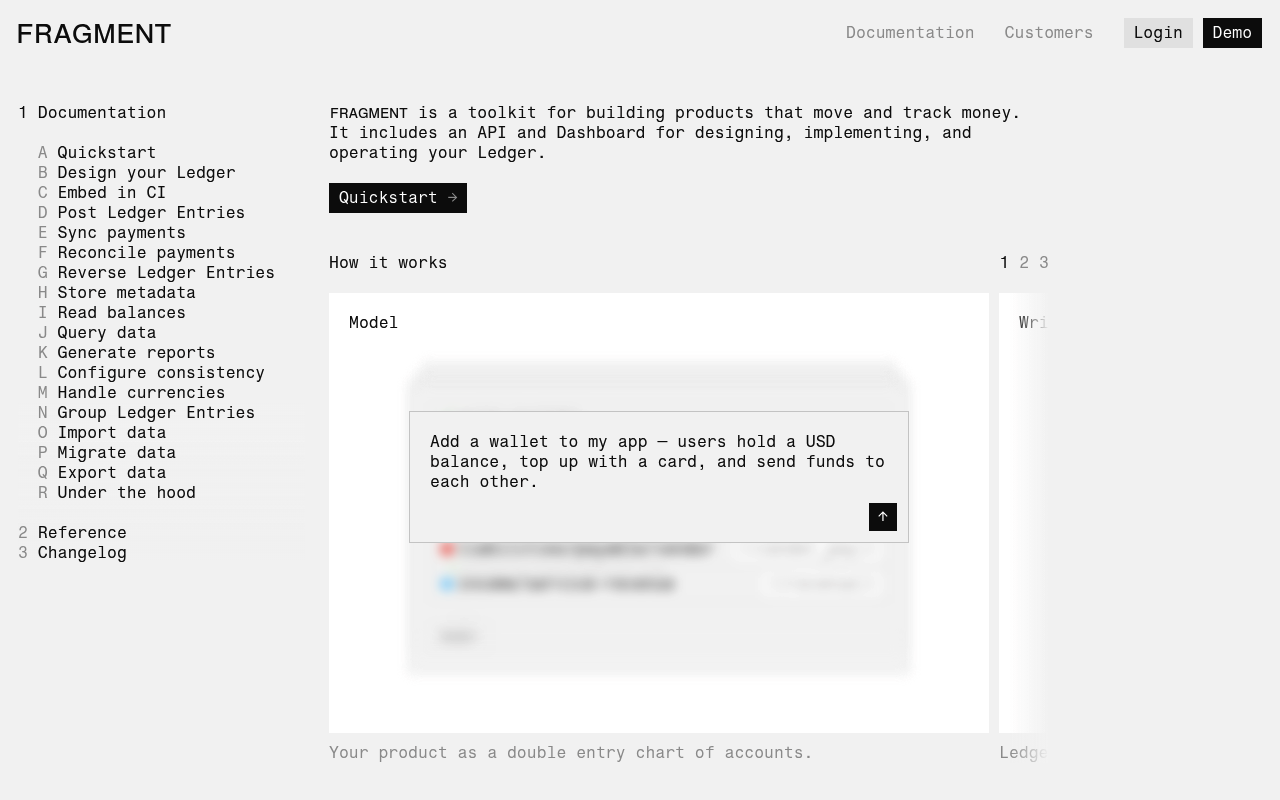
Fragment
Fragment is the ledger API for engineers who move money. It provides a double-entry accounting engine — "the database for money" — that lets developers model any funds flow as declarative, typed schemas and post balanced, immutable ledger entries through a GraphQL API. Fragment generates a typesafe SDK from your chart-of-accounts schema, tracks real-time, historical, period, and strongly-consistent balances across multi-currency and custom-currency accounts, and reconciles internal ledgers against external systems (Stripe, Increase, Unit, banks) via linked and external accounts. Every write mutation is idempotent (per-Ledger idempotency keys), responses are GraphQL union types with typed errors, list queries are cursor-paginated, and the API is deployed across AWS regions. Fragment is used by companies including Bill, Ramp, Pleo, AtoB, Basic Capital, and Nala, and is backed by General Catalyst.
Fragment publishes 1 API on the APIs.io network. Tagged areas include Company, Ledger, Accounting, Payments, and Fintech.
Fragment’s developer surface includes documentation, API reference, getting-started guide, engineering blog, changelog, signup flow, support, and 24 more developer resources.
Kin Score
 Kin Score
How this is scored →
Kin Score
How this is scored →scored 2026-09-06 · rubric v0.19.0
APIs 1
Individual APIs this provider publishes, each with its own machine-readable definition.
Fragment Ledger API
Fragment's GraphQL Ledger API. Store a double-entry chart-of-accounts schema, create ledgers, post idempotent ledger entries and lines, read aggregated / historical / period / s...
Security Posture 4
Authentication, domain security, vulnerability disclosure, and trust-center signals.
Resources
Get Started 4
Portal, sign-up, and the first successful call
Documentation 2
Reference material describing how the API behaves
Agent Surfaces 3
MCP servers, agent skills, and machine-readable catalogs
Design & Contract 6
Pagination, idempotency, versioning, errors, and events
Build 4
SDKs, sample code, and the tooling you integrate with
Access & Security 6
Authentication, authorization, and security posture
Operate 3
Status, limits, changes, and where to get help
Commercial 2
Pricing, plans, and the legal terms of use
Company 1
The organization behind the API
Source (apis.yml)
Work with this as data
Every provider here is available over the APIs.io API and to AI agents over MCP.