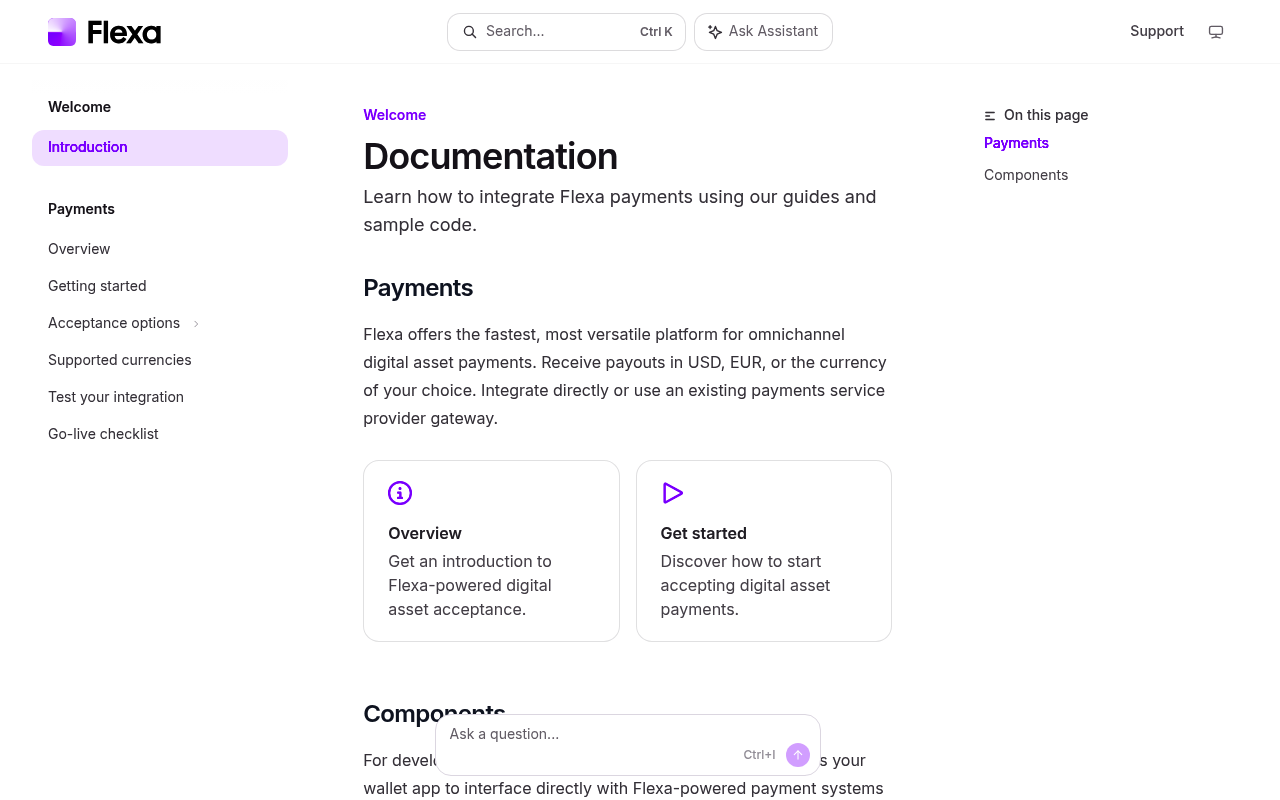
Flexa website screenshot

Flexa

Flexa is a digital-currency payments network that lets businesses accept crypto and other digital assets from customers anywhere, with instant authorization, fraud-resistant settlement, and automatic conversion into a preferred payout currency so merchants avoid price volatility. The Flexa Payments API is built around the "commerce intent" resource, which represents any attempt to collect a digital-currency payment and tracks requested debits against actual credits; supporting resources include assets, refunds, events, links, brands, and flexcodes. Flexa ships prebuilt mobile UI Components for iOS, Android, and React Native, plus in-person (Point of Sale) and online acceptance options, and a production-grade test mode that uses a valueless ERC-20 "Credit" (CR) token. Flexa is backed by Pantera Capital and supports 99+ digital assets across Ethereum, Bitcoin, Lightning, Solana, and more.

Flexa publishes 4 APIs on the APIs.io network, including Assets API, Commerce Intents API, Events API, and 1 more. Tagged areas include Company, Crypto, Payments, Digital Currency, and Cryptocurrency.

The Flexa catalog on APIs.io includes 1 event-driven AsyncAPI specification.

Flexa’s developer surface includes documentation, API reference, getting-started guide, support, authentication, sandbox, and 23 more developer resources.

47.7/100 developing ▬ flat Agent 47/100 agent ready Full breakdown ↓
scored 2026-08-12 · rubric v0.11.0
AccessSelf serve
4 APIs 1 MCP Servers
CompanyCryptoPaymentsDigital CurrencyCryptocurrencyFintechBlockchainMerchant PaymentsWeb3

Kin Score

Kin Score Kin Score How this is scored →
scored 2026-08-12 · rubric v0.11.0
Composite quality — 47.7/100 · developing
Contract Quality 14.8 / 21
Developer Ergonomics 11.4 / 17
Commercial Clarity 3.6 / 17
Operational Transparency 2.6 / 11
Governance 1.2 / 10
Discoverability 6.9 / 9
Regulatory Posture 7.3 / 15
Agent readiness — 47/100 · agent ready
Machine-Readable Contract 18 / 18
Agentic Access Contract 10 / 10
MCP Server 12 / 12
Machine-Readable Auth 10 / 10
Idempotency 0 / 9
Stable Error Semantics 8 / 8
Request/Response Examples 7 / 7
Rate-Limit Signaling 0 / 7
Typed Event Surface 6 / 6
Agent Skills 5 / 5
Well-Known Catalog 0 / 4
Consent & Bot Identity 0 / 3
A2A Agent Card 0 / 8
Dry-Run / Simulate Mode 0 / 4
Regulatory Posture applies to this provider. Its tags matched the Payments regime, so Regulatory Posture carries 15 points of the composite. If this regime is wrong for your business, say so on your provider repo — the applicability map is public and we will correct it.
The six quality facets above are damped to 85 points between them, because the conditional facet above carries the other 15. That is why each facet's contribution is shown against a damped maximum: raising a quality facet moves the composite by 85% of its nominal weight, not 100%. The full arithmetic is at apis.io/rating/.
Improve this rating by publishing the missing artifacts — every area above can be raised, and the full rubric is at apis.io/rating/. This rating is computed from github.com/api-evangelist/flexa: open an issue to ask a question, or submit a pull request to add artifacts. Want it done for you? Prioritized profiling — $2,500 →

APIs 4

Individual APIs this provider publishes, each with its own machine-readable definition.

Flexa Assets API

Assets encompass all the value that flows through the Flexa platform. In the Flexa API, both national currencies (“fiat“) and digital currencies (“crypto“ or “digital assets“) a...

Flexa Commerce Intents API

Commerce intents offer a versatile way to process digital asset payments from your customers using any sales channel.

Flexa Events API

Events are created when any of the core resources on the Flexa platform change in a meaningful way, such as when a commerce intent succeeds or a digital asset transaction is req...

Flexa Refunds API

Refunds are the only way by which a Flexa payment can be reversed. Refunds are always initiated by the recipient, and can be made for either a partial amount or the full value o...

MCP Servers 1

Model Context Protocol servers that expose these APIs to AI agents.

flexa-mcp.yml

MCP SERVER

Event Specifications 1

AsyncAPI definitions for this provider's event-driven and streaming APIs.

Security Posture 3

Authentication, domain security, vulnerability disclosure, and trust-center signals.

Flexa Authentication

http · 1 scheme

SECURITY

Flexa Domain Security

TLSv1.3 · HSTS · DMARC

SECURITY

Flexa Vulnerability Disclosure

contact published

SECURITY

Agentic Access 1

Recommended x-agentic-access execution contracts for AI agents.

Flexa Agentic Access

8 operations · 3 acting

8 operations · 3 acting

AGENTIC

Resources

Get Started 3

Portal, sign-up, and the first successful call

Documentation 2

Reference material describing how the API behaves

Agent Surfaces 5

MCP servers, agent skills, and machine-readable catalogs

Design & Contract 7

Pagination, idempotency, versioning, errors, and events

Scroll for all 7

Build 3

SDKs, sample code, and the tooling you integrate with

Access & Security 4

Authentication, authorization, and security posture

Operate 1

Status, limits, changes, and where to get help

Commercial 2

Pricing, plans, and the legal terms of use

Company 1

The organization behind the API

Other 1

Properties that don't map to a standard resource type

Source (apis.yml)

apis.yml Raw ↑
aid: flexa
name: Flexa
description: Flexa is a digital-currency payments network that lets businesses accept crypto and other digital assets from
  customers anywhere, with instant authorization, fraud-resistant settlement, and automatic conversion into a preferred payout
  currency so merchants avoid price volatility. The Flexa Payments API is built around the "commerce intent" resource, which
  represents any attempt to collect a digital-currency payment and tracks requested debits against actual credits; supporting
  resources include assets, refunds, events, links, brands, and flexcodes. Flexa ships prebuilt mobile UI Components for iOS,
  Android, and React Native, plus in-person (Point of Sale) and online acceptance options, and a production-grade test mode
  that uses a valueless ERC-20 "Credit" (CR) token. Flexa is backed by Pantera Capital and supports 99+ digital assets across
  Ethereum, Bitcoin, Lightning, Solana, and more.
accessModel:
  pricing: unknown
  onboarding: self-serve
  trial: false
  try_now: false
  public: false
  label: Self-serve signup
  confidence: medium
  source:
  - authentication
  generated: '2026-07-22'
  method: derived
image: https://framerusercontent.com/assets/GHzfAvG7SahlNocEC2Agsubvp0.png
url: https://raw.githubusercontent.com/api-evangelist/flexa/refs/heads/main/apis.yml
x-type: company
x-source: vc-portfolio
x-backed-by:
- pantera-capital
x-tier: stub
x-tier-reason: portfolio-lead
specificationVersion: '0.20'
created: '2026-07-17'
modified: '2026-07-19'
tags:
- Company
- Crypto
- Payments
- Digital Currency
- Cryptocurrency
- Fintech
- Blockchain
- Merchant Payments
- Web3
apis:
- aid: flexa:flexa-assets-api
  name: Flexa Assets API
  description: 'Assets encompass all the value that flows through the Flexa platform. In the Flexa API, both national currencies
    (“fiat“) and digital currencies (“crypto“ or “digital assets“) are returned together in one collection.


    The Flexa API uses [CAIP](https://chainagnostic.org/CAIPs/caip-19)-style IDs for all assets. National currency asset IDs
    are all prefixed with “iso4217/” and use [ISO 4217](https://en.wikipedia.org/wiki/ISO_4217) 3-digit alphabetic codes.
    For example, ether on Ethereum mainnet is `eip155:1/slip44:60`, and the Canadian dollar is `iso4217/CAD`.'
  humanURL: https://docs.flexa.co/introduction
  baseURL: https://api.flexa.co
  tags:
  - Assets
  properties:
  - type: OpenAPI
    url: openapi/flexa-assets-api-openapi.yml
  - type: Documentation
    url: https://docs.flexa.co/introduction
  - type: APIReference
    url: https://docs.flexa.co/api-reference/introduction
  - type: GettingStarted
    url: https://docs.flexa.co/payments/getting-started
  - type: Authentication
    url: authentication/flexa-authentication.yml
  - type: Sandbox
    url: sandbox/flexa-sandbox.yml
  - type: ErrorCatalog
    url: errors/flexa-problem-types.yml
  - type: Conventions
    url: conventions/flexa-conventions.yml
  - type: DataModel
    url: data-model/flexa-data-model.yml
  - type: Webhooks
    url: asyncapi/flexa-events-webhooks.yml
  - type: Conformance
    url: conformance/flexa-conformance.yml
- aid: flexa:flexa-commerce-intents-api
  name: Flexa Commerce Intents API
  description: Commerce intents offer a versatile way to process digital asset payments from your customers using any sales
    channel.
  humanURL: https://docs.flexa.co/introduction
  baseURL: https://api.flexa.co
  tags:
  - Commerce Intents
  properties:
  - type: OpenAPI
    url: openapi/flexa-commerce-intents-api-openapi.yml
  - type: Documentation
    url: https://docs.flexa.co/introduction
  - type: APIReference
    url: https://docs.flexa.co/api-reference/introduction
  - type: GettingStarted
    url: https://docs.flexa.co/payments/getting-started
  - type: Authentication
    url: authentication/flexa-authentication.yml
  - type: Sandbox
    url: sandbox/flexa-sandbox.yml
  - type: ErrorCatalog
    url: errors/flexa-problem-types.yml
  - type: Conventions
    url: conventions/flexa-conventions.yml
  - type: DataModel
    url: data-model/flexa-data-model.yml
  - type: Webhooks
    url: asyncapi/flexa-events-webhooks.yml
  - type: Conformance
    url: conformance/flexa-conformance.yml
- aid: flexa:flexa-events-api
  name: Flexa Events API
  description: Events are created when any of the core resources on the Flexa platform change in a meaningful way, such as
    when a commerce intent succeeds or a digital asset transaction is requested. Clients subscribe to a stream that is provided
    over [Server-Sent Events (SSE)](https://en.wikipedia.org/wiki/Server-sent_events).
  humanURL: https://docs.flexa.co/introduction
  baseURL: https://api.flexa.co
  tags:
  - Events
  properties:
  - type: OpenAPI
    url: openapi/flexa-events-api-openapi.yml
  - type: Documentation
    url: https://docs.flexa.co/introduction
  - type: APIReference
    url: https://docs.flexa.co/api-reference/introduction
  - type: GettingStarted
    url: https://docs.flexa.co/payments/getting-started
  - type: Authentication
    url: authentication/flexa-authentication.yml
  - type: Sandbox
    url: sandbox/flexa-sandbox.yml
  - type: ErrorCatalog
    url: errors/flexa-problem-types.yml
  - type: Conventions
    url: conventions/flexa-conventions.yml
  - type: DataModel
    url: data-model/flexa-data-model.yml
  - type: Webhooks
    url: asyncapi/flexa-events-webhooks.yml
  - type: Conformance
    url: conformance/flexa-conformance.yml
- aid: flexa:flexa-refunds-api
  name: Flexa Refunds API
  description: 'Refunds are the only way by which a Flexa payment can be reversed. Refunds are always initiated by the recipient,
    and can be made for either a partial amount or the full value of the original payment.


    Because Flexa supports payments using a wide variety of assets, including some that are highly price-volatile, refunds
    are always processed using current exchange rates. For example, if a customer makes a payment using bitcoin, and the commerce
    intent wasn’t denominated in bitcoin, the customer may not receive a refund for the exact same amount of bitcoin that
    they originally paid. Instead, the payment amount will be converted back into bitcoin using the market exchange rate before
    it’s refunded.'
  humanURL: https://docs.flexa.co/introduction
  baseURL: https://api.flexa.co
  tags:
  - Refunds
  properties:
  - type: OpenAPI
    url: openapi/flexa-refunds-api-openapi.yml
  - type: Documentation
    url: https://docs.flexa.co/introduction
  - type: APIReference
    url: https://docs.flexa.co/api-reference/introduction
  - type: GettingStarted
    url: https://docs.flexa.co/payments/getting-started
  - type: Authentication
    url: authentication/flexa-authentication.yml
  - type: Sandbox
    url: sandbox/flexa-sandbox.yml
  - type: ErrorCatalog
    url: errors/flexa-problem-types.yml
  - type: Conventions
    url: conventions/flexa-conventions.yml
  - type: DataModel
    url: data-model/flexa-data-model.yml
  - type: Webhooks
    url: asyncapi/flexa-events-webhooks.yml
  - type: Conformance
    url: conformance/flexa-conformance.yml
maintainers:
- FN: Kin Lane
  email: kin@apievangelist.com
- FN: APIs.json
  email: info@apis.io
common:
- type: AgenticAccess
  url: agentic-access/flexa-agentic-access.yml
- type: Website
  url: https://flexa.co/
- type: DeveloperPortal
  url: https://docs.flexa.co/introduction
- type: Documentation
  url: https://docs.flexa.co/introduction
- type: APIReference
  url: https://docs.flexa.co/api-reference/introduction
- type: GettingStarted
  url: https://docs.flexa.co/payments/getting-started
- type: Support
  url: https://support.flexa.co/en/
- type: TermsOfService
  url: https://flexa.co/legal/terms
- type: PrivacyPolicy
  url: https://flexa.co/legal/privacy
- type: GitHubOrganization
  url: https://github.com/flexa
- type: LLMsTxt
  url: llms/flexa-llms.txt
- type: Packages
  url: packages/flexa-packages.yml
- type: SDKs
  url: packages/flexa-packages.yml
- type: Authentication
  url: authentication/flexa-authentication.yml
- type: Sandbox
  url: sandbox/flexa-sandbox.yml
- type: WellKnown
  url: well-known/flexa-well-known.yml
- type: DomainSecurity
  url: security/flexa-domain-security.yml
- type: VulnerabilityDisclosure
  url: security/flexa-vulnerability-disclosure.yml
- type: Security
  url: https://flexa.co/security/bug-bounty-program
- type: ErrorCatalog
  url: errors/flexa-problem-types.yml
- type: Conventions
  url: conventions/flexa-conventions.yml
- type: Lifecycle
  url: lifecycle/flexa-lifecycle.yml
- type: Conformance
  url: conformance/flexa-conformance.yml
- type: DataModel
  url: data-model/flexa-data-model.yml
- type: Overlay
  url: overlays/flexa-openapi-overlay.yaml
- type: MCPServer
  url: mcp/flexa-mcp.yml
- type: Webhooks
  url: asyncapi/flexa-events-webhooks.yml
- type: Components
  url: components/flexa-components.yml
- type: AgentSkill
  url: skills/_index.yml
x-enrichment:
  date: '2026-07-19'
  status: backfilled
  pass: local-v1
  note: backfilled from .gitignore signal + verified work evidence
